

Intermediate Unit 1 receives $5K Autism Speaks classroom grant
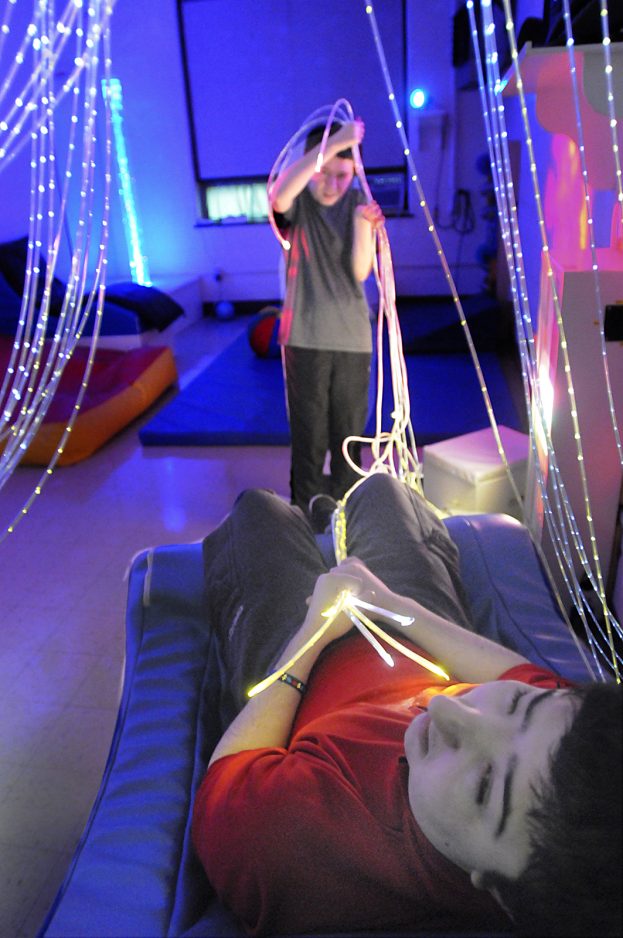
Alyssa Alvarez, 16, daughter of Kelli and Robert Alvarez, shares strings of lights with Lucas Angelo, 20, son of Denise Angelo, while relaxing on a chaise in a classroom.
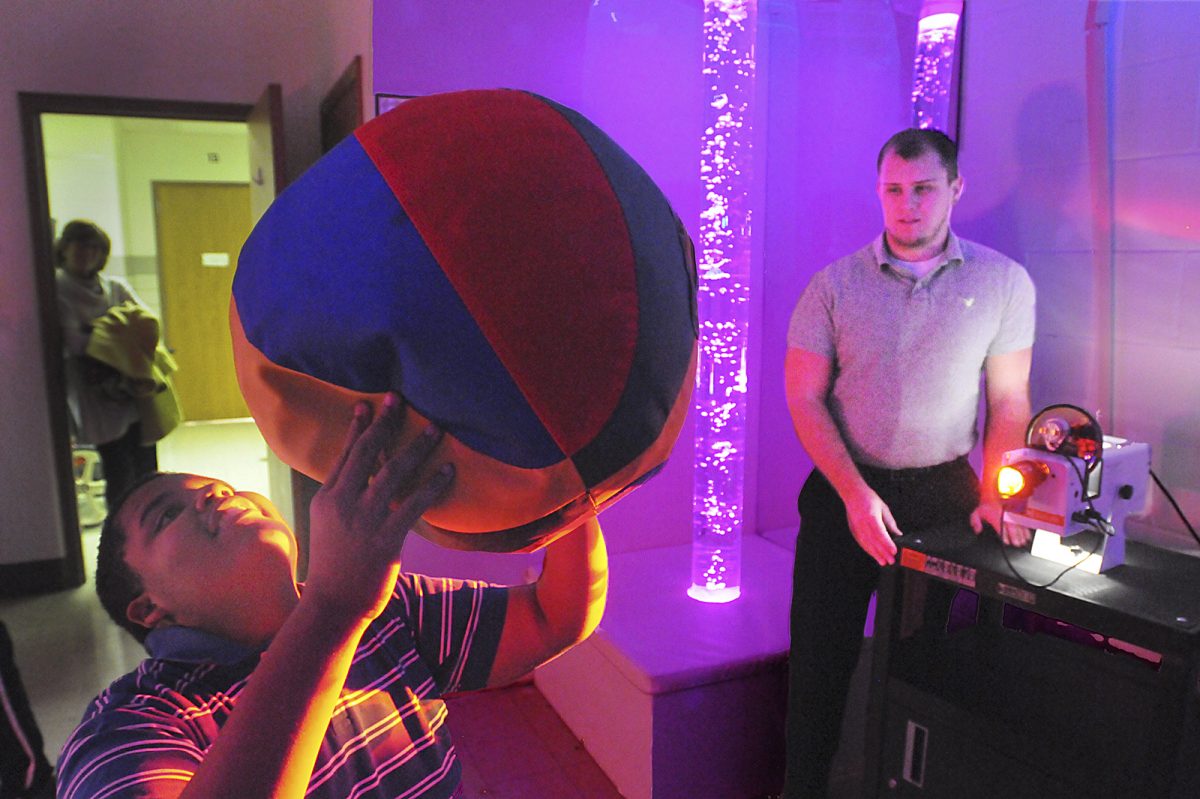
Michael Harris, 17, son of Michael Harris Sr., tosses a colorful ball with Josh Homzak, autistic support teacher, in the background. A variety of useful equipment in the room was purchased through a grant of $5,000 from Autism Speaks for the students at Intermediate Unit 1 at the Laboratory school.
Autism Speaks, which bills itself as the world’s leading autism science and advocacy organization, has awarded a $5,000 grant to Intermediate Unit 1 to equip a model classroom on a modest budget with tools to help calm or stimulate students.
A location for the classroom within the intermediate unit, which includes Washington, Greene and Fayette counties, has not yet been chosen. Intermediate Unit 1 educational campus at Laboratory already has this type of classroom, so Laboratory is not a candidate for the grant money, said Patricia Hazen, outreach and development specialist for the IU.
The equipment to be purchased with grant money and be in place before the end of the school year includes weighted wraps and blocks, a tactile cube, a touchable wall panel, balance beam and tunnels, paths that form a figure 8, a bubble mirror and a ball made of tubing. These are described as “multisensory,” meaning they are designed to calm autistic students who are overstimulated and alert those who are understimulated.
According to a study cited in the grant application, individuals with autism are unable to properly process sensory stimulation. Children with multiple disabilities who are unable to focus their attention can experience stress and anxiety that interferes with the learning process. Using the equipment for 10 to 15 minutes on a regular basis is believed to be helpful in increasing students’ ability to learn.
Leigh Dennick, IU director of special education, said the various autistic support classrooms in the three-county area serve about 94 students with autism.
There term “autism spectrum” is often heard because of the range of autism. Some students are in special programs full time while others are mainstreamed in educational programs.
Full-time autistic support classrooms can’t have more than eight students.
Educating autistic students is not solely the purview of the intermediate unit. There are school districts served by the IU that have their own support classrooms for educating autistic students up to age 21.
“This equipment can be quite expensive,” Hazen said. “We also have other classrooms with sophisticated multi-sensory environments, but we want to show what you can do on a modest budget.”
Autism support is one of 140 services that the IU provides to school districts. Some of the services are geared toward students who have special needs while others are not.
Autism is a general term describing a group of complex developmental brain disorders and autism spectrum disorders. They are characterized, in varying degrees, by difficulties in social interaction, verbal and nonverbal communication and repetitive behaviors. According to the U.S. Centers for Disease Control, autism affects one in 68 children in this country and 1 in 42 boys. There is no cure, but in recent years, scientists have identified a number of rare genetic changes associated with autism.
Autism Speaks has committed $500 million to research and resources for families. Each year, Walk Now for Autism Speaks events take place in more than 100 cities across North America. Pittsburgh’s walk, which had more than 12,000 participants, took place in June.
Charles Mahoney, former superintendent of the Chartiers-Houston School District, is executive director of Intermediate Unit 1, based in Coal Center near California, which serves 25 school districts and five vocational schools. Hazen described an intermediate unit as “a step between local school districts and the state Department of Education.”