

A problem of unknown dimensions
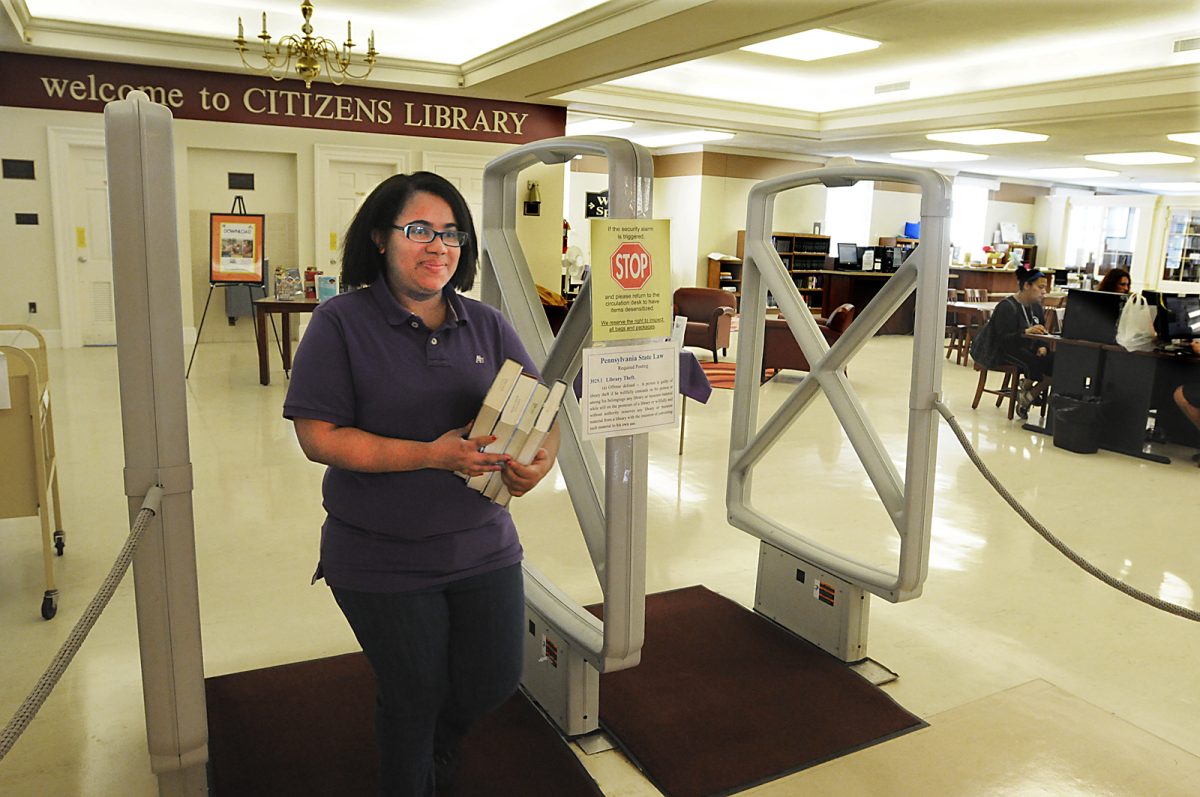
Mary Patterson, a circulation clerk at Citizens Library in Washington, walks through the security system with an armful of books Thursday. The books were desensitized moments before to prevent the alarm from sounding.
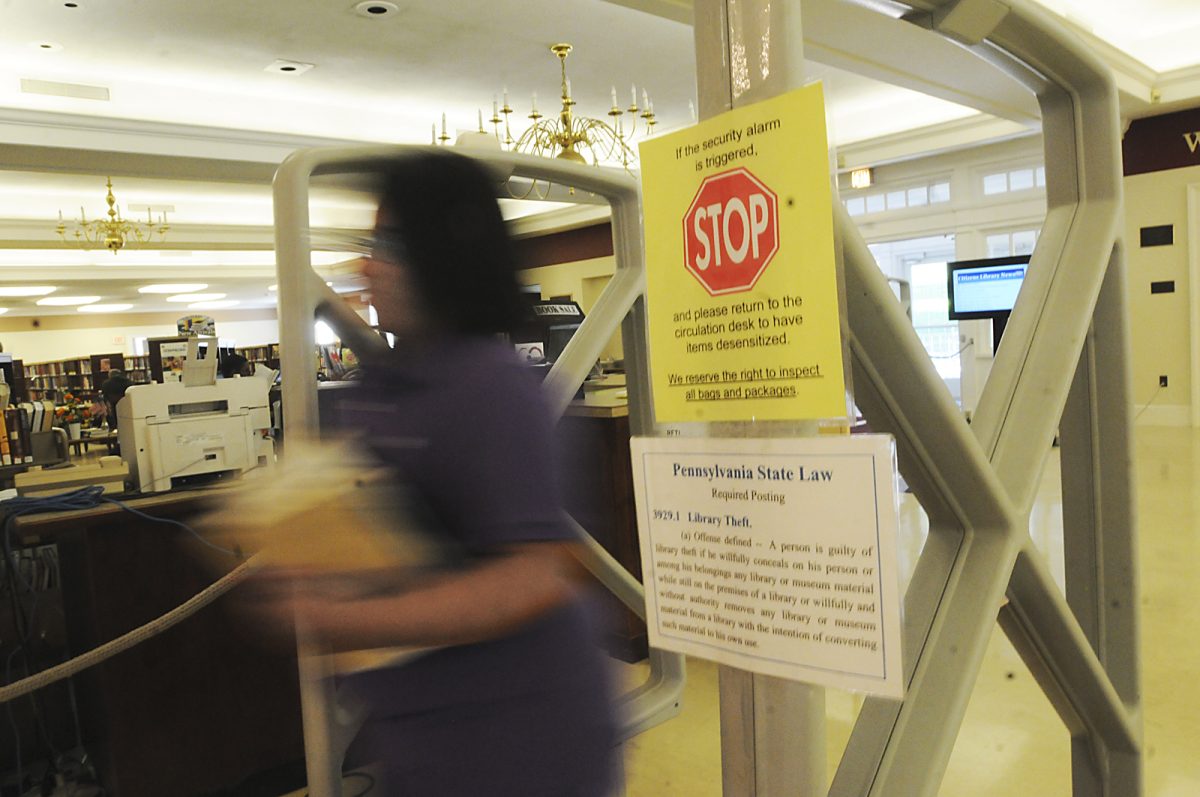
Mary Patterson, a circulation clerk at Citizens Library in Washington, walks through the security system with an arm full of books Thursday. The books had been desensitized moments before to prevent the alarm from sounding.
When Andrew Carnegie financed a string of libraries in this region and around the country in the late 1800s and early 1900s, they often carried a simple, inviting message above their main entrances: “Free to All.”
Some patrons down through the decades have taken that summons all too literally. For as long as there have been libraries, with their bounty of books and other kinds of media that can be sampled simply by virtue of residency and the possession of a library card, there have been devious and greedy souls who have decided to deprive others and enrich themselves by absconding with books both rare and commonplace. In more recent times, they’ve walked off with DVDs, audio books and other types of media that now line library shelves.
If you use a library with any frequency, you’re familiar with the disappointment of tapping a title into a library’s online catalog, and it comes up as being available. But when you head over to the shelves, you find it’s gone. When you inform a librarian, the “available” designation is changed to “missing.”
But library theft also dents the bottom lines of libraries and erodes collections that are built up, in part, with infusions of taxpayer dollars. The library book that’s gotten through a five-finger discount is, in a way, an act of larceny against us all.
“To me, it’s amazing that you have free material and people still take it,” said Kathy McClure, the director of Eva K. Bowlby Public Library in Waynesburg.
And it’s a problem whose dimensions are not fully known. Heather Cho, a spokeswoman for the American Library Association, said her organization does not track library theft, and “is not aware of anyone who does keep those kinds of statistics.” To cite one example, though, Brooklyn Public Library, one of the largest public library systems in the country, reported earlier this year 70,000 books were stolen from its system in 2012, up by 10,000 from the year before. Nursing study guides and preparation guides for the General Educational Development test were among the most commonly stolen books in that system, along with graphic novels and other kinds of professional preparation books.
McClure estimates the Bowlby library loses less than 1 percent of its collection every year to theft, with 761 items having been deemed lost from January 2010 to last week. When an item is missing for two years, it is purged from the system.
At Frank Sarris Public Library in Canonsburg, “We don’t have anything that detailed,” said Jackie Zataweski, the library’s assistant director. The library would have to undertake a detailed inventory to determine what is there, what is not and, if they’re lucky, what has been misshelved. “So unless someone is looking for something, we don’t know.”
Most libraries affix their own stamps to books, so unless they are withdrawn from the system, and marked as such, they have virtually no resale value on the used book market. Washington’s Citizens Library places security strips inside books and other media and, unless they are desensitized at the front desk upon being checked out, they cause a scanner to go off when a patron tries to leave the library. However, not all libraries have security systems. So some libraries are left to rely solely on the goodwill of their patrons and the hope they will be trustworthy and principled.
“For some of the smaller libraries, it’s quite an expensive system,” said Diane Ambrose, the director at Citizens Library. “It’s not something everyone can afford.”
Pier Lee, the longtime leader of Peters Township Public Library, said she and her staff are in a “very fortunate situation” inasmuch as they have detected relatively little theft there. Along with a security system similar to the one deployed by Citizens Library, Lee credits the open layout of the library, with its circulation desk at its focal point, as a likely factor in discouraging theft. Librarians there also make a point of asking patrons what, if anything, they are looking for in the course of their visit.
Still, despite these safeguards, “I don’t have a solution,” Lee said. “It can be very hard to prevent.”
University and college libraries also must deal with theft, but some of what ends up being pilfered can be quite different from what is nabbed from public libraries. University and college collections sometimes contain one-of-a-kind manuscripts, personal papers or extraordinarily scarce and valuable volumes. In recent years, there have been a number of highly publicized cases where researchers have ended up getting jail sentences rather than doctorates after they’ve spirited rarities out of libraries as a supplement to their meager graduate-student incomes.
While Louis L. Manderino Library on the California University of Pennsylvania campus does not contain the wealth of special collections you would find at a Big Ten or Ivy League institution, researchers are accompanied by a staff member when they are looking at rare material, according to Douglas Hoover, the library’s director. Otherwise, the library most often sees textbooks or other texts that are required in classes stolen.
“I’d like to say we are exempt from theft, but I’d be living in a fantasy world,” Hoover said.
Like the libraries in Washington and Peters, material within the Cal U. library is protected by security strips that must be desensitized after a patron checks it out. Without it being desensitized, an alarm at the main entrance will go off. In addition, there are cameras throughout the library that would make acts of brazen thievery visible.
“If you’re walking out with something, we’ll see you with our cameras,” Hoover said. “And they’re wired directly to the police station.”
However, there’s another kind of library theft that slides into a much more murky realm – when items are checked out but never returned. Katy Pretz, the director at Flenniken Public Library in Carmichaels, said the reasons can vary from simple forgetfulness to an item being lost in the household shuffle. Pretz said she and her colleagues try to “assume positive intent” and are willing to work with patrons who admit their tardiness and return items long after their due dates.
“I’m more concerned about getting people back in the library,” Pretz said. “Librarians are good people. We’re not going to throw the book at you.”