

Maple sugaring techniques taught at Mingo Park
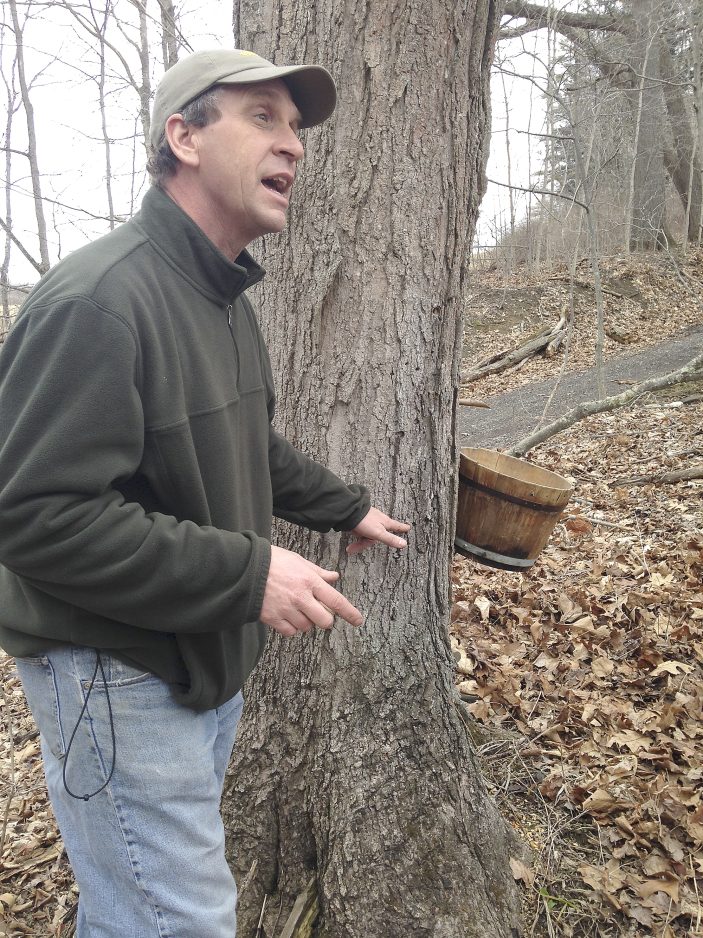
Jeff Donahue, superintendent of recreation with Washington County Parks and Recreation, shows participants how early settlers gathered maple sap March 21 in Mingo Creek County Park.
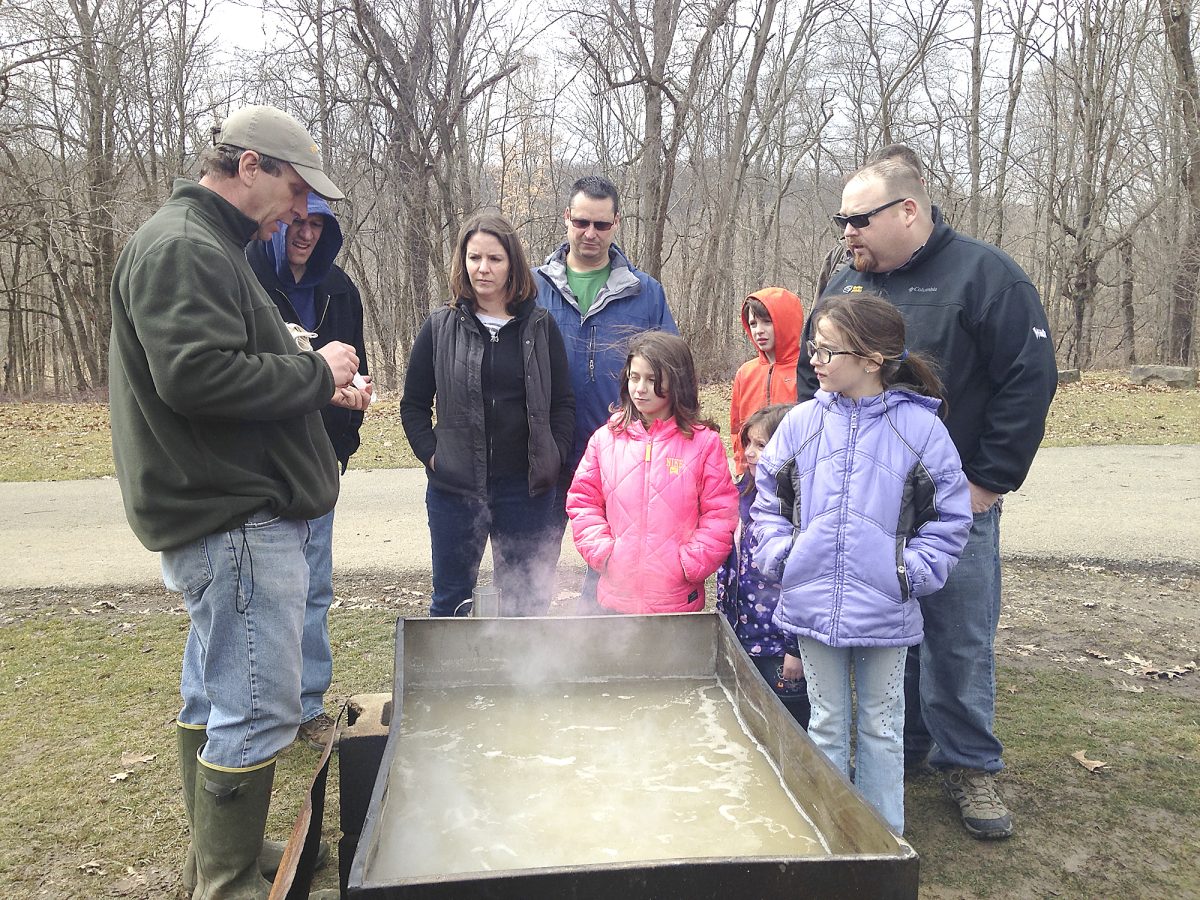
Jeff Donahue, left, superintendent of recreation with Washington County Parks and Recreation, shows participants the evaporation process used to make maple syrup during a maple sugaring tour March 21 in Mingo Creek County Park.
It’s a time-consuming process, but the end result is oh, so sweet.
More than 200 people gathered in late March at Mingo Creek Park to learn techniques used to turn maple tree sap into maple syrup. Washington County Parks and Recreation Superintendent Jeff Donahue led half-hour tours around several stations in the park. Each station depicted either modern or historical sap collection methods.
Donahue also taught participants how to identify a sugar maple tree through the shape of its leaves, the way branches grow and critters that inhabit or eat the tree. Sugar maple trees produce the best sap to make syrup because they contain less water.
Donahue also identified the tools commonly used in sap collection, including an auger, spile and a variety of collection buckets.
The process is rather simple. You simply find a sugar maple tree, drill a hole and watch as the clear-colored sap slowly trickles out.
Once the sap is collected, it is boiled for several hours to evaporate the water. It takes roughly 40 gallons of sap to create one gallon of maple syrup. The final product is then cooled and bottled, and ready to smother a pancake or two.
Participants were able to taste the park’s syrup during a breakfast that followed the tour. The finished product doesn’t compare to store-bought maple syrup. Homemade syrup is lighter in color and much sweeter. It also lacks the sticky consistency that accompanies store-bought products.
Donahue said the park makes syrup only in anticipation of the tour’s breakfast. While the best time to collect sap varies, park staff started their collection process in early March.
“It’s weather-dependent,” Donahue said. “Twenty degrees at night and 40 degrees during the day is ideal.”
Stan and Keegan Brusoski, a father and son team who attended the tour as a part of a school field trip, were pleasantly surprised when they tried the park’s syrup.
“It’s sweet,” Keegan, of Bethel Park said. “It’s not really the store (brands).”
The pair were so impressed they’ve decided to give syrup making a try.
“We have a red maple in our yard,” Stan Brusoski said. “We’ll give it a try, but I’m sure it will be a lot of boiling.”