

Former coal executive guilty of misdemeanor in mine explosion trial
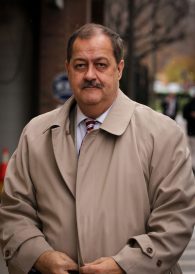
CHARLESTON, W.Va. – Former Massey Energy CEO Don Blankenship was convicted Thursday of a misdemeanor count connected to a deadly coal mine explosion and acquitted of more serious charges.
Blankenship was convicted of conspiring to willfully violate mine safety standards. The misdemeanor charge carries up to one year in prison. He was acquitted of a more serious conspiracy charge that could have netted five years in prison.
He was acquitted of making false statements and securities fraud.
A 12-member jury returned the verdicts for the former coal industry executive in U.S. District Court in Charleston.
Blankenship was tried on charges of conspiring to break safety laws and defrauding mine regulators at West Virginia’s Upper Big Branch Mine, and lying to financial regulators and investors about safety. The mine exploded in 2010, killing 29 men.
Defense attorney William Taylor said Blankenship plans to appeal.
“We are disappointed, but not as disappointed as we could have been. The case should have never been brought,” Taylor said.
Judy Jones Petersen, whose brother Dean Jones died in the Upper Big Branch explosion, said she felt vindicated by the verdict and directed a scathing comment at Blankenship: “Although you may not be judged responsible by the courts of this land, you are guilty. The blood of these 29 people is on your hands.”
Asked for a comment after the trial, Blankenship just winked. Only a wink, he was asked?
“Just a wink and a nod,” he said, citing a phrase used by defense to debunk the conspiracy notion. Then he laughed.
The conviction becomes the centerpiece of a wide-spanning investigation into Massey that began after the explosion. The probe produced four other convictions up the Massey corporate chain, leading to Blankenship.
Relatives of the miners who died have long called for Blankenship to go to prison.
During the trial, which began Oct. 1, prosecutors contended Blankenship was a bullish micromanager who meddled in the smallest details of Upper Big Branch.
Prosecutors said Massey’s safety programs really were just a facade – never backed by more money to hire additional miners or take more time on safety tasks.
And prosecutors consistently reminded jurors a conspiracy doesn’t have to be spelled out formally between parties.
“The defendant wants you to reward him for being smart enough not to come right out and say, ‘I want you to break the law,”‘ Assistant U.S. Attorney Steven Ruby told jurors in closing arguments.
“He wants you to let him off the hook because he was careful enough to come right up to the line of putting it explicitly, putting it into words without doing it. Don’t do that.”
Blankenship’s defense made a rare, risky move by not calling a single witness in the case. His attorneys said there wasn’t a shred of evidence that Blankenship was involved in a conspiracy.
“We don’t convict people in this country on the basis of maybes,” lead defense attorney William Taylor said in his closing argument.
“We don’t convict them of crimes because they are rich or they are rude or they are tough. We require the government to prove more than that a man was in charge of a company when a terrible tragedy occurred.”
Prosecutors made their case with Blankenship’s own voice, using phone calls he secretly recorded in his Massey office.
In key calls, Blankenship said a scathing internal safety memo should be kept highly confidential, and that it would be a terrible document to show up in legal discovery if there was a mine fatality.
Under defense cross-examination, Christopher Blanchard – who ran the subsidiary that oversaw Upper Big Branch – said Blankenship and Massey pushed for safety.
Testifying to prosecutors, Blanchard said he believed Blankenship thought it was less expensive to pay fines than pay for measures to prevent safety violations. He also said most Upper Big Branch violations could have been prevented by hiring more miners or spending more time on safety tasks.
Former Massey safety expert William Ross, who gave a tough review of the company’s safety shortcomings, wept while testifying about how thrilled he had been to think that Massey was going to change.
He also became emotional while talking about a 2009 meeting with Blankenship, in which he told the executive Massey couldn’t “afford to have a disaster.”