

Retired Cal U. professor haunted by interviews with Nazi official
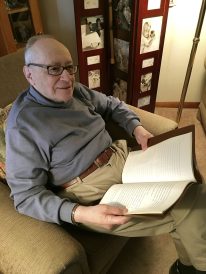
CALIFORNIA – Dr. Leonard Siegel is sitting in a living room chair, thumbing through 20 pages of notes from a July 1980 interview he conducted with Albert Speer, a close associate of Adolf Hitler’s and a high-ranking Nazi German government official.
Clearly, he is bothered.
“I don’t want this anymore. I despise it and I want to be done with it. We had enough death and destruction then, and we’re having it all over again,” said Siegel, 84, a retired professor of American and European history at California University of Pennsylvania. “There’s too much evil in the world, and I just want to erase all of it from my mind. It makes me sick and I’m getting rid of this.”
Siegel spent three days in Heidelberg, Germany, visiting with Speer, the Third Reich’s former minister of armaments and war production during part of World War II, with whom he struck up a 12-year correspondence after Speer was released from West Berlin’s Spandau Prison, where he served a 20-year sentence for war crimes.
In the late 1970s, Siegel began developing a course on Hitler and the Holocaust for the university, and Speer, who by that time had written two memoirs that sold several million copies, granted Siegel a personal interview.
Siegel, accompanied by his wife, Lorraine, traveled to Germany, with a list of questions he wanted to ask Speer, who had used millions of forced laborers, most of them prisoners of war or civilians from occupied countries, to produce armaments to fuel the German war machine.
Siegel recalls lugging heavy recording equipment up a steep incline that led to Speer’s residence; Speer’s wife, Margaret, led Siegel into the study, where Speer was waiting for him.
“I remember every detail from our meeting. I don’t know why, but I remember there was a grandfather clock ticking away when I entered his study,” said Siegel.
Over the course of the three-day interview, Siegel spent more than 20 hours talking with Speer about his friendship with Hitler (he last saw Hitler in a Berlin bunker before the Nazi leader committed suicide) and Speer’s role in the war.
Speer, an avid gardener who turned a vegetable garden at Spandau Prison into an elaborate garden with paths, rock gardens and a wide variety of flowers, was eager to show Siegel his garden, and pointed out roses imported from the Netherlands, of which he was especially proud.
They walked along the same path that Hitler walked with Speer more than 35 years earlier, noted Siegel.
For years, Siegel based classroom lectures on his interview with Speer, and he invited Holocaust survivors, including the late Eva Schreiber, to visit the campus, so that his students could hear firsthand accounts of the persecution Jews suffered under Hitler.
“Here’s the point: What happened then can happen today. History can repeat itself, and I don’t want to see it happen,” Siegel said, in an apparent reference to the threat of ISIS and the growing anti-Muslim sentiment in the U.S.
These days, Siegel is feeling reflective. The recent deaths of a few close friends have made Siegel think about his accomplishments and what’s most important to him.
“How long does anybody have to live? I know I’m not going to live forever,” said Siegel. “When the time comes, it comes. But I made a lot of friends, I traveled. I loved my classes and everything I did with my students. I feel a sense of accomplishment with what I did.”
Over the years, Siegel amassed a large collection of historical documents, military medals, papers, mementos (including Speer’s tie pin decorated with a swastika), and more than 300 signatures of world leaders, most of which he donated to John Carroll University, his alma mater.
He met and talked with powerful world figures; among them were presidents Harry Truman, whom he met during a campaign visit to Ohio when Truman was running against Republican candidate Thomas Dewey (“He had a never-give-up attitude that influenced me for the rest of my life,” Siegel said), Ronald Reagan, Richard Nixon and Jimmy Carter.
In 1981, while Siegel was talking with colleagues from Cal U.’s history department, Pam Turner, Reagan’s deputy assistant for legislative affairs, called him on the telephone on Reagan’s behalf, seeking his insights about the Ayatollah Khomeini, the religious and political leader of Iran who led the 1979 Iranian Revolution.
Siegel had written a dissertation about the Middle East and British control there, which was turned into a book, “A History of the British East India Company from 1813 and its Aftermath.”
The two spoke for an hour and 15 minutes (colleagues tape-recorded the conversation), and when they were finished, Reagan got on the phone and thanked him for his service to the country, Siegel recalled.
In 1991, Siegel and his son, Bill, a high school history teacher, traveled to Saddle River, N.J., for a two-hour conversation – and a cup of coffee imported from Lebanon – with former president Richard Nixon, with whom Siegel had corresponded.
Siegel said the men talked about sports, including the Pittsburgh Steelers, education and foreign policy.
“Nixon was the most underrated president we ever had,” said Siegel.
Siegel’s son also accompanied him to Maranatha Baptist Church in Plains, Ga., in 2006, to attend Sunday school and worship, in order to talk to and have a photo taken with Carter and his wife, Rosalyn.
But his best memory, Siegel said, is when he met his wife of 48 years, “Rocky,” who died in 1980.
“She was a beautiful girl. We traveled all over the world together,” said Siegel, who grew up in Cleveland, Ohio, worked three jobs to earn money for college (his father, a dentist, wanted him to be a doctor, but his aunt, a journalist for the Cleveland News, encouraged him to study what he enjoyed, history and philosophy), and earned his doctorate from Case Western Reserve University. “I went to 36 countries, and she went almost everywhere with me, except to China and Japan. We’d scrape our money together to do these trips, to Venezuela, Spain, Italy, Brussels.”
Siegel, who received an honorary degree from John Carroll in 2011, said he plans to offer the Speer transcript to the university, and he no longer wants to think about Speer and the events of World War II.
“I want to get this out of my house and forget it ever existed. I feel so strongly about that,” said Siegel.
Speer, who died in 1981, was the only one of the 23 war criminals tried at the Nuremburg Trials to admit guilt, but Siegel believes his motives were self-serving.
“As far as I’m concerned, Speer was a con artist and a slick character,” he said. “I want people to know that they’re wrong if they think what happened in the past can’t happen again. I don’t want history to repeat itself.”