

Lawmakers aim to revisit Act 13
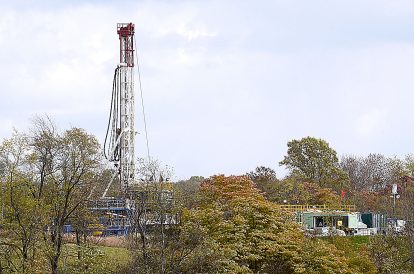
Two state lawmakers from Washington County want to revisit the Marcellus Shale Act 13 law after it was revealed last week that nearly $30 million in impact fees drillers pay to municipalities statewide is unaccounted for between 2011 and 2013.
This comes at a time when state Auditor General Eugene DePasquale said the money given to communities affected by the natural gas drilling boom was “on our radar” and that his office plans to begin performing spot audits to better safeguard the local Act 13 accounts.
State Reps. Brandon Neuman and Peter Daley, both Democrats, also said last week they would support revisiting the law passed in 2012 after the Observer-Reporter revealed this month that the law lacks provisions to mandate reporting of the spending of the fees that are collected and distributed by the state Public Utilities Commission.
“How do we improve the law and ensure that it’s doing what it was intended to do?” said Neuman, of North Strabane Township. “We want to make sure the money is being used for the right purposes.”
Daley said he was troubled by the lack of enforcement capabilities and believed Act 13 should be amended to include state checks and balances on the money.
“If we do not have a mechanism in there for enforcement, we have to have accountability,” said Daley of California.
State officials have said they don’t suspect the Act 13 funds have been misappropriated, even if the spending wasn’t properly reported to the PUC. Some municipal staffs have insisted they reported the handling of the money to the PUC, even though online commission records indicate otherwise. Others have said they were unaware of the requirement, and local officials have said the guidelines for how to use the money are vague and, in some cases, confusing.
Neuman suggested it might be better to transfer the program’s oversight from the PUC to the state Department of Community and Economic Development, which typically handles the distribution of grants and special funding to local communities.
“There is always talk (in Harrisburg) about looking at laws, and this was a new concept when it came out,” Neuman said. He voted against Act 13 because he disagreed with provisions in the law that took away zoning control of drilling operations from local governments. However, he supported the impact fee because it would help communities most affected by drilling.
Neuman said it made sense in 2012 to keep the law’s oversight within one agency, but that changed a year later when Commonwealth Court overturned the zoning provision in a legal challenge filed by a number of area municipalities. Neuman, a member of the House Resources and Energy Committee, said he would be in favor of holding hearings to discuss with area township leaders how the law can be improved.
“Maybe the PUC is not the proper place for oversight. Maybe it’s the DCED or another agency that is used to looking at the fees,” Neuman said.
It was not immediately known if the entire state Legislature would embrace any changes to Act 13.
Local communities are required to submit annual reports showing the PUC how they handled the money, although the PUC’s website revealed that some, including several in Washington and Greene counties, have failed to do so since the money was first distributed in 2013.
The situation gained the attention of DePasquale after his office received numerous complaints from residents across the state who raised concerns about how their communities were spending the impact fee money.
“We’ve gotten feedback from a bunch of different areas, but no one (municipality) in particular,” DePasquale said.
“Act 13 is one that tends to pop up a lot. It’s mostly a concern for the lack of transparency (on spending). It’s not always transparent. That’s the complaint.”
State Rep. Pam Snyder, D-Jefferson, said she doesn’t think the problem lies in the legislation, but with how the PUC is carrying out its duties.
“I don’t understand why the PUC isn’t reaching out to these communities. They’re in charge of the oversight. If they’re not reporting, they should be going after them,” Snyder said.
“Minimally, the PUC should send them a letter and tell them to report,” she said.
PUC spokesman Nils Hagen-Frederiksen said the law carries no penalties for communities that do not comply with the reporting standards.
“The statute puts the obligation on the municipalities to file these reports, but it does not speak to any penalties should they not file them,” Hagen-Frederiksen said. “There’s no mechanism in the act that says should a municipality not report, they will not receive future disbursements.”
Snyder responded that if communities continue to disregard the reporting standards, then state lawmakers might need to investigate how to change the law to compel them to comply with rules.
Not everyone agrees with that assessment. State Sen. Camera Bartolotta, R-Carroll, doesn’t think it will be necessary to revise Act 13 to increase transparency in how local governments spend the impact fee shares. The freshman senator from the Mon Valley said many small municipalities don’t have the staff that is needed to deal with the extra paperwork involved with the new Marcellus cash flow.
Bartolotta added that the Pennsylvania Association of Township Supervisors or other groups with outreach programs could be used to train municipal staffs on how to properly report Act 13 spending and post that information on local government websites.
“It’s just a matter of working out the glitches,” said Bartolotta, adding that she planned to discuss the Act 13 problems with the PUC and the auditor general.
State Rep. Rick Saccone, R-Elizabeth, did not return messages seeking comment on Act 13. His district includes Union, Nottingham and Somerset townships in Washington County.
Meanwhile, the industry that pays the impact fees, which have totaled $856 million in the first four years of the program, had little to say about how the money is being spent. Erica Clayton Wright, a spokeswoman for the Marcellus Shale Coalition in Pittsburgh, said the impact fee expenditures are “more of a government oversight matter” that does not affect the industry.