

A whole lotta mush!
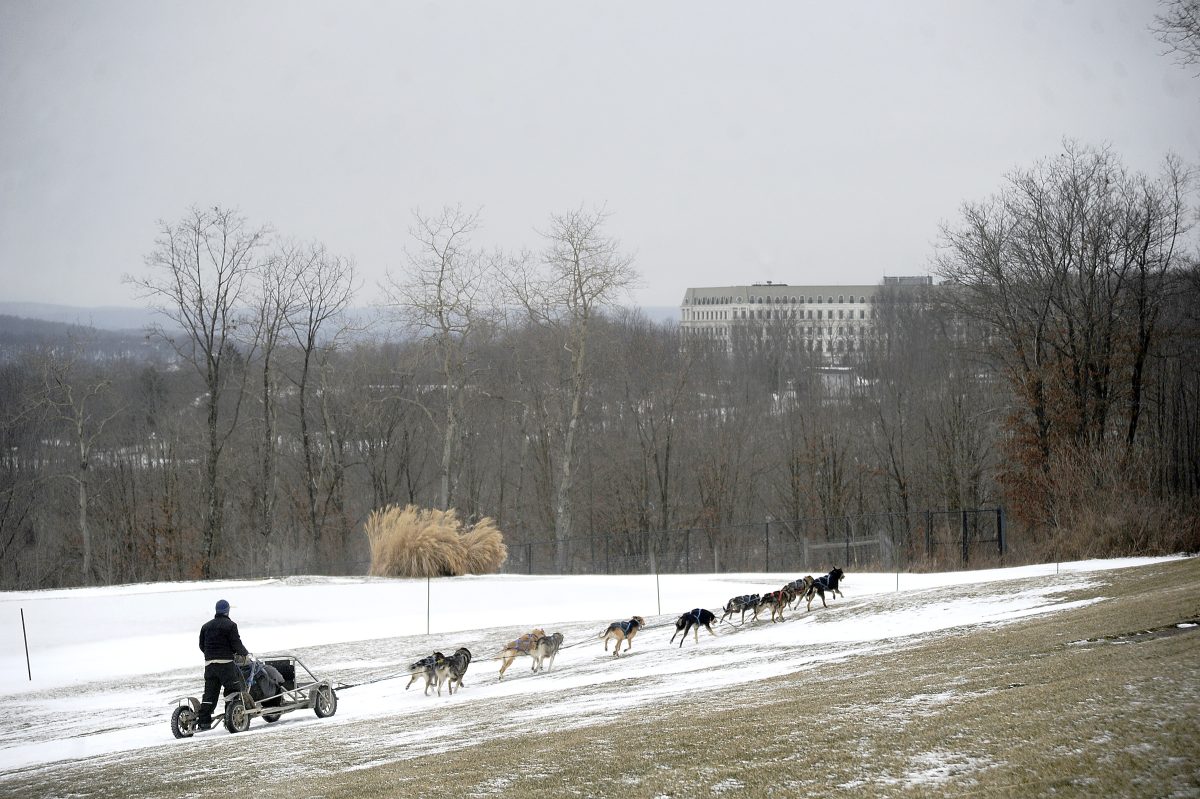
The dogsled team travels past the Nemacolin Woodlands Resort on the ground's golf course. The resort has a sled with wheels for the dogs to pull when there is less than eight inches of snow.
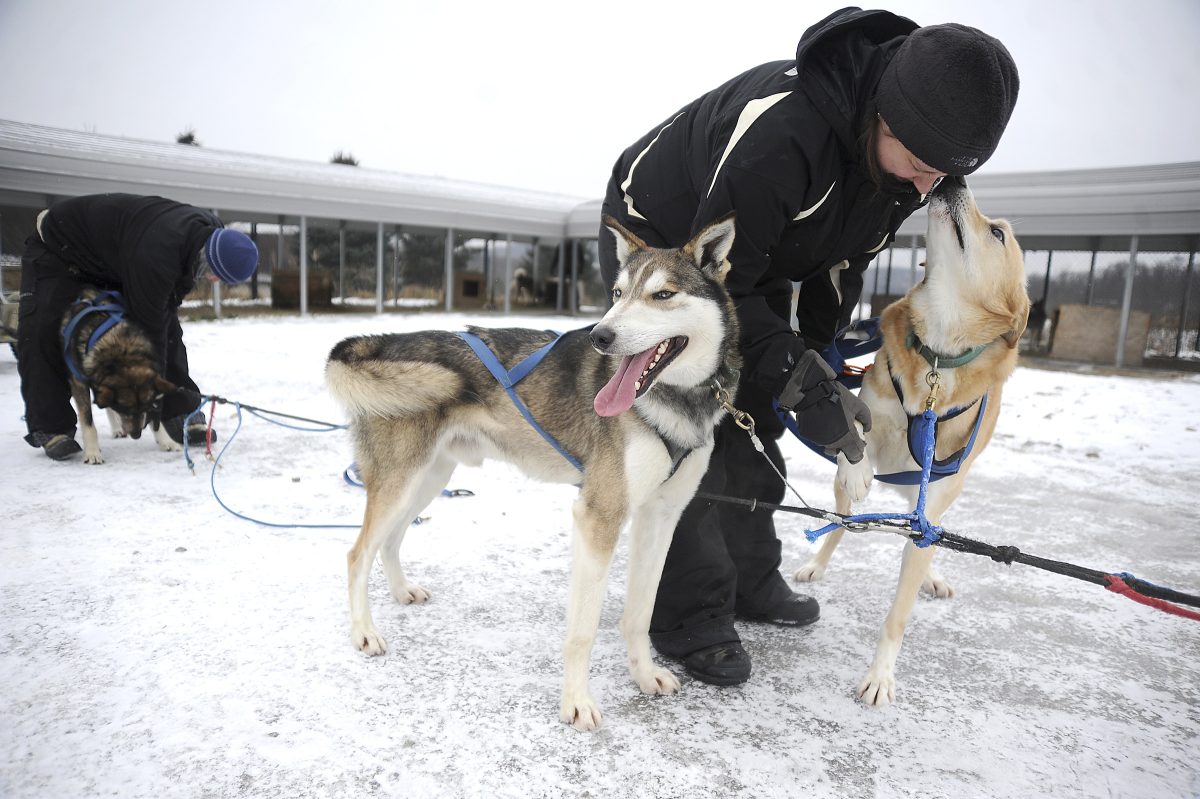
Recreation office coordinator and musher Karen Brindle unhooks the dogs from their harnesses after a dogsled run at Nemacolin Woodlands Resort.
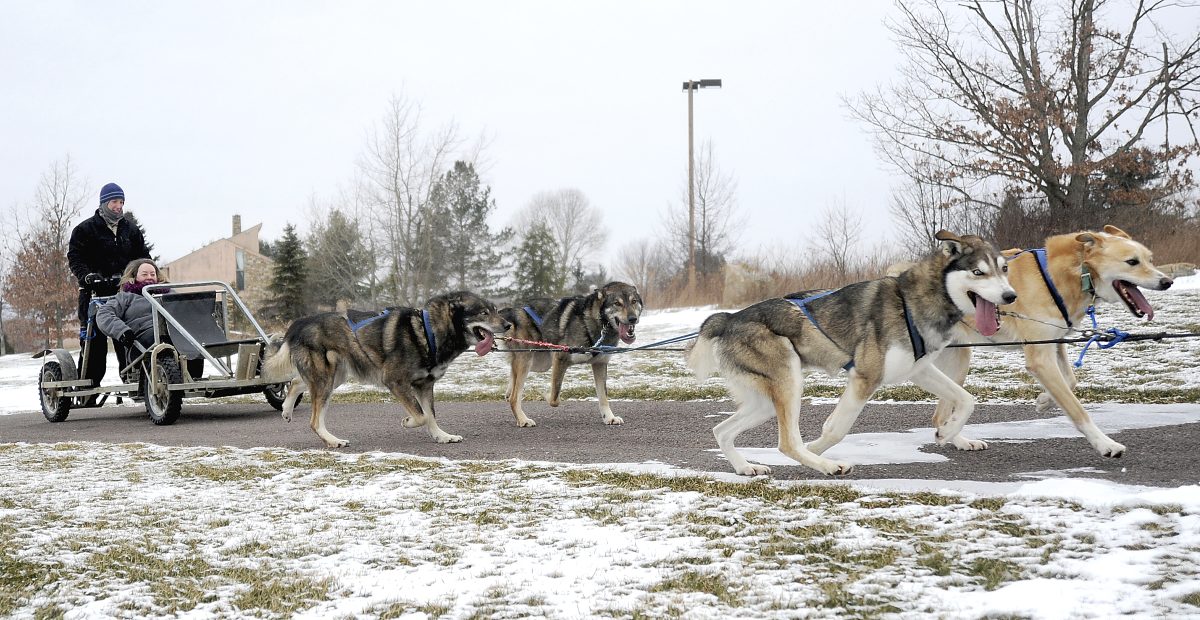
Observer-Reporter staff writer Karen Mansfield takes a ride while musher Maggie Petruska steers the sled and directs the dogs during a trip around the resort’s grounds.
FARMINGTON – Among the popular winter activities at Nemacolin Woodlands Resort in Fayette County is a sport more associated with Alaska than Southwestern Pennsylvania: dogsledding.
The Wildlife Academy’s Alaskan Husky Kennel is home to 25 huskies that make up the resort’s dogsled teams.
On a gray January day in the Laurel Highlands, the dogs barked excitedly as Karen Brindle, recreation office supervisor and one of the resort’s four regular mushers, approached the kennels to select 10 for a morning run.
“They love running. They can’t wait to get out there,” said Brindle. “They’ve got those thick coats, and they’re strong. This is fun for them.”
Part of the hourlong tour includes time in the dog yard, and Brindle introduced all of the dogs – all of them friendly, lively and eager for a pat.
Nemacolin breeds and raises most of its huskies, and when they “retire,” the dogs remain at the academy.
“A lot of little kids are in love with the dogs. They’ll spend so much time interacting with the dogs, and the dogs love the attention,” said Brindle.
She settled on Tango and Suka to lead.
Behind them were Nova, Heartbreaker, Morgan, Twist, Scooby and Dillon. Titan and Vinny were in the last row, closest to the sled, which meant they would pull the most weight.
The Alaskan huskies are a mixed breed known for their strength, speed and stamina, but they’re not recognized by the American Kennel Club. Some resemble Siberian huskies, while others look like hound and retriever mixes. Most of the dogs weigh between 50 and 60 pounds.
Brindle hooked up the dogs to a gang line that was connected to a double seat Dyck Cart, a wheeled sled that resembles a dune buggy with knobby tires and sling seats. There was not enough snow to use the resort’s white ash and aluminum MaineMade sled.
Musher Maggie Petruska stood on a metal platform behind the seats, equipped with a handlebar for steering and hand brakes. It’s easier to steer the cart than the sled, which doesn’t have a brake.
“The sled requires more skill. You have to shift your weight, and you have to rely more on your strength,” said Petruska.
As soon as Petruska said, “Hike,” the dogs took off, full speed ahead along a path that wound through The Links golf course, heedless of hills or turns.
She shouted out commands – “Gee” for right and “haw” for left, and “On by” to lead them past distractions that include wildlife.
The dogs attacked the terrain, barreling across the open field and down the hills, slowing to gain traction on icy stretches.
Sled dogs can cover about 20 miles an hour, but Brindle said the mushers tackle the three- or four-mile loop (they change the course because the huskies enjoy the variety) at about 10 to 12 miles an hour.
“They can fly, especially on straightaways,” said Petruska.
Petruska stopped twice to give the dogs a break and to admire the view.
Out West, in states like Montana and Colorado, the popularity of dogsledding has led outfitters to offer guided trips of various lengths, including one- and two-day excursions.
Nemacolin Woodlands has offered dogsledding for nine years.
Sledding is provided year-round. In the summer months, Jamaican dogsledding, in which the dogs pull an ATV-style cart, is available.
It’s an exhilarating way to travel. Quieter than a snowmobile and faster than snowshoes or skis, you get the feeling that you’ve been dropped into Jack London’s “The Call of the Wild.”
“I think part of the attraction is the fact that people don’t think of being able to dogsled in this area. It’s something different than they’ve ever experienced. They really enjoy it,” said Brindle. “It’s a unique experience. Even if we don’t have snow, guests are able to enjoy it, and they get a whole different experience with our Jamaican dogsled.”
Before dogsledding became sport, sled dogs pulled loads across frozen terrain in North America and Siberia as long as 4,000 years ago.
During Alaska’s Klondike Gold Rush, which started in 1896, dogs were used for hauling freight, mail and for transport.
Dogsledding became celebrated, Brindle said, in the winter of 1925 when a relay of 20 mail carrier mushers and 150 dogs covered nearly 700 miles in five days, seven hours, to deliver diphtheria medicine to Nome, Alaska. The trip normally took between 15 and 20 days.
Since 1973, the Iditarod Trail Race has been run annually in honor of that sled dog relay. Today, sleds are still used among the Inuits in the Arctic Circle and other groups, although they’ve mostly been replaced by snowmobiles.
“Dogsledding is just something cool,” said Brindle. “If you would have asked me 10 years ago what I would be doing today, I never in a million years would have guessed that I’d be dogsledding. I love doing this. The dogs are amazing.”
n Dogsled rides are available at 8:30 and 10 a.m. and 1:30 and 3 p.m. Tuesdays, Wednesdays, Fridays, Saturdays and Sundays. Reservations are required. Cost is $150. The minimum weight for children is 45 pounds. The maximum combined weight for riders is 275 pounds. Riders are encouraged to dress appropriately for the weather. For reservations or information, call 724-329-6961.