

A close call Once one step away from demolition, the David Bradford House marks 50 years as state museum
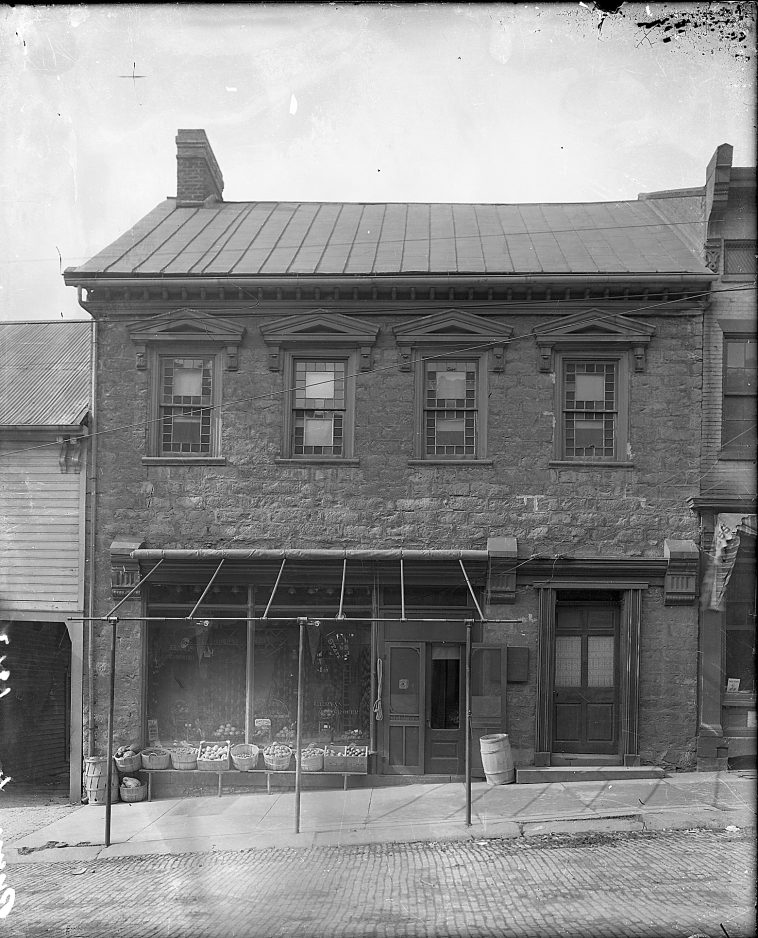
The Bradford House as it appeared before restoration
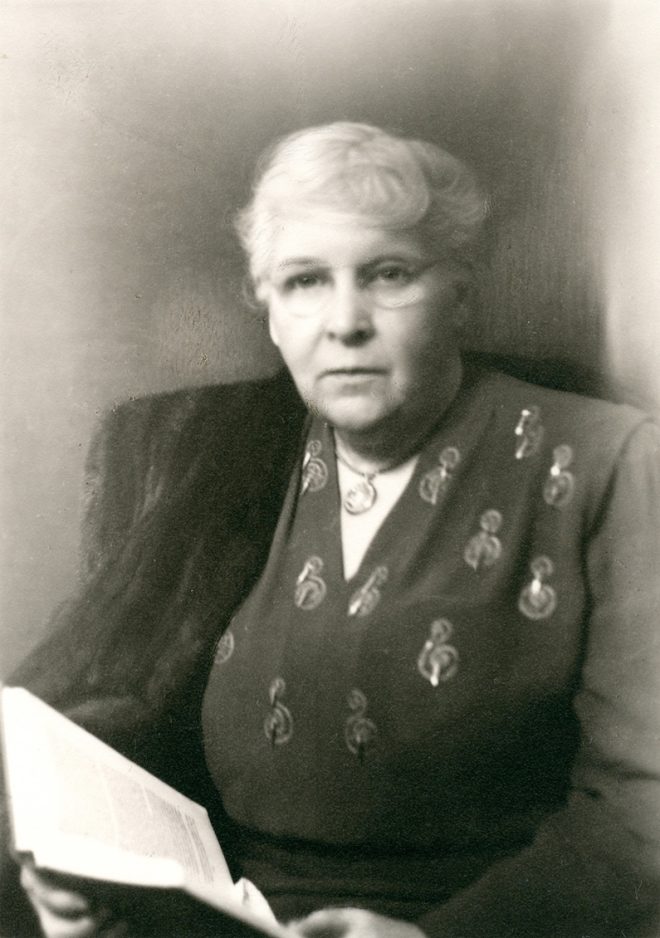
Margaretta Stewart inspired the restoration of the David Bradford House.
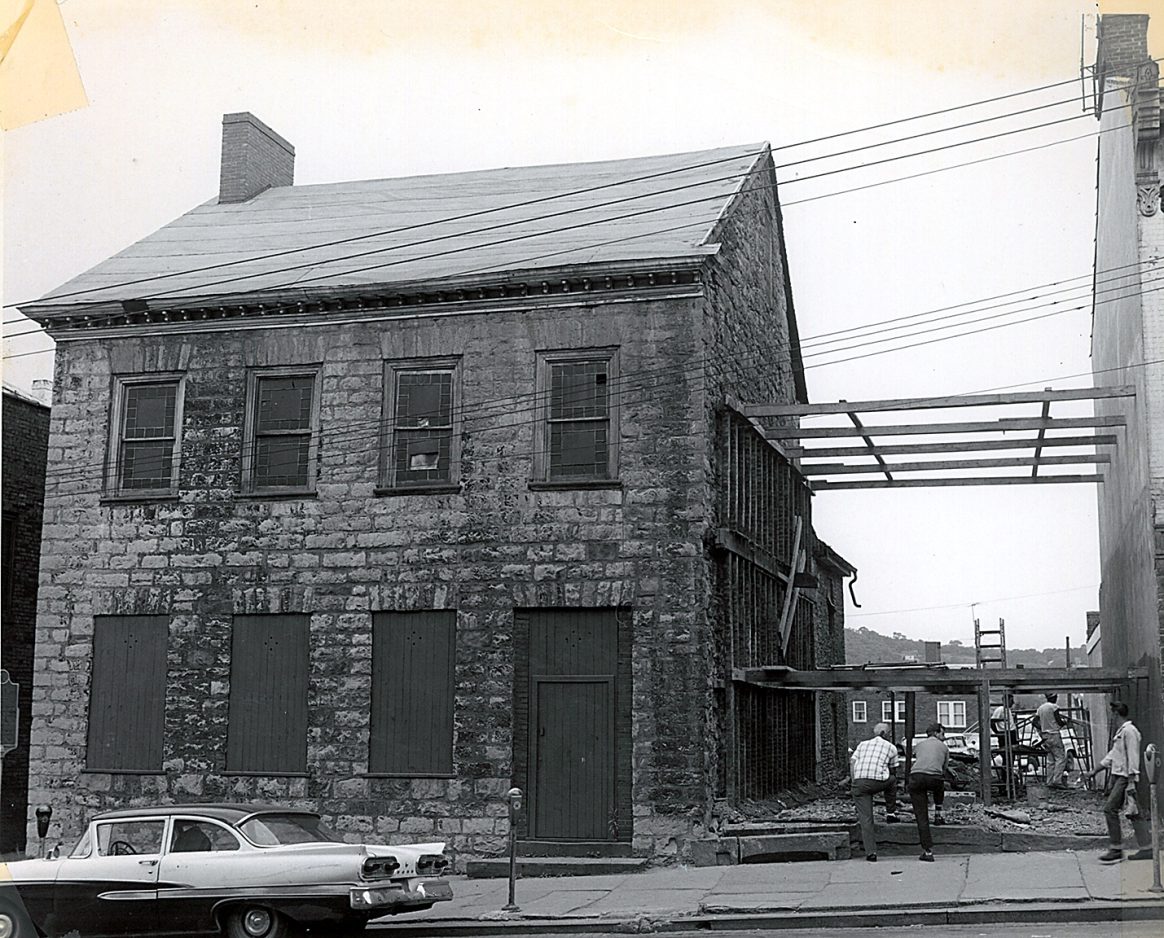
The north wall of the Bradford House was braced to prevent its collapse.
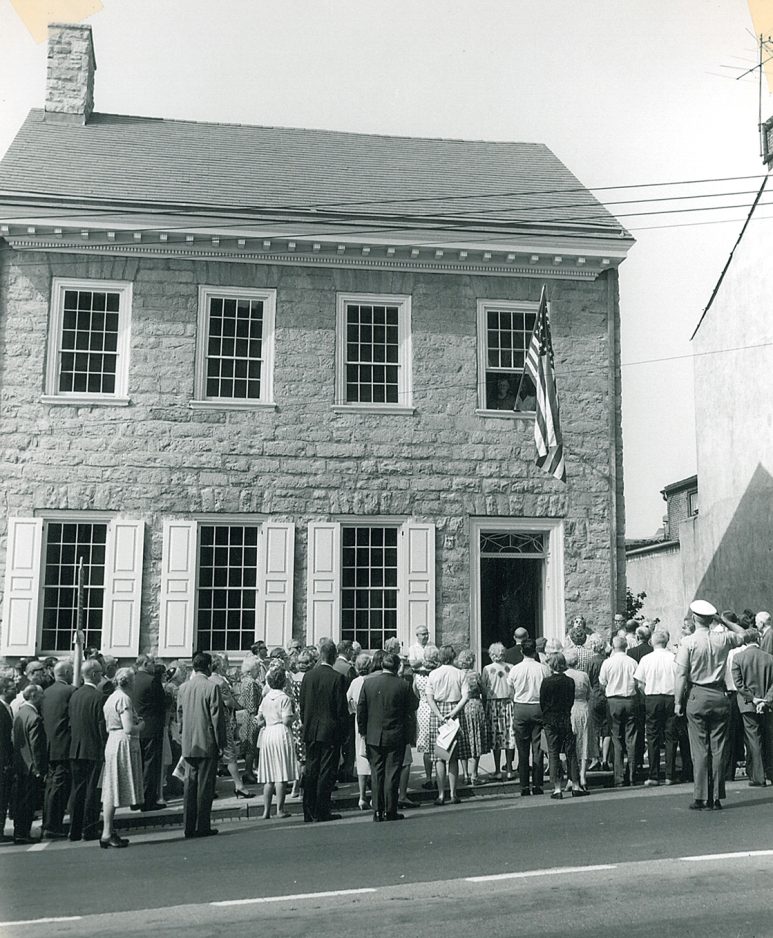
A crowd assembed on South Main Street on Sept. 18, 1965, to view the dedication of the David Bradford House as a Pennsylvania museum.
The David Bradford House is Washington’s oldest building. It is an architectural gem, a point of local pride and a National Historic Landmark whose role in our nation’s early history is not insignificant. This year, the house celebrates it 50th year as a Pennsylvania museum.
Yet, 75 years ago, it was one small step away from demolition.
The old stone house on Washington’s South Main Street had seen better days. Lots of them. By the 1940s it had become an eyesore, dirty and decayed, its stone walls crumbling. It seemed there was little hope for the oldest building in town, once the home of David Bradford, a leader of the Whiskey Rebellion, which might well have been plotted within the old house’s walls.
When it was finished in 1788, Bradford’s house was a palace compared to its humble and crude surroundings. But over the many decades its purpose changed. The house became a furniture store and funeral parlor. When Pittsburgh architect Charles Stotz first saw it in 1945, the building housed a grocery store. Stotz had been asked to look over the place as a possible home for Washington’s public library. He noted at the time that the house had been disfigured by alterations and so-called improvements well before 1900.
“But by far the greatest disaster to occur to this fine old structure was the alteration made around the turn of the century when the first floor was converted to use as a storeroom,” Stotz wrote years later. “The portion of the first floor south of the stairwell was completely dismantled, and the floor lowered 12 inches so that entrance could be had from the sidewalk … The whole front wall of the building with its beautiful old windows was torn out and the corresponding wall on the western side likewise removed.”
The library lost interest and the house was purchased in 1946 by Charles W. McWreath, who owned a bar abutting it to the north. McWreath planned to expand his business into the building and contacted Stotz for advice on restoring it. Nothing came of the conversation, but McWreath proceeded to make changes to the building to strengthen it, and in doing so did other damage before abandoning his plans, according to Stotz.
The Bradford House continued to deteriorate, its windows broken by vandals, its interior and exterior littered with trash and liquor bottles.
Something had to be done. Demolition seemed the most likely course, but some citizens insisted that to knock it down would be to destroy the city’s most important historical artifact. Among them was Margaretta D. Stewart, owner and publisher of the city’s two daily newspapers, The Observer and The Reporter. She believed the Bradford House was too essential to lose and directed Observer Publishing Co.’s general manager, James S. Lyon, to do something about it.
Mrs. Stewart and Lyon had powerful allies in their effort. Former governor and then-U.S. Sen. Edward Martin hoped to see a restored Bradford House become headquarters and museum of the 110th Infantry. And with state Sen. William J. Land and state Rep. J. Dean Polen twisting arms, the Pennsylvania Legislature in January 1957 approved $50,000 for the purchase and restoration of the Bradford House. Much more money would be needed, because restoration alone was expected to cost twice that amount, and then the house would need to be furnished and maintained.
Aside from the money, there was another problem: The act called for the Washington County Historical Society to undertake the restoration and maintain the house, but that organization’s board decided that, because it was already encumbered with the maintenance of the LeMoyne House, it was unwilling to take responsibility for the Bradford House until it was purchased and fully restored. It became clear that another organization must be formed in order to raise the money needed for the restoration and furnishings.
The first meeting of the Bradford House Historical Association was held March 7, 1961. Attending were the seven board members who had applied for the organization’s charter: Mrs. Stewart, Lyon, Gen. Martin, Sen. Lane, Rep. Polen, James R. Braden and county Commissioner Michael R. Flynn. Five others were added to the board: Charles S. Coen, Howard H. Hildreth, Janet Fitch and Earle R. Forrest, all of Washington, and Stanton Belfour, director of the Pittsburgh Foundation. Mrs. Stewart was elected honorary president and Lyon was elected president. (Artist Malcolm Parcell joined the board shortly after its formation, replacing Forrest.) Also attending the meeting was the architect Stotz, who had been appointed architect for the project by the Pennsylvania Department of Property and Supplies. First order of business was a clean-up and inventory of the historic building.
Stotz found that the house had much deteriorated since he’d last seen it. Rain had come through the roof for years with disastrous consequences. “The wood trim that had been removed from the second floor had been piled in confusion in the rear rooms without any key to their original location,” Stotz informed the directors. “The beautiful stair which had been in excellent condition in 1945 was a shambles.”
There was more bad news: The north wall that abutted the former tavern would need to be rebuilt. That meant that the board would need to purchase that building and demolish it before anything could proceed.
The board embarked on a quiet campaign to raise the money to purchase the former tavern, soliciting donations from the area’s business leaders. It was not easy, but by April 1963 the property was purchased and handed over to the state. That cleared the way for construction, but Lyon saw that as just the beginning.
“After the project gets under way, our association will have a more realistic obligation, and that is to authentically furnish the interior,” Lyon wrote to his board. “Lastly, if you see anyone walking down the street with loose money in his hand, looking for a worthwhile project to support, you know the answer.”
In November 1962, the General State Authority Board approved a $50,000 grant for the restoration of the Bradford House. Lowest bids for general construction, plumbing and electrical work would total more than $106,000, but the state would pick up the tab and awarded those bids in July 1964.
The start of construction was the climax of seven years of hard work by the board of directors, the area’s state legislators and, especially, Sylvester Stevens, executive director of the Pennsylvania Historical and Museum Commission.
Not everyone was thrilled with the restoration project. The writer of a letter to the editor of the newspaper noted that plumbing, heating and electricity could hardly be “restored” to a house that had none. “Instead of spending such huge sums of money to restore any other rundown buildings, we can save an awful lot of money by hiring a truck and high lift for a day or two and get rid of another eyesore,” he wrote.
The Bradford House was essentially rebuilt from top to bottom. A building at the rear of the property was purchased and demolished to make way for a parking lot. Stevens thought the area directly behind the house should be used as a period garden. An old well was found there and a stone housing built around it. Work was finally completed by the end of spring 1965.
Patti J. Lacock was Lyon’s secretary and remembers how much time she and her boss spent on getting the association together and raising funds. “I was lucky that I got carried along with him on that project and many others,” she said.
Lacock also remembers the Bradford House in its darker days. “I grew up in an apartment across the street from the Bradford House and remember it when it was a really ratty grocery store. To have seen it then and then to see what they had done with it was remarkable.”
The Bradford House was dedicated with a ceremony on Sept. 18, 1965, described as a perfect day. Many members of the Pennsylvania Historical and Museum Commission were present, and their chairman, James B. Stevenson, was one of those to address the large audience. Also speaking were Stevens, Lyon, Gen. Martin and George Bloom, who represented Gov. William Scranton.
Tours were not available that day and would not be until the house was adequately furnished. Lyon had feared that purchasing appropriate furniture would require raising a great deal of money, but that was not the case. Many people offered to donate pieces to the Bradford House Historical Association, but the Historical and Museum Commission was interested only in items appropriate to the late 18th century.
“That caused a lot of problems with people who wanted to donate,” Lacock remembers. “There were a lot of hurt feelings.”
Antique dealer Peter Chillingworth, a longtime former board member of the Bradford House Association, recalled that although some of the furniture was acquired locally through donation, the state took up the responsibility of selecting and purchasing items. “Edward LaFond made the Bradford House his personal mission,” Chillingworth said. LaFond was field curator for the Bureau of Historic Sites and Properties.
Through the tireless work and dedication of so many people, the Bradford House soon opened for tours. Lack of state funding forced the house to close temporarily on a number of occasions over the years, but Washington-area residents rallied around the house and have kept it open.
A board of directors and a corps of docents – all volunteers – now maintain the house and lead tours.