

Chevron agrees to pay $940k fine for well pad explosion in Dunkard Township
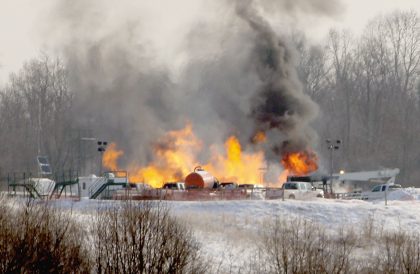
Chevron Appalachia entered a consent agreement with the state Department of Environmental Protection under which it will pay a fine of almost $940,000 for violations related to the explosion and fire that killed a worker at its Lanco well site in Dunkard Township.
The Feb. 11, 2014, explosion took the life of one worker and injured another. The fire burned for four days and then continued to emit gas and production fluid until the wells were capped several days later.
“The (consent agreement of civil penalty) outlines the specific areas where we felt there were very clear violations of the state’s oil and gas act,” DEP spokesman John Poister said Monday. “We wanted to focus on the operational and safety problems we believed were evident at the Lanco well pad.”
According to the consent agreement, the fine is for $939,552. Poister said DEP does not track the size of past fines it issues for violations.
“But this is a considerable amount, and we believe it reflects the seriousness of the violation,” he said.
“Chevron deeply regrets this incident,” Brenda Cosola, a Chevron communication advisor, wrote in an e-mail response for comment. “We cooperated fully with the DEP during the course of its investigation and accept the DEP’s consent assessment of civil penalty.
“Protecting people and the environment is a core value for Chevron and we are determined to prevent an incident like this from happening again.”
Last month, Chevron also agreed to pay $5 million to settle a wrongful death lawsuit filed by the family of Ian McKee, 27, an employee for Cameron International, a Chevron contractor, who died when the well pad exploded and erupted in flames.
The explosion came at the start of the work day as contractors prepared the Lanco 7H well for production. McKee and another worker were walking toward the wellhead, which was covered by a tarp, to investigate a hissing sound when it ignited. McKee was killed and the other worker was injured.
The force of the explosion damaged and ignited the Lanco 6H well, which was on the same well pad.
The cause of the ignition was never determined. However, a report prepared by DEP’s Bureau of Investigations concluded a lockpin improperly secured on a wellhead assembly by an inexperienced worker allowed gas from the pressurized well to escape and ignite.
The report criticized Chevron for its lack of supervision of contractors on the well pad that, among other things, would allow an inexperienced employee to do work for which he was neither trained nor properly supervised.
Some of the company’s site managers, DEP said further, lacked experience in the gas industry and provided only limited oversight of contractors working at the pad.
Some managers had “virtually no background” in the industry and worked in jobs previously that included information technology, food service and construction, it said. They also had little time to supervise contractors because of other duties.
Because of the lack of documentation, DEP said it could not determine what the inexperienced worker, who was never publicly identified by authorities, did in regard to the lockpin assembly or whether other contractors who worked on the site afterwards, but before the explosion, might have done to affect the condition of the assembly.
However, on the morning of the explosion, one lock pin was ejected from the well head assembly, allowing gas to escape. The pin was found about a week later. The lack of damage to the threads on the nut portion of the pin indicated no mechanical cause for its ejection, the report said.
DEP also criticized Chevron for initially barring DEP personnel from the site and for failing to provide DEP with “meaningful” updates during regularly scheduled briefings.
Chevron since made improvements at its well sites, Poister said. It inspected other wells with similar installations and made operational changes and issued guidelines on how those changes are carried out, DEP said.