

Re-enactor gets cannon salute
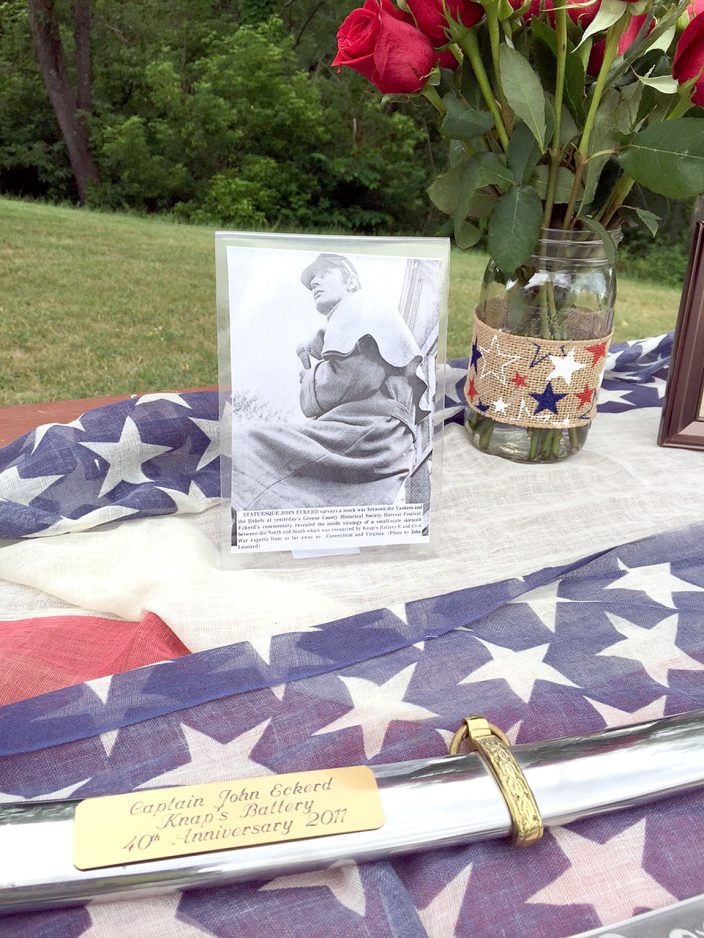
John Keith Eckerd organized Greene County’s first Civil War re-enactment group in 1971. The sword commemorates the group’s 40th anniversary.
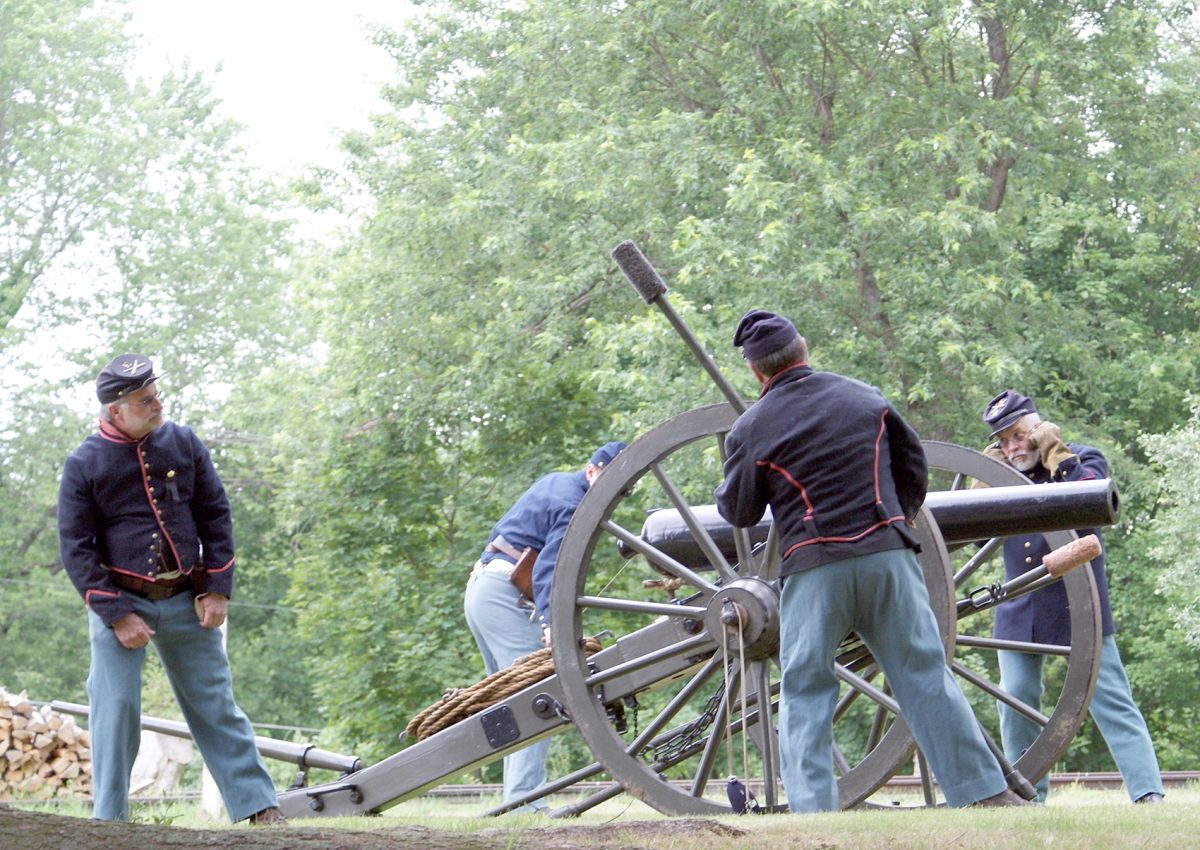
Members of Knap’s Battery prepare a cannon during a Civil War re-enactment.
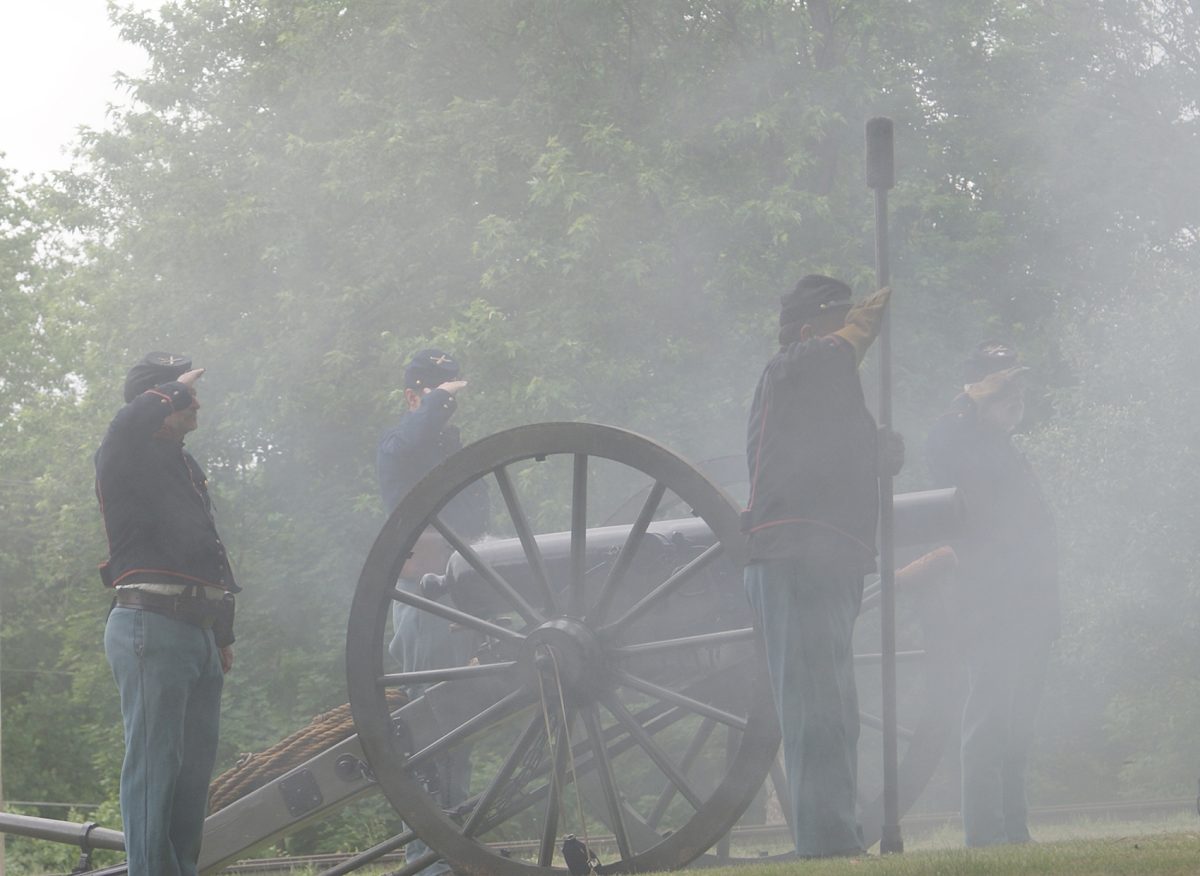
Members of Knap’s Battery watch a cannonball in the smoky aftermath of firing a cannon.
When John Keith Eckerd died at 73 two months ago in Loudon, Tenn., his family chose to bring him back to Greene County for a send-off ceremony befitting a man who loved history enough to bring it to life.
In 1971, Eckerd organized the county’s first Civil War re-enactment group, Independent Battery “E” Third Pennsylvania Volunteer Light Artillery, better known as Knap’s Battery. This seasoned band of volunteers still truck their artillery to Civil War re-enactments and events where battles were once fought or where Civil War history is still celebrated.
On June 6, Knap’s Independent Battery mustered once more at Greene County Historical Society Museum. They were in uniform, with the cannon Eckerd helped build in tow, ready to pay tribute to their fallen captain. The grounds overflowed with friends and family who came to hug, cry and most of all remember. This is where it all began, in the old barn where battery regulars cleaned out stalls to make room for more history and in the field out back where they made encampments, gave history lessons to passers-by and fired their cannon every October at the museum’s Harvest Festival.
In order to do that first recruitment, Eckerd found a sure fire way to get attention for his cause when he decorated a window of First Federal Bank, Waynesburg, with two mannequins, dressed for the 1860s in his wife Nicky’s hoop skirt and his full dress artillery uniform, and invited the press to help spread the word.
“Civil War buffs in Greene, Washington and Allegheny counties will soon have an opportunity to re-enact some of the famous engagements of the War Between the States if a Waynesburg area man is successful in organizing a Civil War Memorial Unit,” the Observer-Reporter wrote March 31, 1971.
More than 40 years later, George “Bly” Blystone was still smiling as he pointed to himself as “Cpl. Blystone” in one of the many photos on display in the barn for the occasion.
“We advertised in all the papers and our first meeting was at the East Franklin Grange,” he said. “Twelve men showed up and that’s how we got going.”
Knap’s Battery took its show on the road and spent the re-enactment seasons of spring into fall traveling to events in Ohio, New Jersey, West Virginia, New York and historic battlefields like Gettysburg, then back to the museum for the Harvest Festival. They were accompanied by a fife and drum corps and brought home trophies and plenty of stories to tell.
Back at Eckerd’s farm in Kirby, the men became a team, working long hours creating two ordnance rifles with rifled barrels that spun their ordnances out 1,200 feet with deadly accuracy.
“We had winter meetings at the farm and we learned to be blacksmiths there,” Blystone said. “It was five or six years of pure labor making the cannon carriages and everything was handmade, the carriage, the limbers, implements, everything except the barrels. We ordered them from a foundry in New York.”
Eckerd’s talent for building things was exceptional and he had a 33-year career to prove it, starting in construction for United Industries, then on to U.S. Steel as an engineer. He was there to ground break and do the iron work when Cumberland Mine was built, practically next door to his Kirby farm.
“It was a point of pride that my dad built the Kirby Mine,” daughter Diana Wagner told those who gathered for the service. “I have wonderful childhood memories of that old farmhouse, of hearing Johnny Cash and Sonny Terry coming out of the garage when Dad was working. I remember the campfires and Dad playing harmonica, just like Sonny Terry. There were always lessons to learn and stories to tell. He taught us to persevere. His last words to us were ‘Sometimes you just have to put your head down and go into the wind.'”
When the last friend had stepped to the podium to share a personal story and hug Nicky, and granddaughters Kendall Eckerd and Mikayla Wagner played and sang their last song, the men of Knap’s Battery mustered past the tent with the empty boots sitting by the empty cot, out to the field where the big gun waited. Moving with quiet precision they did their jobs as artillerymen, swabbing the barrel, placing the round, packing it down, covering the vent and preparing to fire. There would be three rounds fired, comparable to a 21-gun salute.
The barrel was swabbed for the first round, and the special ordnance loaded. Stepping back, those closest to the muzzle brought their gloved hands protectively to their ears as the silence shattered. Then, through the cloud of smoke that made everything suddenly ghostly and surreal, the men of Knap’s Battery drew themselves to attention and saluted their goodbye to Capt. John Eckerd.
Eckerd and Blystone arrived in Greene County from Los Angeles July 4, 1970. Both men were part of the First California Volunteer Light Artillery re-enactment group, based at Fort Tojon State Park. When Eckerd decided to give up big city living to move to a secluded farm near Kirby with Nicky and their three children, Blystone went with his comrade in arms and found a new life for himself as well.
The rich history of the Civil War in the East was hard for these California transplants to resist. Fort Pitt Foundry in Pittsburgh cast cannons for the war and when owner Joseph E. Knap started Knap’s Battery Pennsylvania Volunteers he recruited locally. It was a perfect historical match. Eckerd approached both the historical society and the history department of Waynesburg College for support and began his recruitment drive.
Knap’s Battery incorporated May 5, 1972, as a nonprofit to “commemorate some of the aspects of our American heritage” specifically the “Union Army Light Field Artillery of the Civil War era.” Its mission was to collect artifacts and reproductions, learn the use of the equipment and teach living history to schoolchildren and the public at large. For battery members, their dream machine was the three inch ordnance rifle, a top of the line cannon for its time, firing shells rather than cannon balls and being able to hit what it aimed at across three football fields.
But no such original gun still existed, so in the meantime, smaller “pea-shooter” cannons bought or acquired from other re-enactment groups would have to do until a reproduction could be built.
In June 1972, the newly formed battery lined up on the Greene County Courthouse lawn to celebrate Flag Day with a bang.
“Colors Fly, Windows Break During Flag Day Ceremony” the headline read the next day. “The shot, startling in its intensity, was followed by a tinkling of glass” from the second-floor office of attorney R. Wallace Maxwell, across the street in the Allison Building.
More than 40 years later, family and friends remembered Eckerd on a June afternoon with that final salute from the cannon.