

Tyler supervisor: ‘All the assessments are going to go up’
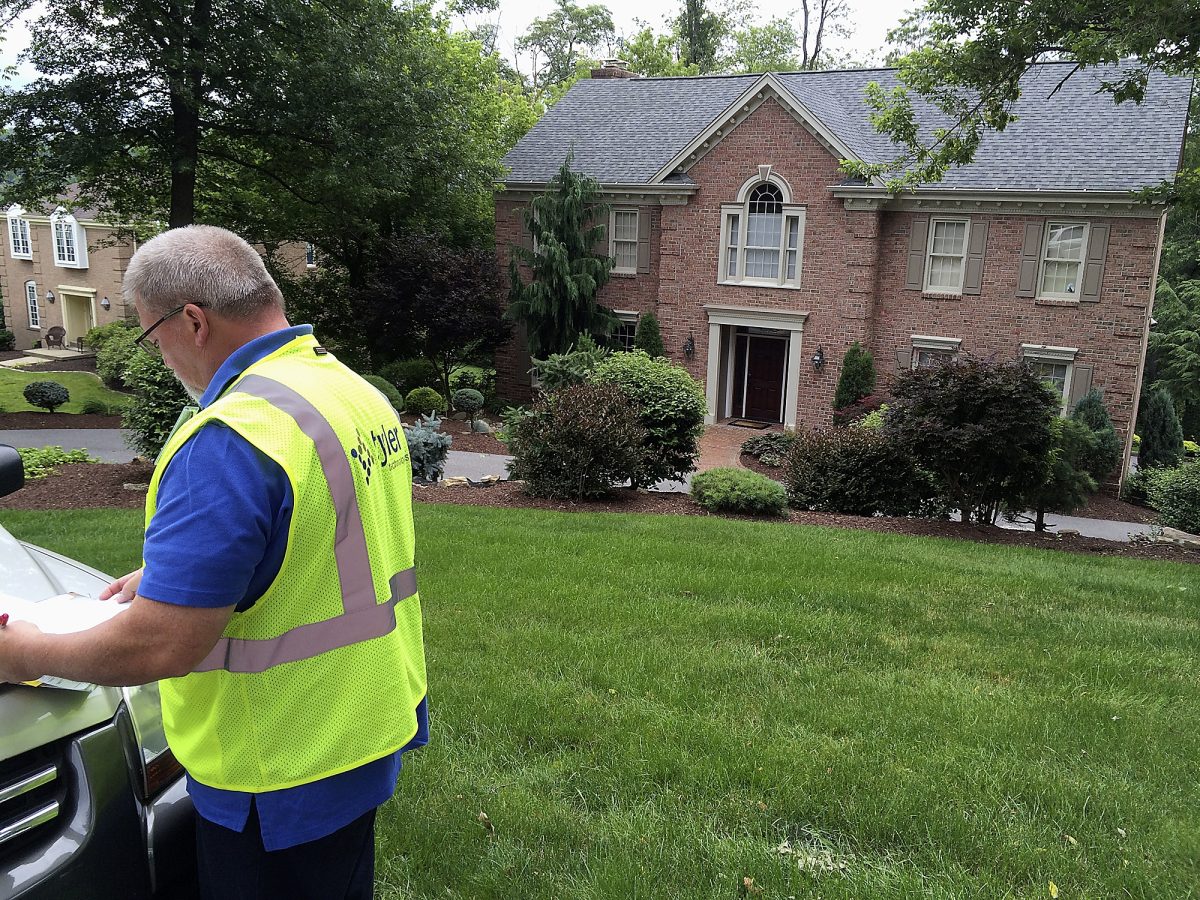
Tyler Technologies Inc. employee Gary Sciullo readies paperwork Thursday morning before approaching a home for reassessment data collection.
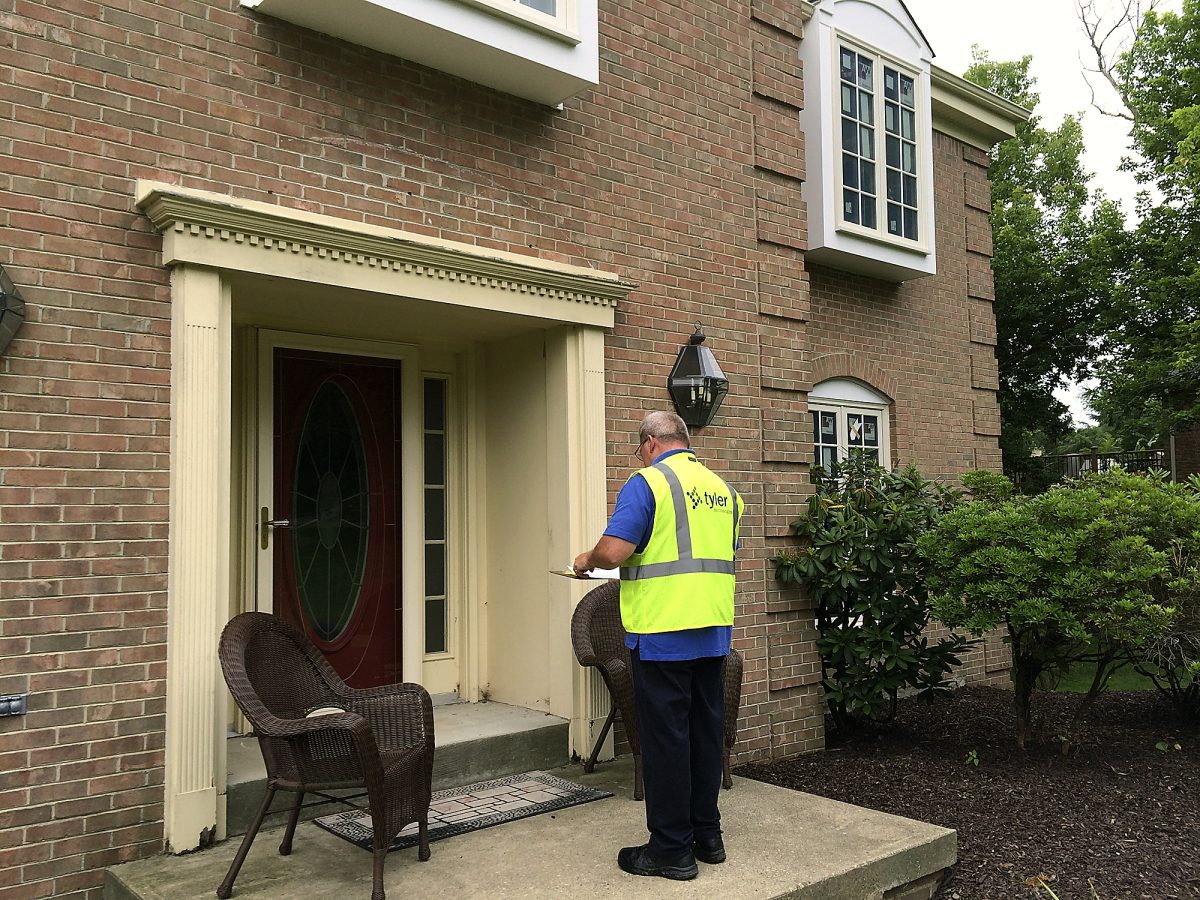
Tyler Technologies Inc. employee Gary Sciullo approaches a house to collect residential data for the countywide reassessment.
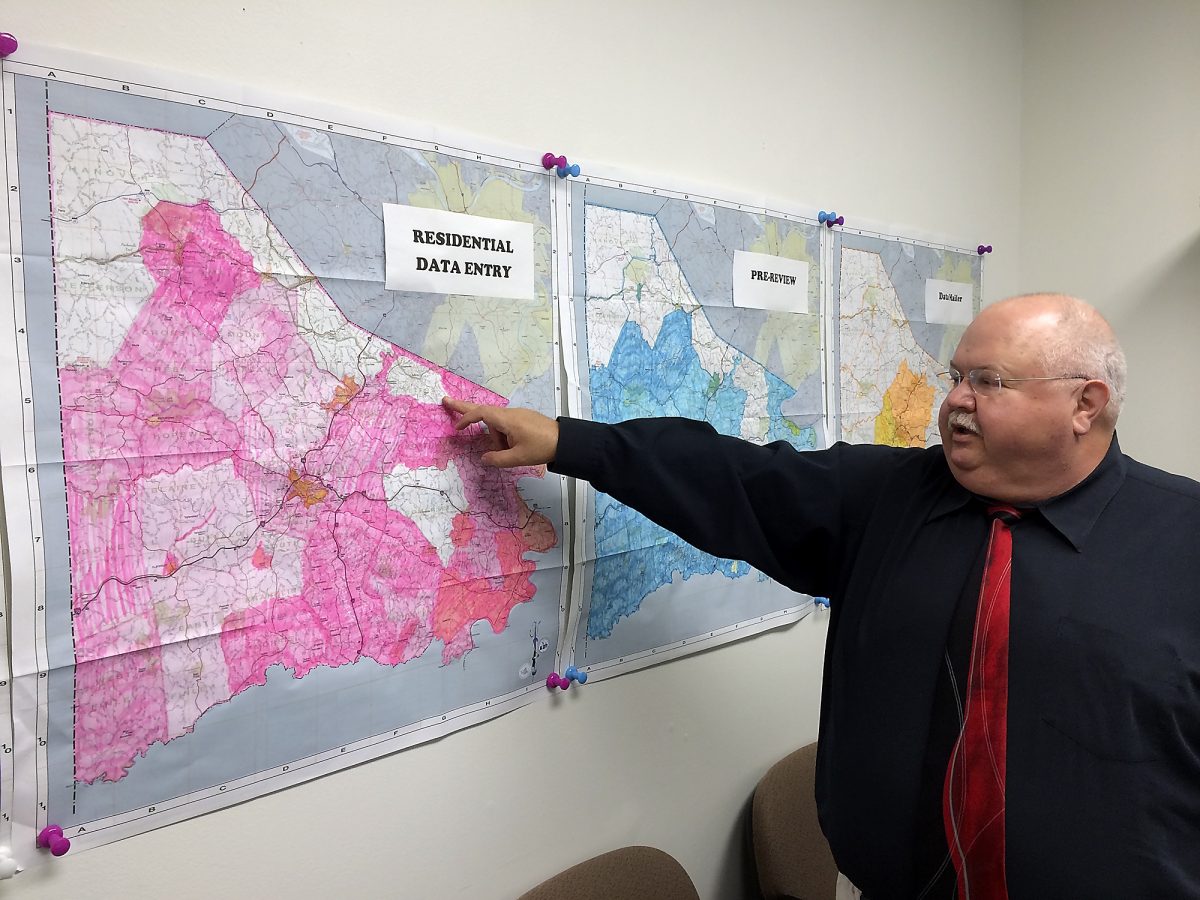
Wesley Graham of Tyler Technologies Inc. discusses maps in his Arden office that show the progress of various stages of the Washington County reassessment project.
On Wednesday, most people will be contemplating the upcoming holiday weekend, preparing a shopping list for the Fourth of July cookout or scoping out the best vantage point to watch fireworks and parades.
Wesley Graham, Tyler Technologies’ project supervisor for the Washington County reassessment, has a unique perspective on July 1, 2015. For him, it’s the Valuation Date. For property owners, it means what they get in the mail from Tyler in early February 2016 will show a current assessment and a new appraised value. You may want to sit down before you open it.
Property values can change over time, but for the purposes of reassessment and comparison, property values across the county will be set as of July 1, even though those values don’t affect county and municipal taxes until Jan. 1, 2017. School districts, because of their fiscal year, won’t be using the new values for tax purposes until July 1, 2017.
As Graham told a group of real estate agents two years ago, “We’re concerned with the value. We don’t deal in taxes.”
The effect on the bottom line, however, is the issue that most concerns those who pay property taxes, which are the basis of county, school district and municipal budgets.
But property assessments don’t exist in a vacuum, so people are naturally interested in what that means for property taxes.
“All the assessments are going to go up, but that doesn’t mean your taxes will go up,” Graham said. “Because it’s been such a long time since the last reassessment, it will shock people. The county is going to tax at 100 percent of market value as of July 1, 2015, and they’ve been taxing at 25 percent of the base year value of Jan. 1, 1981. The market values have gone up in 34 years in most places. It’s that loaf of bread syndrome. In 1981, that loaf of bread cost 89 cents, and now it’s $3.
“The values can be alarming when they see those values increase and not understand that the millage has to decrease.”
Tyler employees completed commercial data collection June 12, and they expect to wrap up residential data collection around mid-July.
Last week, Tyler’s collectors of residential data finished their task in Robinson and Hanover townships and the Washington County part of McDonald Borough. They’ll be focusing on Peters Township for their final press to ring doorbells, talk to homeowners in neighborhoods and measure the exterior of homes where Tyler employees have not yet trod since they began their task in Venetia a year ago.
When the commissioners awarded a $6.96 million contract to Tyler in the summer of 2013, they estimated the county had about 118,000 separate parcels of land. Development was occurring during the intervening years. Now, the figure is 121,000, including residential, commercial, tax-exempt and vacant lots, Graham said in an interview last week.
When residential data collection ends, Tyler’s staff will be doing five weeks of what Graham called “cleanup and quality control,” revisiting places where measurements don’t seem accurate or where a storefront has sprung up in what used to be a front porch; encoding data; and continuing to model the validity of sales.
“We’ll be putting values on all properties from now until January,” Graham said,
That’s not all that will be happening. Between October and the end of November of this year, Graham anticipates a series of public meetings at various locations to discuss what he’s calling the upcoming informal review process, in which someone can correct information that seems to be out of line. If the recipients believe something is in error, informal reviews at the Chapman Building, at Jefferson Avenue and West Beau Street in Washington, will begin the third or fourth week of February.
Washington County property owners should be receiving their new property values about mid-February of next year. “We’ll be sending them out in two or three batches,” Graham said.
Robert Neil, Washington County project manager for the reassessment, called this letter the “impact notice.” He was a field operations supervisor in 1981, the last time Washington County residents opened up letters to discover new property assessments.
“They didn’t go out and publicly speak to groups of people,” Neil said of those performing the reassessment in the 1980s. “It was handled in a news release. At that time, technology wasn’t nearly what it is now. The changes were made on paper, and data was entered by keypunch operators.”
This time, plans call for a phone bank to be set up to schedule the informal reviews at the former Washington County Youth Development Center on Old Hickory Ridge Road, Arden, which Tyler has been using as office space. The reviews will be considered at the rate of four per hour. Graham anticipates some informal reviews being held during evening hours. If the property owner cannot attend, he or she should put in writing the name of the person or attorney they will have representing them at the review.
Neil recalled that during the last assessment, the process wasn’t chaotic. “It went pretty smooth for the most part,” Neil said. “They told the taxpayer what value would be changed and made it on the spot.”
That won’t be the case this time.
“We don’t automatically give another value to the property owner,” Graham said.”The question will come up, ‘What will my new taxes be?’ I don’t have any idea,” Graham said he’ll respond. He described the informal review as one step of a process, not an end in itself. The county commissioners won’t be certifying the data until Nov. 15, 2016, and taxing bodies will be adjusting their millage at that time.
Property owners will be in suspense to find out how the informal review went.
On June 1, 2016, Tyler’s contract with the county calls for the reassessment data to be handed over to Washington County Chief Assessor Bradley Boni, and property owners will have to look at a July 1, 2016, notification to learn if any change took effect. That’s also the date that triggers the formal appeals process, which will be heard by county-appointed members of assessment appeals boards.
Two municipalities on the northern and eastern edges of Washington County present anomalies. West Brownsville Borough lies within the Brownsville Area School District in Fayette County, while a sliver of McDonald Borough, Allegheny County, is in Washington County’s Fort Cherry School District.
Allegheny County’s McDonald Borough residents won’t be affected by Washington County’s post-reassessment county tax rate, but their property will be getting new tax rates from their borough and Fort Cherry School District.
Tyler employees finished collecting residential data in McDonald last week.
“We’re getting tons and tons of phone calls,” said Marie Maximovich, secretary for McDonald Borough, where she lives on the Allegheny County side. “Some people don’t know where they live.”
Although Allegheny County had two reassessments in the past 15 years, Maximovich said Wednesday, “I’ve never seen a big change.”
After the 2012 reassessment, she was assessed for farmland with livestock, when she had only a house, a shed and two dogs.
“I just appealed that,” she said. “I think it got coded wrong. They had it changed within a couple days.”
West Brownsville, meanwhile, is just the opposite, because their Brownsville Area School District crosses county lines while the borough does not.
“The county will make them aware,” Graham said of McDonald and the Brownsville school district.
If Washington County contacts Brownsville schools’ business manager Bill Boucher, it will be dealing with a certified public accountant with a master’s of business administration degree who is also a veteran of two Allegheny County reassessments in Clairton School District.
“That’s what makes real estate taxes so unfair,” Boucher said. “It takes into account intangibles and the subjectivity of an assessor’s eye. An assessment is a subjective number, not like income tax that’s based on a tangible number or a sales tax that’s based on consumption.
“They have a methodology, but it’s a subjective number based on a calculation and the assessor’s eye on condition and workmanship. That subjective nature of assessments will also present inequities. Everything has its variants.”
Boucher said he also found in Clairton that “just about anyone and everyone whose assessment went up challenged it. No one appealed to pay more money because they felt their assessment was too low, so it only went in one direction.”
There is an anti-windfall provision in place that will require taxing bodies to adjust their millage so as not to reap megabucks after a reassessment.
But Boucher noted, “The anti-windfall only had a ceiling, not a floor. Money was going out the door and then some. Business and industry, they got a legal team to do that. We didn’t have the resources to fight some of these appeals. (In Clairton) we had to put a whole new line item in for refunds of prior years’ taxes.”
Clairton is home to U.S. Steel’s coke works, and there, the school district saw a reduction of millions of dollars of assessed valuation and, with it, revenue.
“It wreaked havoc on the budgeting process,” he said.
The McGuffey and Washington school districts filed suit against the county in 2008 for not reassessing property for nearly 30 years. Out of legal options, members of the current board of Washington County commissioners were faced with a contempt-of-court hearing in June 2013, when they opened bids from firms vying to conduct the reassessment. They unanimously chose Tyler to conduct the reassessment two months later.