

Range submits report to DEP
Range Resources will continue to monitor the water quality surrounding several of its defunct impoundments in Washington County, but the company wants to “discontinue” its tests for substances typically associated with fracking fluids, including benzene, toluene, methanol and glycols.
Those so-called constituents “have never been detected or have been detected at such low levels that they do not constitute a concern,” according to a report submitted on behalf of Range to the state Department of Environmental Protection.
If the DEP agrees, it could bring an end to a long and costly ordeal for the natural gas drilling company.
Groundwater and soil tests from four of Range’s impoundments received the DEP’s stamp of receipt May 1, the day they were due, but environmental regulators have not yet pored over the hundreds of pages of chemical analyses.
Range was required to provide testing results in accordance with the DEP’s consent order and agreement last September, which also compelled the company to pay a $4.15 million fine for issues at several pits used to store flowback or recycled water.
DEP spokesman John Poister said Range has been conducting an “exhaustive review” of the impoundments to address potential issues while they still have the chance.
“The last thing anybody wants at this point is to have to go back a few years from now in what would be an exceedingly expensive process for Range,” Poister said. “In knowing that, I think they’re working very hard to catch those things.”
If the DEP identifies any lingering issues during its review of the tests, Range will be required to create a new cleanup plan.
Three sites were ordered to be shut down immediately as part of the consent order: the Lowry and Kearns impoundments in Hopewell Township and the Worstell impoundment in Cecil Township. A fourth site, the Yeager impoundment in Amwell Township, already was in the process of being closed.
None of the impoundment tests conducted by Civil and Environmental Consultants Inc. on behalf of Range Resources revealed the detection of what are typically considered to be industrial chemicals. Above-background levels of chloride, arsenic, selenium and several metals were detected in many of the soil and water samples, but reports suggested those conditions were naturally occurring in Southwestern Pennsylvania or resulted from agricultural runoff or coal contamination.
According to the report, soil tests also confirmed Range finished remediating the Yeager impoundment, which was the site of an extensive cleanup and excavation of 540 tons of soil. However, it also noted that two soil samples contained higher levels of chloride, as well as an “elevated concentration” of oil and grease.
The impoundment was the subject of an ongoing lawsuit filed by three Amwell Township families who alleged that the Yeager well pad and impoundment contaminated their water supplies.
Range spokesman Matt Pitzarella said, “No data collected to date suggests that any nearby drinking water supplies have been affected, nor does the data suggest there will be any lasting significant environmental impacts.”
Another file in the DEP’s Pittsburgh office has “Kearns ‘impoundment'” written on the tab of a manila folder. The quotation marks refer to Range’s failure to obtain a permit to operate a centralized impoundment at the site along Fox Road.
In January 2009, the DEP observed dead fish in a tributary leading to Brush Run, a high-quality stream near the Kearns impoundment. Tests from the water revealed high levels of sodium, chloride and total dissolved solids. Similar results were observed in 2010, at which time the DEP learned that a collection pit at the Kearns site was overflowing and discharging into the tributary.
Range replied they “felt the contamination was coming from the manure pile located on the farm on the west side of the impoundment,” according to DEP records.
By 2011, the source of the contamination was still being investigated. Coal was found near the impoundment, which could have been contributing to the poor water quality, a DEP mining inspector noted. Later that year, Range spilled about 400 barrels of recycled frack water on the ground, and a small amount trickled into Dunkle Run. The cleanup effort involved 92 roll-off boxes of waste, and the impoundment was taken out of service about a year later.
The most recent test results from the Kearns impoundment this year harked back to earlier observations and the difficulty in determining the source of contamination. There were excessive levels of arsenic, manganese and selenium in the samples, but those constituents are “naturally occurring,” the report indicated.
Coupled with the presence of “weathered coal seams, there is no evidence that site activities have influenced water chemistry at Brush Run,” according to the report. “Chloride is the only constituent of concern for both groundwater and surface water southwest of the impoundment.”
Tests for the other three impoundments yielded similar results. In some cases, additional groundwater monitoring wells were requested for further testing.
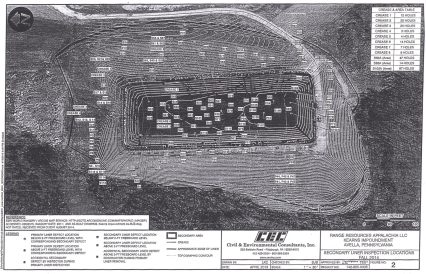
Defects and holes in the impoundments’ liners also were noted in the documents. The Lowry impoundment liner had 26 defects; Worstell had 31 defects; and Kearns had 80 defects.
However, the report noted that it’s impossible to determine “if the defects were in place during the operation of the impoundment, if they occurred when the impoundment was cleaned out and taken out of service or if they occurred after the impoundment was taken out of service.”
Range also is required to submit soil and groundwater tests for the defunct Bednarski impoundment in Hopewell by Nov. 1. In a recent letter sent to the DEP, Range indicated that it is currently preparing a permit application to convert the impoundment into an above-ground storage tank pad.
Proposed regulations from the main DEP office in Harrisburg would ban the use of on-site wastewater pits, except for those used at conventional well sites, and restrict the use of typically larger, centralized impoundments.
Poister said the Pittsburgh office has been pushing Range and other companies to make the switch from impoundments to storage tanks.
“We’ve been suggesting, maybe not so subtly, that we would like to see these storage tanks for a lot of reasons,” Poister said.
He said the storage tank requirements are more specific with regard to containment and inspection, and issues are “a lot easier to spot.”