

Could marijuana legalization come to Pa.?
Editor’s note: This story has been modified from the print version to correct Camera Bartolotta’s title to senator.
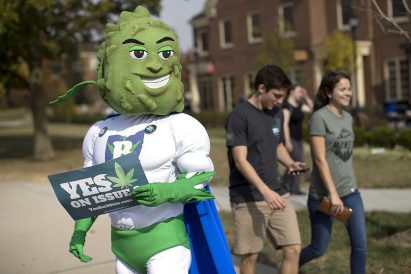
Ohio voters will have the opportunity to directly decide marijuana policies for their state in a referendum in Tuesday’s election.
Here in Pennsylvania, some are predicting the state could legalize medical marijuana before the end of 2015. In May, the state Senate passed medical cannabis legislation, which in now awaiting a vote in the state House.
While Pennsylvania tends to take the lead from Ohio on such issues, reformers are unsure if legislators will follow the Buckeye State along the path to full legalization.
Nonetheless, many wonder what marijuana reform would look in Pennsylvania. While many support the legalization of marijuana for medical use, others are concerned about the effect that full legalization could have on our already drug-ridden communities.
Washington County District Attorney Gene Vittone said marijuana isn’t currently a concern in Washington County. He conducted a sample survey of all criminal cases in 2014 and found that less than 10 percent were related to marijuana. But he is unsure of the ramifications if marijuana became legalized in any regard.
“We are facing major problems with drug abuse,” Vittone said. “I don’t know how we tell people not to use these drugs when other drugs are out there.”
Greene County District Attorney Marjorie Fox said her county “has some prosecutions related to marijuana, including driving while under the influence incidents.” Fox said statistics for her county were not available, but said legalization would create “a lot of problems that would need to be addressed.”
“It’s not a simple issue,” she said.
Since 1996, 23 states and Washington, D.C., have passed laws allowing marijuana to be used for a variety of medical reasons. The state laws do not change the fact that using marijuana continues to be an offense under federal law, according to the Office of National Drug Control Policy. That has not stopped a growing number of Western states from decriminalizing all marijuana use, and Eastern states like Ohio and Delaware from considering it.
State Sen. Camera Bartolotta, R-Carroll Township, who cosponsored the marijuana reform bill known as SB 3 and authored three of its amendments, said the bill pertains to oils and not the plant itself. Bartolotta said medical marijuana has many benefits.
“It should see the light of day,” she said about the bill. “It would be a wonderful breakthrough for so many people. There is a stigma when people say medical marijuana. There is scientific proof that cannabis oil is helpful to kids with seizure issues.”
Bartolotta said medical cannabis is not addictive, and could be an ally in the fight against opioids.
“It can be used for chronic pain,” she said. “It could help limit the issues we are experiencing with heroin.”
According to the Partnership for Drug-Free Kids, marijuana is one of the most often-used drugs in the United States. The main active chemical in marijuana, THC, is a mind-altering chemical that gives the plant’s users a high. More than 400 chemicals can be found in marijuana.
Users can smoke or ingest marijuana.
Short-term effects include problems with memory and learning; distorted perceptions; trouble with thinking and problem solving; loss of motor coordination and increased heart rate and anxiety, according to the Partnership for Drug-Free Kids. Long-term effects can include emotional issues, increasing the risk of chronic cough, bronchitis and schizophrenia in vulnerable individuals. The use of marijuana also can increase the risk of anxiety, depression and a series of attitude and personality changes, according to the partnership.
Contrary to what many people believe, marijuana can lead to addiction, as it affects the brain’s reward system in the same way as all other drugs of addiction, the partnership claims. The likelihood of addiction increases considerably for those who start using the drug young, it says.
Tammy Taylor, prevention supervisor with Washington Drug and Alcohol Commission, said marijuana use is up in Washington County among high school students. She said the WDAC is focusing on preventive measures in the schools, and is looking to change perceptions and identify those at risk.
Taylor said the marijuana that is now available is more potent than ever, and that marijuana is still considered a gateway drug.
“We are working very hard to change perceptions as it implies to social use,” she said. “We are trying to change the focus to the good; that the majority of teens aren’t using.”
Taylor said the medical marijuana bill is likely to pass in Pennsylvania.
“But let’s face it, bringing gambling into the area hasn’t helped issues,” she said. “I’m not saying that it can’t help someone, but there are already approved drugs on the market that contain marijuana. It’s just not what it appears to be. There’s a lot of concern.”
State Rep. Brandon Neuman, D- North Strabane, also said it is likely that a medical marijuana bill will pass the House of Representatives, even though the budget impasse has placed the legislation on the “back burner.” Neuman said he supports the current version of the bill.
“There is a great amount of support,” he said.
Patrick Nightingale, executive director of the Pittsburgh NORML, a local chapter of the National Organization for the Reform of Marijuana Laws, believes it is only a matter of time before marijuana laws change across the state. If medicinal use is passed, he believes decriminalization will follow.
“It’s a logical step,” Nightingale said.
Nightingale said legalization would create a “disinterest” for teens.
“It wouldn’t be cool anymore,” he said.
As with alcohol, Nightingale realizes that there could be an increase in driving while under the influence. He acknowledges that users can become addicted to marijuana.
“Reform doesn’t allow people to drive impaired. It would be important to give law enforcement the means to detect cannabis DUI,” he said.
But his concern is twofold, as he explained the need to protect marijuana users from being targeted.
“We are pushing to get something by November (on medical marijuana),” he said. “We have concerns.”
Those concerns include the fear that the bill would be tightened to the point that a low number of licenses would be available for dispensers or that it restricts participation.
For more information on the topic, visit the National Institute on Drug Abuse at http://www.drugabuse.gov/ or NORML at http://norml.org/.