

Ky. governor’s race highlights off-year election ballot
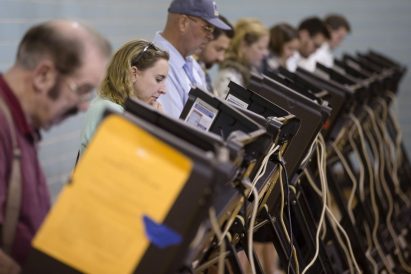
Kentucky voters Tuesday elected just the second Republican in four decades to hold the governor’s office, in a race that hinged largely on President Barack Obama’s signature legislation, the Affordable Care Act.
The results were a potentially troubling sign for Democrats ahead of next year’s presidential election and represented a big win for the GOP as it continues to consolidate political power across the South.
The governor’s race in Kentucky was the highest profile race in Tuesday’s off-year elections. Elsewhere, Ohio voters were deciding whether to legalize the recreational and medicinal use of marijuana, a measure about transgender rights was driving voter turnout in Houston, and the two major political parties were in a fierce contest for control of the Virginia state Senate.
In Kentucky, Republican businessman Matt Bevin had waged a campaign to scale back the state’s Medicaid expansion that was made possible under the federal health care overhaul. Some 400,000 lower-income people who gained health coverage under the expansion could be affected.
The Republican also played up his support for Kim Davis, the Rowan County clerk jailed for refusing to issue marriage licenses to same-sex couples.
His Democratic opponent, two-term Attorney General Jack Conway, embraced Obama’s health care reforms, saying hundreds of thousands of residents could lose access to taxpayer-funded insurance if Bevin won.
Mississippi was the only other state holding a gubernatorial election on Tuesday, and just three had general state legislative elections.
Despite the relatively low number of races, the results could be an important bellwether of sentiment ahead of next year’s presidential elections.
In Virginia, a swing state, Democrats were pushing to reverse a narrow Republican majority in the state Senate and empower Democratic Gov. Terry McAuliffe in negotiations with Republicans who control the state House.
Mayors in some 300 cities were also on the ballot. In Philadelphia, former longtime Councilman Jim Kenney was elected mayor on a promise to fight poverty and push for universal pre-kindergarten education. In Salt Lake City, voters were choosing between the incumbent and a challenger who seeks to become the first gay person elected mayor of Utah’s capital.
Several city or state ballot initiatives will test voter preferences on school funding, marijuana, gay and lesbian rights, and the sharing economy.
The governor’s race in Mississippi has been largely overshadowed by a fight over a constitutional amendment that would allow people to sue the state to increase funding for public schools. Critics say it would take budget decisions away from Mississippi lawmakers and give the courts too much power. The Legislature has put forward its own ballot measure that would prohibit “judicial enforcement” of school funding.
The outcome could prompt similar efforts in other states where education remains a key challenge for lawmakers as they look to balance their budgets with tax revenues that have yet to rebound to pre-recession levels.
Meanwhile, Mississippi Gov. Phil Bryant, a Republican, appeared on track for re-election. He faced political newcomer Robert Gray, a long-haul trucker who was the surprise winner of the Democratic primary.
In Houston, the nation’s fourth-largest city, efforts to secure nondiscrimination protections for gay and transgender people faced a key test. Now that same-sex marriage is legal, such laws have become a priority for gay, lesbian, bisexual and transgender groups. Opponents, including a coalition of conservative pastors, contend the measure infringes on their religious beliefs.
Houston voters also were choosing from among 13 candidates to replace outgoing Mayor Annise Parker.
The Salt Lake City mayoral race features two-term incumbent Ralph Becker, one of President Barack Obama’s appointees on a climate change task force, and former state lawmaker Jackie Biskupski. If Biskupski wins, she will be the city’s first openly gay mayor.
State judicial elections in recent years have become a focal point for political parties and interest groups seeking to influence the courts. Tuesday’s election to fill three open seats on the Pennsylvania Supreme Court was the latest judicial contest to attract heavy attention and spending.
So far, campaign contributors have poured $11.5 million into the Pennsylvania high court race, most of it going to the Democratic candidates.
Elsewhere, voters in Ohio were considering whether to allow the use of marijuana for recreational and medicinal use. San Francisco voters were deciding a citizen-backed initiative to restrict the operations of Airbnb, the room-rental site, and a $310 million bond package for affordable housing.
In Washington state, a proposal backed by Microsoft co-founder Paul Allen would add state penalties for anyone who imports certain animal products for commercial purposes, such as elephant ivory or rhino horns.
And Colorado voters were deciding what to do with $66 million in tax revenue generated from the sale of recreational marijuana. An existing state law requires excess tax revenue to be returned to taxpayers. A statewide initiative on Tuesday’s ballot asks voters to make an exception with the marijuana revenue and direct it instead toward public education and drug-prevention programs.