

E. Washington woman pitches ‘Pittsburgh Plaid’ to city council
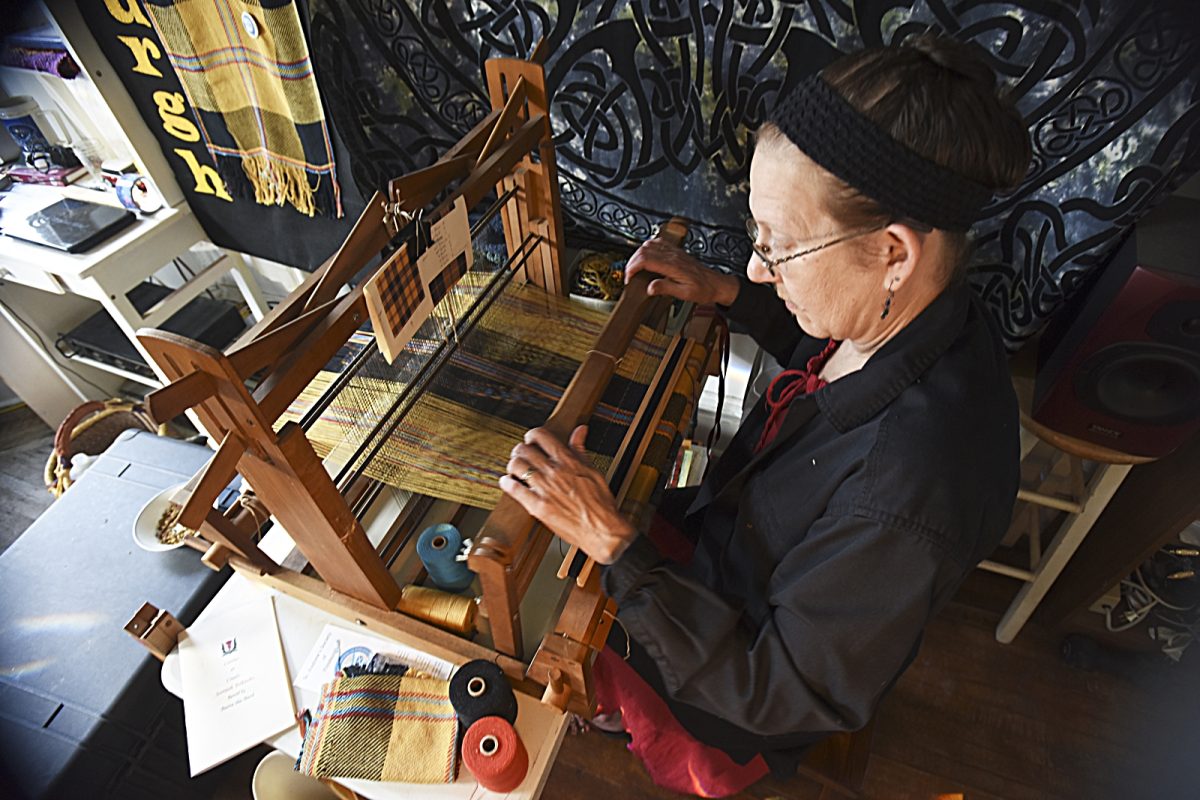
Kathy Wells of East Washington works on her loom in her home while making a Scottish Pittsburgh tartan.
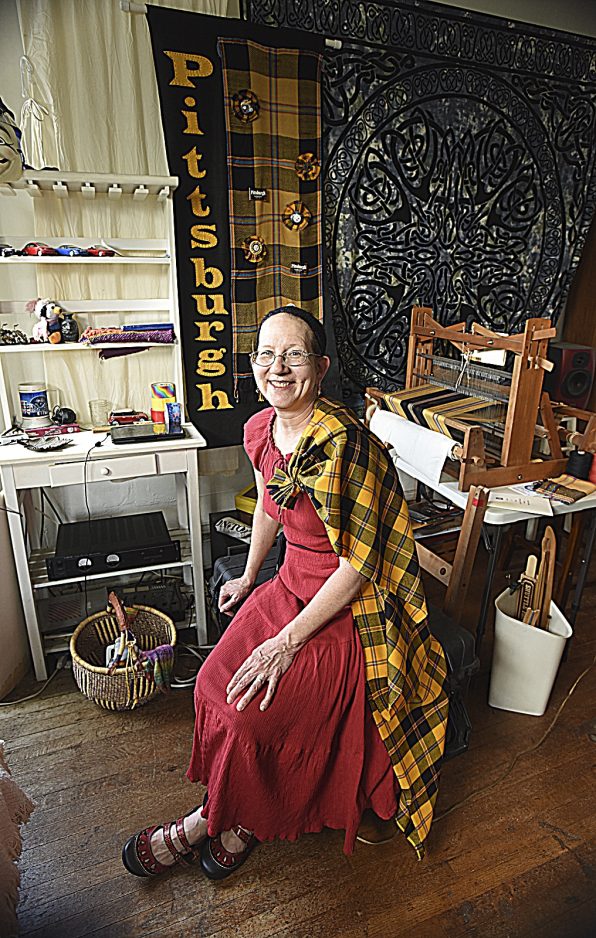
Kathy Wells of East Washington displays the female version of a kilt she made with the Scottish Pittsburgh banner in the background at her home.
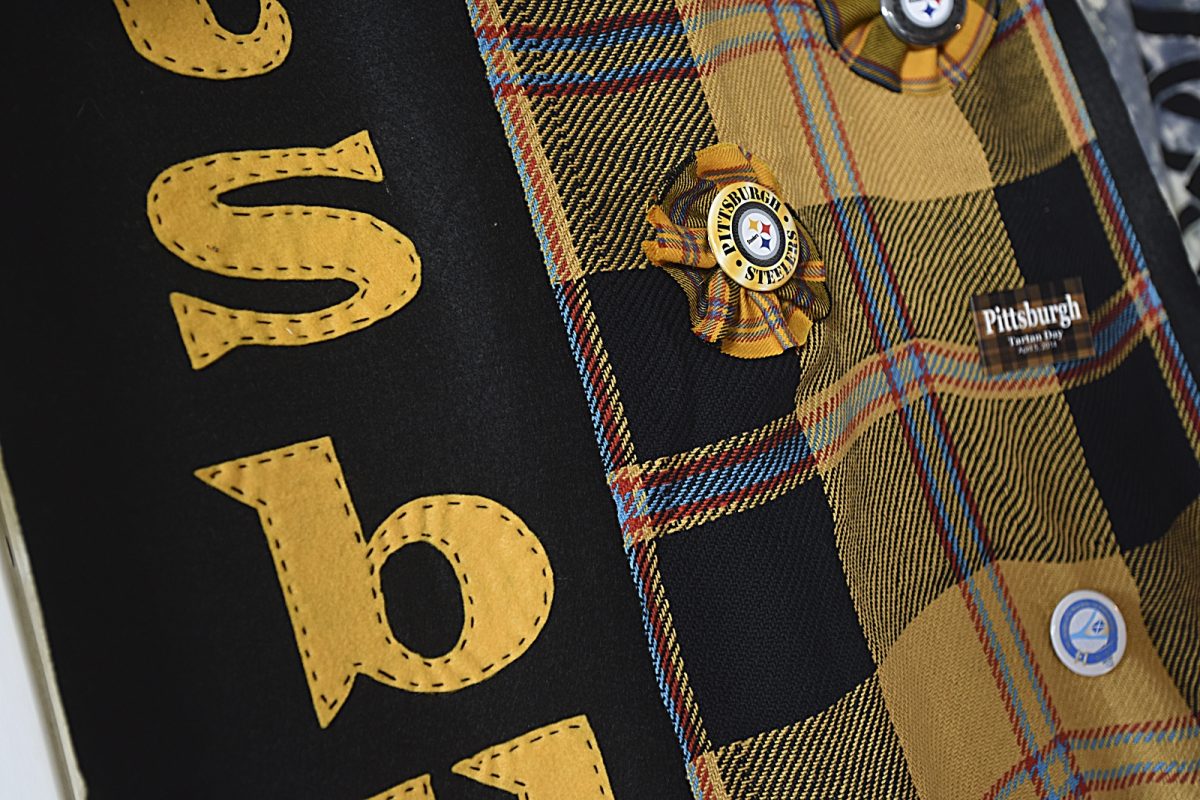
A close-up view of Kathy Wells’ Scottish Pittsburgh tartan she made in her home

Kathy Wells of East Washington displays the female verson of a kilt she made in her home.
Kathy Wells admits it: She’s mad for plaid.
The East Washington resident, who has worked with textiles for more than 50 years, recently combined her passion for tartans (a fabric and its unique plaid pattern) and Pittsburgh sports teams.
The result was a Pittsburgh tartan, which has been officially recognized by the St. Andrews Society of Pittsburgh and registered with the Scottish Registry of Tartans in Scotland, which maintains a registry of tartans.
Wells is hoping that Pittsburgh City Council adopts the black-and-gold tartan as the official tartan of the city, which celebrates its 200th anniversary in 2016.
She submitted a request to council, but the tartan, currently named the “St. Andrews Society Pittsburgh Tartan,” has not been voted upon.
“It’s a great tartan because it’s a black and gold tartan that embodies the rich history and traditions of Pittsburgh,” said Paul Thompson, president of the St. Andrews Society of Pittsburgh. “Tartans are important to us. Most of our members are Scots with their own clan tartans. We’re all about celebrating and preserving our Scottish heritage, and we think it would be great to have a Pittsburgh tartan. Right now, it’s registered as the ‘St. Andrews Society Pittsburgh Tartan,’ but when the mayor recognizes it as the city’s tartan, which we hope he does, we’ll drop our name from the tartan.”
Wells said she started thinking about creating a Pittsburgh tartan pattern two years ago.
“My husband, Jim, and I both have Scottish roots and we would be sitting around watching the football game, like so many of our friends and neighbors, and we’d say, ‘Pittsburgh needs a tartan,'” said Wells. “Up until this point, there has been no tartan designated for Pittsburgh. I tried to get imaginative and put this together. I think it looks fantastic.”
It does.
Wells’ Pittsburgh tartan combines broad and thin yellows, blacks, blues and reds, a nod to the city’s three rivers, professional sports teams and the steel industry.
And while most people associate “black and gold” with the colors of the city’s athletic teams – the Pittsburgh Steelers, Penguins and Pirates – they are the colors of the coat of arms of William Pitt, the city’s namesake, explained Wells.
Pittsburgh was officially named in 1758, and more than 140 years later, Pittsburgh council voted to use the black and gold (which looks more like a yellow) for the city’s flag.
According to the Scottish Tartan Authority, Celts have been weaving tartans for at least 3,000 years. One of the most famous Scottish tartans dates to 230 A.D. In 1933, workers found a wad of brown and yellow woolen cloth (it was a dog-tooth pattern) now known as the Falkirk tartan, was used as a stopper in an earthenware pot filled with 2,000 silver coins and buried in a pit.
In the Scottish highlands, tartans – usually made of wool – became a symbol of defiance after British rulers tried unsuccessfully to ban it in the 1700s. Over the next two centuries, clothing made with tartan patterns identified various regions and clans.
In the United States, it has become popular for cities and states to designate official tartans (at least 34 states have their own tartan, joining more than 600 other tartans adopted by U.S. companies, organizations, fire departments, schools and universities – among them, Carnegie Mellon University and West Virginia University).
“I’ll know I really have made it when I have the Pittsburgh Police Pipes and Drums Band or the Pittsburgh Firefighters Pipe Band go marching down the street black and gold come St. Patty’s Day,” said Wells. “I’ve really thought about this. You can have the police department wear black, and you can fold the black in and have the yellow predominantly for the fire department. It would look great.”
Johnson said the response to the Pittsburgh tartan has been tremendous at several Scottish events, including National Tartan Day, held on April 6.
“People love it. Wherever the Pittsburgh tartan has been on display, it has been very popular,” said Thompson.
Wells has made arisaids – an arisaid is a female version of the kilt – and incorporated Pittsburgh Steelers buttons onto the tartan and given them to friends, who envision the Pittsburgh tartan on ties, scarves, blankets, flags, banners and other merchandise.
However, Wells’ work schedule prevents her from making the amount of fabric the she needs to make those items, because she weaves it by hand.
“Right now, I can’t produce enough fabric to meet the demand on my own,” said Wells. “I’m not in marketing and I could use some guidance there. We’ll see what happens. This is what keeps me sane, doing this. I don’t think I could deal with life’s stresses without having this to come home to. The whole process of making the Pittsburgh tartan has been fun.”