

150-year-old voter lists found in Courthouse Square
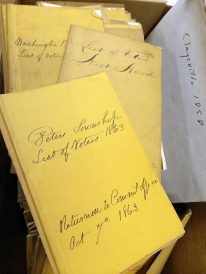
A worker cleaning out a storage room in the Washington County Tax Claim Bureau recently came across a shoebox-sized container holding lists of voters compiled, in some cases, more than 150 years ago.
Debbie Bardella, recorder of deeds and director of the tax claim bureau, turned over the old booklets to the elections office.
“Don’t throw anything away, even if you don’t know what it is,” Bardella said has been her philosophy of preserving historical documents. She also wondered if today’s residents might recognize the names of – or be descended from – some of the people who inhabited the communities of yesteryear.
Property records in her office date to the formation of Washington County in 1781, and when Bardella worked in the recorder of deeds office, originally in the courthouse, she recalled her predecessor, Olga Woodward, coming across a registry of Washington County slaves in the building’s attic.
The original slave docket is now archived at Washington & Jefferson College.
One characteristic that strikes a contemporary person leafing through the Washington County voter rolls of the 1860s is that the realm of casting a ballot was reserved for men only until the passage of the 19th Amendment to the U.S. Constitution in 1920 gave women the right to vote.
Gender wasn’t the only barrier to voting.
Steven Mintz, in an online article, “Winning the Vote: A History of Voting Rights” from the Gilder Lehrman Institute of American History, noted by 1790, all states eliminated religious requirements for voting, noting Catholics were barred from voting in five states during the colonial period and Jews were disenfranchised in four.
Owning property was intertwined with voting rights because those who held title to land were through to have a bigger stake in community issues, and how one voted was often announced publicly.
Mintz wrote that in the first half of the 19th century, voting by voice was replaced by voting by written ballot. “This was not the same thing as a secret ballot, which was instituted only in the late 19th century … The most significant political innovation of the early 19th century was the abolition of property qualifications for voting and office holding … Pressure for expansion of voting rights came from propertyless men; from territories eager to attract settlers; and from political parties seeking to broaden their base.”
Race apparently became more of a factor as divisions that led to the Civil War came to the forefront. Only five states – all in New England, according to Mintz – “allowed African-Americans to vote without significant restrictions. In 1826, only 16 black New Yorkers were qualified to vote.”
In the days of the fledgling United States, Pennsylvania permitted free blacks to vote until 1838, according to the Pennsylvania Historic and Museum Commission.
In Washington County’s most recent election, another type of poll book came under scrutiny, and this type of record is an electronic one.
Wes Parry, county assistant director of elections, spoke with officials of the Pennsylvania Department of State on Monday about the Statewide Uniform Registry of Electors, which has the acronym SURE, which has not updated the list of voters to reflect those no longer required to show identification because they have previously voted in a precinct.
Parry called the conversation “basic nuts and bolts kind of stuff” and said the database needs “a better method of making sure our data transfers the way it’s supposed to.”
A 2012 decision by Pennsylvania’s Commonwealth Court struck down a state law that demanded voters show photo identification at every election, but voters are still required to show proof of residency – not necessarily photo identification – the first time they report to cast a ballot at a precinct as a new resident. Then-Gov. Tom Corbett declined to appeal the court decision.
Championed by Corbett, Republicans contend the law targeted voter fraud. However, Democrats argue the law disenfranchised young adults, minorities, the elderly, poor and disabled by making it harder to vote. Plaintiffs in the case include the League of Women Voters of Pennsylvania and the Pennsylvania chapter of the National Association for the Advance of Colored People.
On Washington County’s voters and the issue with electronic poll books, Parry said Larry Spahr, elections director, also talked last week with staff from SURE’s technical support.
People who shouldn’t have to show identification are being asked, election after election, to produce it because the electronic poll book isn’t properly interfacing with the SURE system.
“It’s supposed to be fixed by the time of the presidential primaries” next year, Parry said.
Ballots for the Pennsylvania primary, now scheduled for April 26, will be designed with three ballots rather than the usual Democrat and Republican. There also will be a nonpartisan ballot that won’t include the names of major-party candidates, but will include a referendum on a proposed state constitutional amendment that would increase the mandatory retirement age for judges to 75 from the current 70.
“That’s what we’re being told right now,” Parry said. “It’s going to be on the ballot in April. Things are always subject to change when it comes to that sort of thing.”