

Attacks by Trump, Carson on Muslims worry GOP elders
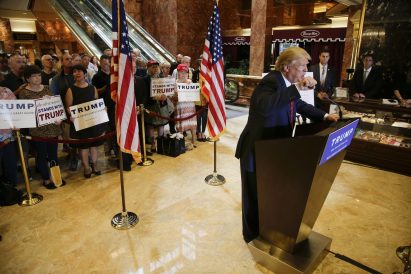
WASHINGTON – The candidates atop the GOP presidential field are ramping up political attacks aimed at Muslims, a move designed to appeal to hardline conservatives. But party elders worry that escalating anti-immigrant rhetoric could cost Republicans the White House in 2016.
The aggressive words, in particular from front-runners Donald Trump and Ben Carson, have exacerbated a widening rift between the GOP’s pragmatic and ideological wings as the party tries to avoid losing a third consecutive presidential election.
His relationship with the nation’s Hispanic community already strained, Trump vowed on Wednesday to deport any Syrian refugee taken in by the U.S. Most likely would be Muslim, and Trump warned they could be Islamic State militants in disguise.
“If I win, they’re going back,” the billionaire businessman said.
Carson, a retired neurosurgeon, launched a petition on Thursday challenging the nation’s largest Muslim advocacy group’s tax-exempt status, escalating his ongoing rift with the U.S. Muslim community.
The Council on American-Islamic Relations last month called for Carson to quit the presidential race after he said a Muslim should not serve as president. He has since clarified his position, stating he wouldn’t support a radical Muslim who did not support the Constitution.
“Under Sharia law, women must be subservient and people following other religions must be killed,” Carson said in a fundraising appeal distributed this week that repeats his criticism of a prospective Muslim president who supports a harsh interpretation Islamic law.
No such candidate exists, although some conservatives have repeatedly tried to link President Barack Obama to Islam. He is a Christian.
“The Judeo-Christian values upon which America was built allowed us to become the greatest force for good on the planet,” Carson said. “We shouldn’t give them away in the name of political correctness.”
Carson’s fortunes have surged since he first said he wouldn’t support a Muslim president. He raised roughly $700,000 and added more than 100,000 Facebook friends in the 36 hours after making the comment, said campaign manager Barry Bennett.
The focus on Islam comes as Republicans work to repair a strained relationship with the nation’s surging Hispanic population, a critical voting bloc in presidential elections. The U.S. Muslim population is a fraction of the size of the Hispanic community, yet the party’s overall tone could complicate broader outreach efforts.
Political observers in both parties agree, among them, the GOP’s 2012 presidential nominee Mitt Romney. More than anything, he said of his lessons from his failed campaign, is that Republicans must do a better job at connecting with minority voters.
“I think it’s been unfortunate that some of the rhetoric has so clouded the picture that some people think we’re anti-immigrant. Nothing could be further from the truth,” Romney said, prompting audible laughs of disbelief from the crowd gathered at a Washington conference Wednesday.
“Hey guys. My party is pro-legal immigration. Massively,” Romney pleaded and later added, “The rhetoric has been terribly unfortunate in many respects.”
Foreign policy analyst Rula Jebreal cited a sharp shift in the GOP’s present-day tone compared to 2008 Republican presidential nominee John McCain and former President George W. Bush, who visited a mosque shortly after the 9/11 terrorist attacks to demonstrate religious tolerance.
“Islamophobia is now an industry,” Jebreal said. “In the long run it will hurt the Republican Party and it will hurt the country in general.”
Yet there is some evidence that anti-Muslim rhetoric resonates with voters in both parties. A June Gallup poll found that 54 percent of Republicans would not vote for a well-qualified Muslim nominee from their own party; 39 percent of independents and 27 percent of Democrats said the same.
The U.S. Muslim population is growing, according to a May survey by the Pew Research Center, which found the group remains extremely small, representing just under 1 percent of the U.S. population.
Meanwhile, some Republican presidential candidates have adopted a softer tone.
Former Florida Gov. Jeb Bush, whom conservatives have been slow to embrace, said Trump should show “some sensitivity” to the Syrian refugee crisis.
“We have an obligation to make sure that people coming here are legitimate, but send them all back? To a hellhole?” Bush said Wednesday.
Democrats are trying to capitalize, with Democratic front-runner Hillary Rodham Clinton casting Trump the poster boy for the Republican Party.
“Don’t be distracted by their flamboyant front-runner,” she said in a recent New Hampshire speech. “He’s been trafficking in prejudice and paranoid throughout this campaign. But if you look at the policies of the other Republican candidates … they are just Trump without the pizazz or the hair.”
Meanwhile, Romney downplayed Trump’s chances in 2016.
“I will support the Republican nominee. I don’t think that’s going to be Donald Trump,” Romney charged.
Trump fired back Thursday, writing on Twitter that Romney let his party down in 2012. “Should’ve won,” Trump tweeted. “He choked!”