

New trial in well water contamination case?
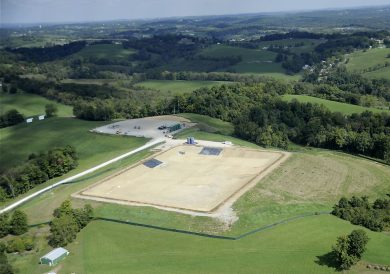
Newly discovered evidence in a case filed by an Amwell Township man who claims Range Resources contaminated his drinking water could result in a new trial before the Pennsylvania Environmental Hearing Board.
According to a motion filed Wednesday in Commonwealth Court by attorneys for Loren Kiskadden, the gas company failed to reveal the use of radioactive tracers, which chart and analyze the reach of hydraulic fracturing.
Range was previously ordered to turn over a detailed list of all the chemicals and components of substances used at the site since 2009.
Kiskadden’s attorneys, John and Kendra Smith, argue the use of tracers was not previously disclosed, and at least one of newly disclosed tracers was detected in Kiskadden’s drinking water.
In June, EHB Chief and Chairman Thomas W. Renwand determined Kiskadden “failed to meet his burden of proving by a preponderance of the evidence that his water well was impacted by gas drilling operations conducted by Range Resources,” according to court documents. Kiskadden lives along Banetown Road, having moved there in 2008. In June 2011, while filling a child-sized pool, Kiskadden claims his water began foaming, contained gray sludge and had a rotten-egg odor. His well sits a half-mile away from Range’s Yeager impoundment. He filed a lawsuit in 2012 and has since been embattled with Range. In September, the board held a 20-day trial on the issue, which included a tour of the property.
While Renwand agreed a “number of problems existed at the Yeager site,” he said Kiskadden did not prove the various leaks and spills that occurred at the Yeager site lead to the contamination of his water. The DEP included those problems when it issued Range a record-setting $4.15 million fine for various leaks and other problems at six of the company’s water impoundments in Washington County.
The Smiths asked the Commonwealth Court to vacate the hearing board decision denying their client’s contamination claim and send the case back to the board for a new hearing. John Smith said they filed an initial appeal to the hearing board’s June decision last month.
The tracer information was discovered during sworn dispositions from employees of Multi-Chem and Universal Well Services Inc., two of Range’s fracking subcontractors on the Yeager site. The employees were subpoenaed for a separate case, in which Kiskadden is also a party with neighbors Stacey, Harley and Paige Haney and Beth, John and Ashley Voyles, charging Range with negligence, partly over allegations it allowed a hole to develop in the liner of the impoundment, contaminating the soil and groundwater.
Wednesday’s motion also acknowledges the use of antimony – one of three solid tracers used at the site by Protechnics, another Range subcontractor – was found at a level four times the federal maximum acceptable for drinking water in Kiskadden’s well.
Range previously argued Kiskadden’s water was typical of the area’s groundwater. However, the Smiths argue Range concealed a draft letter from the U.S. Agency for Toxic Substances and Disease Registry that showed Kiskadden’s water contains high concentrations of sodium, methane, arsenic and diesel range organics at levels “high enough to affect your health.”
Range spokesman Matt Pitzarella said Friday in an email Range did not contaminate Kiskadden’s water supply.
“After conducting a very thorough analysis, the EHB upheld the DEP’s determination that Range’s activities did not impact Mr. Kiskadden’s water supply. This well-founded decision supplements a wealth of scientific evidence, including a multi-year study conducted by the EPA, demonstrating that drilling is being done safely and is well regulated. There’s no additional information in this filing that changes the fact that Range and the broader industry is protective of the environment and the public and that Range’s activities did not impact Mr. Kiskadden’s water supply in any way.”
He alleges chemical tracers were heavily relied upon during the board’s hearing and determination.
“This filing in no way affects the EHB’s evaluation and ruling inasmuch as there was extensive discussion on the record by all of the experts on both sides of the appeal of other ‘chemical tracers’ including chlorides and isotopic analysis of methane,” he said. “As determined by the EHB and the DEP there is no hydrogeological connection between the Range location and the water well, nearly a mile away.”