

Flags played huge role in Civil War
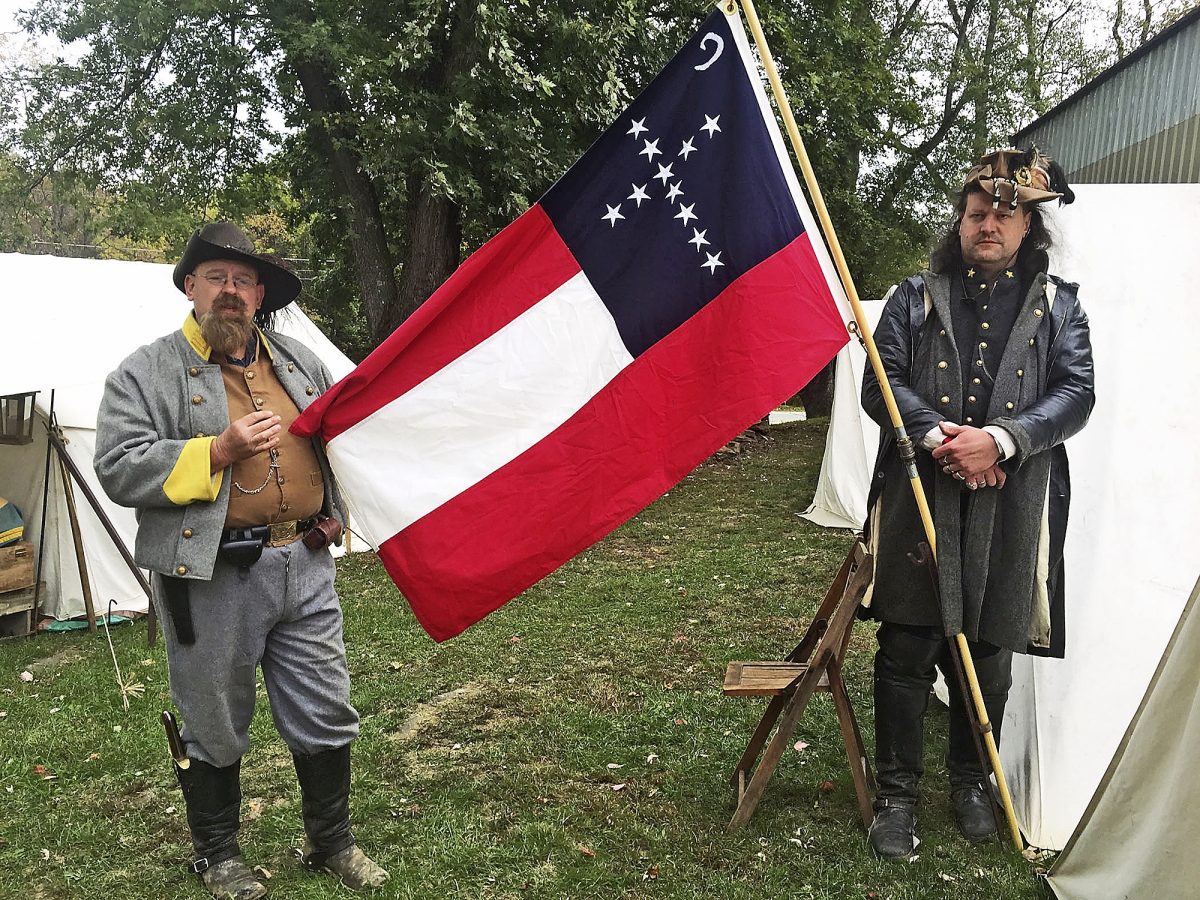
C.R. Nelson for the Observer-Reporter From left, Confederate reenactors Roy Fagan and John Brasuk display the flag that Virginia soldiers carried during the Civil War.
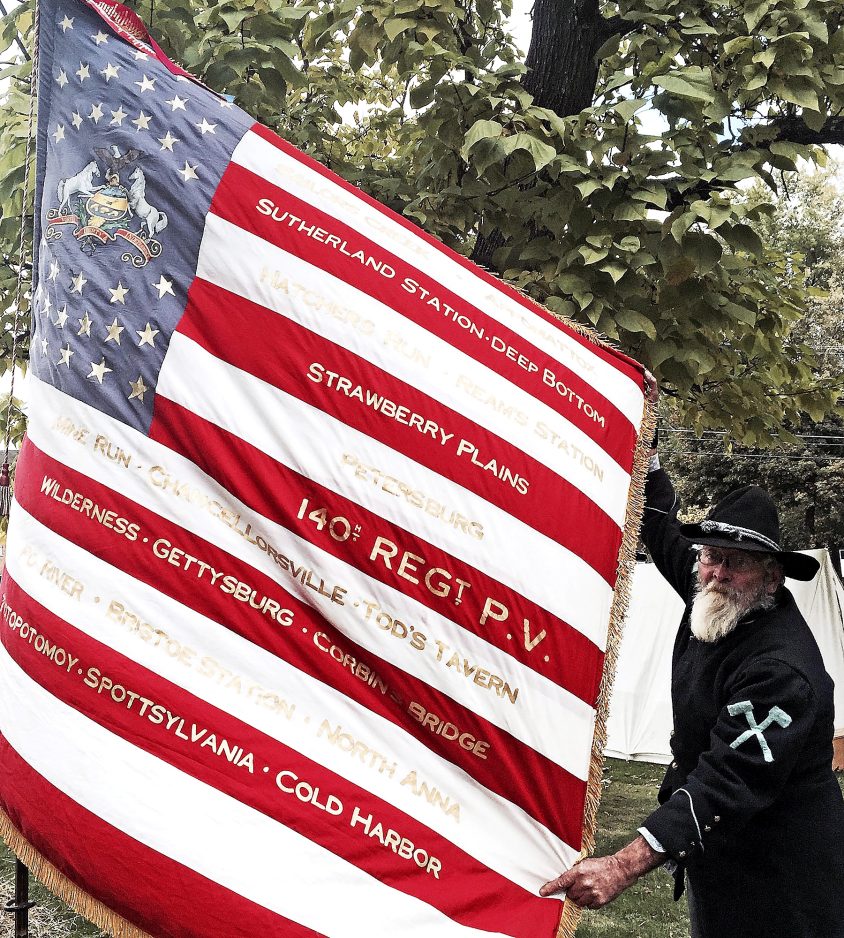
Union Re-enactor Mike Foley shows the colors of the battle flag that the 140th Pennsylvania Volunteer Infantry carried during the Civil War from 1862-1865. He and other century-hopping soldiers staged a mock skirmish in the “War between the States” at the Greene County Historical Society Harvest Festival Oct. 17 and 18.
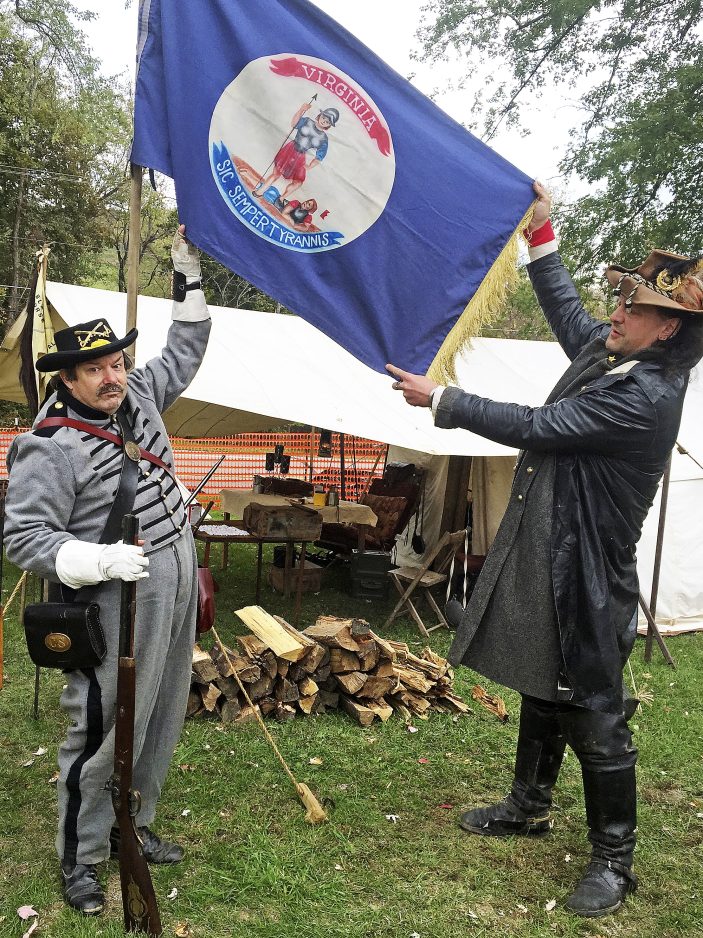
Confederate reenactors Daryl Metcalf, left, and John Brasuk show a battle flag unfurled during the Civil War. It is the flag of 14th Kentucky Cavalry, Company F.
WAYNESBURG – As it does every year, the Greene County Historical Society’s Harvest Festival invited local and regional Civil War re-enactors to put on mock battles on the woody hillside behind the museum on Rolling Meadows Road in Franklin Township.
During the recent festival, Oct 17 and 18, cannons boomed, shots were fired and men and boys in blue and gray uniforms scrambled, crawled and took bloodcurdling “casualties” as festivalgoers watched from above like commanding generals.
And fluttering over the encampments on both sides were flags, flags and more flags. Why so many?
Flags, it turns out, were the communication system of the war.
“We have three that we’re proud to carry – our regiment flag, the national flag and the state flag,” Mike Foley of the 140th Pennsylvania Volunteer Infantry said. His rank of pioneer, somewhere between a private and a corporal, is unrenowned to those not steeped in the history of the Civil War.
Foley’s duty was to prepare the way for battle, building roads and clearing land ahead of the front line as the troops worked their way through the farmlands and forests to engage the Confederates.
Although the state flag of Pennsylvania is the same now as it was then, the other two flags dancing in the cold breeze over the Union camp that weekend were historic reproductions.
The United States flag of 1862 had 35 stars, including a star for West Virginia, which became its own state separate from Virginia that year.
The regiment flag of the 140th was unmistakably Old Glory with a twist – the seal from the state flag was added to the stars in their blue square and the names of the major battles the regiment fought were lettered in gold on the red and white stripes.
These were battle flags, more square than rectangle and decked out with gold fringe and fancy finials. Carrying the flag was a source of hard won pride for the troops, Foley said.
The original regiment flag of the 140th saw plenty of action and was never replaced when struck by enemy fire.
“There was only a small piece of it left in the end, most had been shot away in battle,” Foley, an avid historian since childhood, said with pride.
The 140th Company A mustered out of Waynesburg College in 1862, joined with other men from Greene, Beaver, Mercer and Washington counties and fought battles from Chancellorsville to Gettysburg to the army of Virginia’s surrender at Appomattox in 1865.
Going into battle meant even more flags – brightly marked Guidons at either end of a company that helped generals sitting on high ground distinguish companies and regiments and guide the course of attack or retreat.
Company A’s Guidon was a white flag with a red clover symbol on it and there were different colored clovers identifying individual companies in the regiment and different symbols on different flags to identify the companies in other regiments, Foley said.
Beyond that, there were brigades made up of varying numbers of regiments, each brigade bearing triangular flags that identified their corps, each part of a chessboard of military players ready to obey orders from above.
This is how generals communicated with their signal corps as the battle progressed so it was “save the flag at all costs.”
When the Civil War began in 1861, county and town militias joined their rebelling state or commonwealth cause and brought their flags with them, Confederate reenactor John Brasuk said.
The battle flag of his group, the 1st Virginia Company A was emblazoned with the state seal of Virginia on a field of blue. The reenactment group the 14th Kentucky Cavalry, Company F also had its flag flying at the festival, a cross of stars on a blue square, with two big red stripes and one white accompanying it.
The official flag of the Confederacy was a work in progress throughout the war and in the beginning it was hard to tell it from Old Glory, especially in the heat of battle, Brasuk said. The blue Saint Andrews Cross with white stars set on a red background became the war flag that is now most identified with the Confederacy, but in those first battles, red, white and blue stars and stripes of varying combinations carried by the Confederacy made for lives being lost to friendly fire.
Adding to the deadly confusion, uniforms were similar since many Confederate soldiers were still wearing their Union army gear in the early days of the war.
Stonewall Jackson didn’t wear grey until late 1862 and the 1st Alabama Company was still wearing federal blue on July 21, 1861 at the 1st battle of Manassas, also known as Bull Run, in Prince William County, Va. It was fought a day’s march – 25 miles from Washington D.C., and was the first major engagement of the war, involving about 18,000 untested troops and commanders on either side.
As the battle raged and the Union troops were routed, it was hard to tell one side from the other, Brasuk said. How did these green soldiers know who to target? In the end, “You shot at the guy who was shooting at you,” he said.