

Clean Power Plan unpopular in Greene
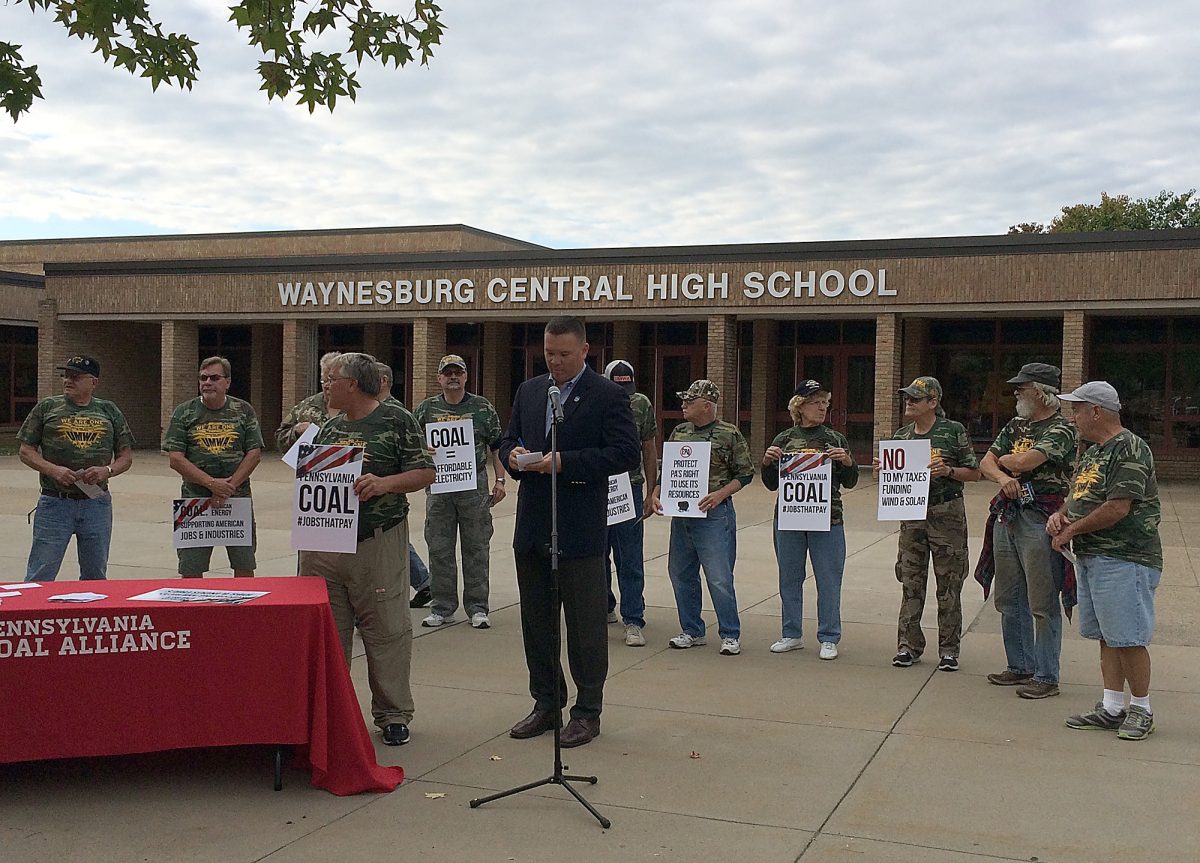
John Pippy, chief executive officer of the Pennsylvania Coal Alliance, speaks to miners before the start of Tuesday’s listening session.
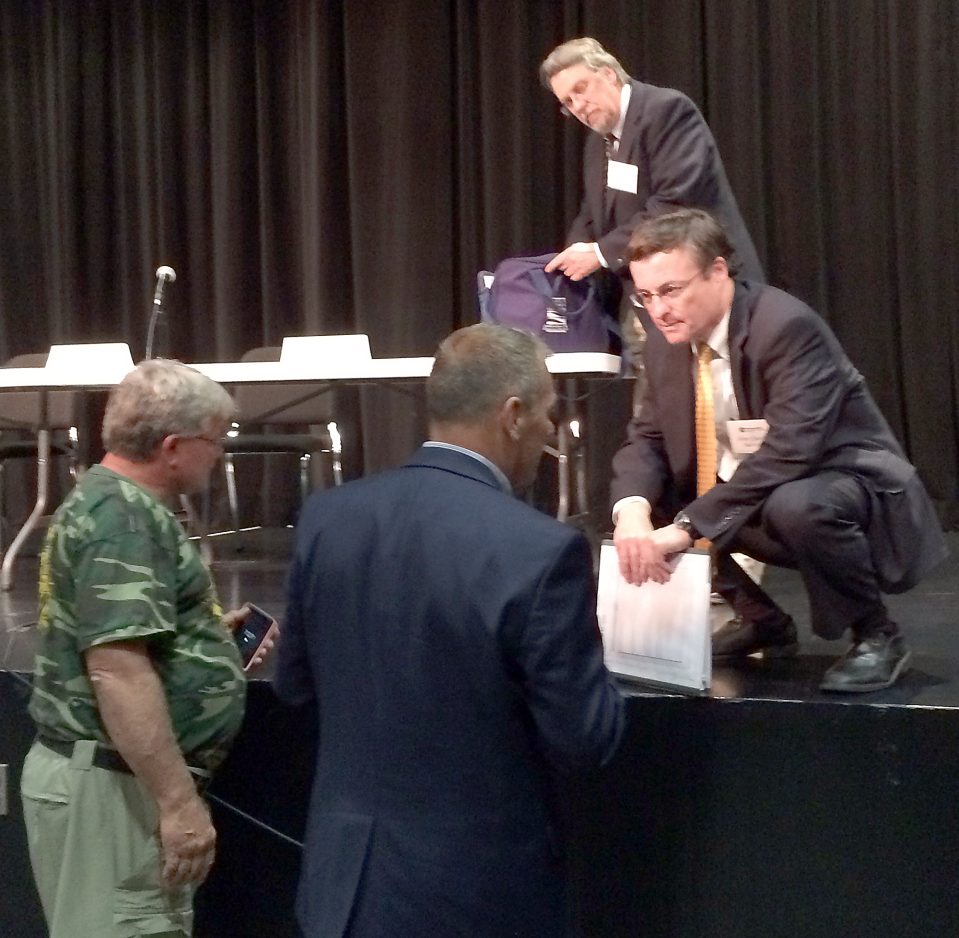
DEP Secretary John Quigley, who chaired the Tuesday’s session, speaks to former miner John Riggi, left and Greene County Commissioner Blair Zimmerman.
WAYNESBURG – Most of those who spoke at a public “listening session” Tuesday on the federal Clean Power Plan urged state Department of Environmental Protection officials not to forget coal in developing the state’s plan to meet the new clean air requirements.
The session, which attracted about 40 people to Waynesburg Central High School, was one of 14 listening sessions DEP is holding before it begins preparing the state’s plan to address new federal rules that regulate carbon dioxide from power plants.
“You can do all the compliance studies and planning you want but the most important thing not to forget is the communities and the industries this affects,” said John Riggi of Jefferson, a former coal miner.
Coal can be burned cleanly, Riggi said, urging the DEP to “slow down and take a good look at these plans” and their impacts before moving forward.
The Clean Power Plan requires each state to develop a plan to meet its specific emission reduction goal and offers a variety of options for reaching its target.
Pennsylvania will be required to reduce its emissions of carbon dioxide, the principal gas contributing to climate change, by 33 percent by 2030 in order to meet its target.
At previous sessions, according to news accounts, many of the speakers supported the new federal regulations. That wasn’t the case at Tuesday’s session held in the heart of the state’s coal industry.
Of the 15 speakers to address DEP, 11 spoke about the need to preserve the coal industry to protect the jobs it provides and the local economy. Three spoke in favor of the plan.
“The coal industry has fed my family as it has thousands of other families here in Greene County,” said Greene County Commissioner Blair Zimmerman, who worked as a coal miner almost 41 years before retiring.
Not enough has been done to make sure coal can be burned cleanly, Zimmerman said.
“Our federal and state governments have spent millions if not billions to develop means of alternative energy, from solar to wind to nuclear power. Where is that investment in our existing fossil fuels,” he asked.
Thelma Szarell, superintendent of West Greene School District, spoke about the importance of the coal industry to her district.
“Our school district has been supported by the coal industry,” she said. “Local taxpayers would be burdened with higher taxes without the contributions of the mining industry to offset the costs.”
Szarell asked DEP to find a solution in developing a plan “that will allow the coal industry to continue to operate and support Western Pennsylvania.”
John Pippy, chief executive officer of the Pennsylvania Coal Alliance, testified the coal industry supports more than 36,000 jobs in Pennsylvania.
Some of those miners are here tonight, he said, ” but all of them are watching the process closely, because if you get it wrong, it will not just be a double-digit increase in their electric bill, but devastating to their family income, way of life and their communities.”
Though the state’s plan is due in September 2016, Pippy asked DEP to seek the two-year extension permitted under the rule to allow time to further consider the rule’s impact on the electrical grid, the economy and electric prices.
One of those who spoke in favor of creating a plan was Veronica Coptis of Carmichaels with the Center for Coalfield Justice.
“For too many years, my friends and family have suffered from serious health impacts from the life cycle of coal,” she said.
The federal plan is only continuing what has been the trend for the last 10 years as electric generators replace old coal-fire electric plants with new cleaner burning plants.
She noted that as part of the plan, federal money is being made available to help those displaced from the coal industry.
“It is time for our community to stop clinging to a dying industry and embrace these new opportunities,” she said.
DEP Secretary John Quigley, who chaired the session, said DEP in developing the plan will consider the interests of many stakeholders includes the energy industry and low-income communities that may be impacted by any proposed changes. The state’s existing energy portfolio, including coal, will be a part of the plan, he said.