

Expert: U.S. approach to terrorism wrong
Armed factions that had hierarchies and leaders with whom one could negotiate were once the primary actors on terrorism’s bloody stage.
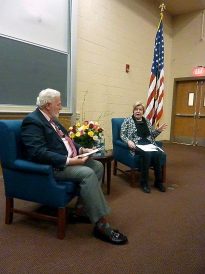
That has changed, according to Mary Montague, an international peace negotiator who is visiting Washington & Jefferson College this week.
Terrorists like the ones who struck in Brussels or San Bernardino, Calif., are freelancers planning their deeds in closely contained cells. They have their own set of grievances, driven by extreme ideologies.
“There’s no structure,” she noted Wednesday during a talk at the college.
Montague was a mediator in the long-running conflict in Northern Ireland, and also worked in trouble spots such as the Balkans, Kosovo, Afghanistan and Sudan.
Rather than being fueled by, say, a desire for statehood, terrorists who have recently been in the headlines have been lured through the Internet or social media and hooked by less concrete, more amorphous goals.
“It’s not as clear cut as it was a generation ago,” she said.
Montague’s visit to W&J is the second she has made in the last six months, having previously visited in November. She will be returning next fall as a scholar-in-residence.
Her talk Wednesday, “The Challenge of Peacemaking and Terrorism in the 21st Century,” was a conversation between her and James Longo, chairman of W&J’s education department.
The co-founder of the nonprofit organization TIDES Training & Consultancy, based in Belfast, Northern Ireland, Montague also pointed out that the way Western nations have responded to terrorism has served mostly to exacerbate the problem. Heavy-handed crackdowns on communities that are perceived to be threatening only serve to bring more recruits into the terrorist fold.
“When a whole society or population has been afraid, they will look for protection,” she said. “And when that protection is a security response, that creates resentments.”
She cited the conflict that ripped apart her homeland for so many years. When British paratroopers shot 26 protesters during a protest in Derry, Northern Ireland, in January 1972, killing 13 of them, it served as a prime recruitment tool for the Irish Republican Army, Montague said.
“The heavy security response is counterproductive to what you’re trying to do, which is change behavior patterns,” she said.
As a result of her work as an international peace broker, Montague won awards last year from the Schwelle Foundation in Bremen, Germany, and Mediators Beyond Borders International, based outside Washington, D.C. She was invited to Washington & Jefferson College by faculty and associates in the education department and conflict and resolution studies program.
Her thoughts on how to take the oxygen out of terrorism? “Build relationships,” she said.
“We can only build peace by starting with ourselves.”