

Paying for bad air? Groups question subsidies for Monessen coke plant
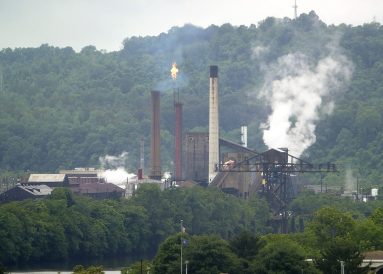
In 1986, when the Monessen mill where he’d been working was shuttered, steelworker Emory Terensky started making a 135-mile round trip for a job in Ohio because he doubted he’d find a job in his hometown with good pay and the same benefits that the industry offered.
Like the rest of the Mon Valley, the city hasn’t recovered from that industry’s collapse.
“There’s so much dope in this town because there’s no jobs,” said Terensky, 66, now retired.
“If there’s no jobs, you’re going to do what you have to do.”
Now, one of the main employers is the ArcelorMittal coke plant, where operations have drawn dozens of notices of emissions violations from environmental regulators since the Luxembourg-based company resumed production there in 2014.
The spate of violations leads some to question whether the state should have given hundreds of thousands of dollars in taxpayer-funded subsidies to the world’s largest steel producer before it fired the plant back up.
“It just doesn’t make any sense for public money to be used for projects that deteriorate the environmental quality in the community,” said Philip Mattera, research director for the watchdog group Good Jobs First in Washington, D.C.
ArcelorMittal spokesman Bill Steers said the company is working with state and federal environmental regulators to “address notices of violation issued by both agencies against our Monessen coke plant.”
“Numerous improvements made at the facility over the last several months have resulted in improved environmental performance; our goal is to achieve and maintain full compliance,” he said in an email.
Steers said the plant employs 179 people.
ArcelorMittal restarted it in 2014 after it had been on “hot idle” since 2009.
State environmental regulators have proposed a $780,100 fine for violations at the facility from April 2014 to May 2015. Department of Environmental Protection spokesman John Poister said the investigation is ongoing and “that number is likely to change.” No fine has been proposed yet for violations that occurred later, he said.
As the plant drew rebukes from environmental regulators, ArcelorMittal held onto $840,000 in tax credits and grant money it received through a Department of Community and Economic Development program before production resumed at the coke plant.
“DCED evaluates any potential concerns or violations prior to offering a funding proposal,” agency spokeswoman Heidi Havens said in an email. “The monitoring for this project was conducted prior to any pending DEP findings.”
In 2012, ArcelorMittal received $339,000 in state job-creation tax credits and a $350,000 grant. The company agreed to create 113 new full-time jobs at the Monessen plant within three years. It said it would retain another 67 existing employees at the plant and 1,834 employees statewide, Havens said.
She said DCED clawed back all the tax credits and $8,965 of the grant when the agency determined the company added 111 news jobs and didn’t retain as many employees as it had promised.
“The recouped funds were based on the failure of the company to meet with the obligations on the agreement with DCED, not due to any DEP findings,” she said.
ArcelorMittal received another $500,000 in tax credits in 2014 through an incentive program for private companies that rehabilitate or improve a building in an enterprise zone – a state designation for certain areas within distressed communities.
In the two years since, residents and an advocacy group have raised concerns about emissions from the restarted plant.
Two neighbors of the plant – from Donora and Monessen – filed a class-action lawsuit in federal court last year, accusing the plant of releasing particulate matter onto their properties and emanating noxious smells.
A proposed settlement negotiated between the sides in the case would require the company to spend $450,000 on environmental improvements and pay $452,500 – with up to $252,500 deducted to cover the plaintiffs’ attorney and court costs – that would be distributed to residents within 1 1/2 miles of the plant.
Not all locals share the complaints outlined in the class-action lawsuit. Terensky said he’ll return his check if he gets one in the settlement.
“I’ve been in filthy coke plants,” he said. “Monessen is like a paradise compared to those other places.”
The group PennEnvironment filed a citizen suit against ArcelorMittal in federal court last year, seeking a court order requiring the plant to comply with the Clean Air Act and pay civil penalties for previous violations.
That case has been stayed until Sept. 1 to allow the parties to negotiate, according to court records.
Told about the tax credits and grant money that went to ArcelorMittal while it prepared to resume operations at the plant, PennEnvironment executive director David Masur said, “It should never pay to pollute. The residents of the commonwealth, local residents, want companies to comply.”
Reform types often question subsidies that go to large companies like ArcelorMittal, which reported $63.6 billion in revenue last year.
“The largest steel company in the world – why do they need the tax dollars of the average working Pennsylvanian who’s scraping to get by?” Masur said.
Even though the company looks like a multibillion corporation on paper, Steers said ArcelorMittal’s business is “capital intensive.”
“Our operations must be cost-competitive to ensure their viability,” he said. “Tax credits and economic development grants provide meaningful incentives on where and when to invest in our operations.”
Joe Kirk, former director of the Mon Valley Progress Council, which consolidated with another nonprofit this year to form the Mon Valley Alliance, said that “from the standpoint of a practitioner, there are many times that we wish we had more incentives.”
The progress council helped ArcelorMittal secure the enterprise zone tax credits in 2014.
“The reality is that Pennsylvania competes with states for the locations of companies,” Kirk said.
Mattera has been critical of governing bodies’ attempts to outdo each other in offering companies incentives.
“In many cases, the competition between communities or between states gets out of hand, and you end up with a race to the bottom,” he said.