

Looking to balance the scales
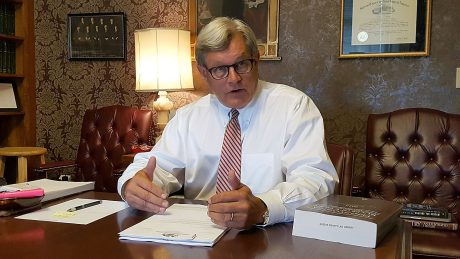
WAYNESBURG – Greene County President Judge Farley Toothman is asking for feedback over whether he should request the state judiciary to realign the county’s three magisterial districts, despite crime statistics showing an even caseload over the past three years.
Toothman said Monday District Judge Glenn Bates approached him in early 2015 requesting some of the former municipalities along the Interstate 79 corridor be returned to his district.
The three magisterial districts were realigned in 2013 following the most recent census, and Washington, Whiteley and Perry townships were moved out of Bates’ area and into the jurisdiction of former magistrate Lou Dayich’s office.
The changes were needed after statistics showed Bates with a larger caseload than the other two offices, especially from traffic citations from speeders on I-79.
Bates, who could not be reached for comment Monday afternoon, wrote in a letter dated July 5 it was his opinion that Washington and Whiteley townships should be returned to his jurisdiction.
“I believe this would more evenly balance the workload in the county,” Bates wrote.
However, that workload between the three districts is nearly identical with each averaging around 2,400 cases a year. The three magisterial districts are presided over by Bates, who oversees Franklin Township and the northeastern part of the county, Senior District Judge Jesse Cramer, who is in Waynesburg and the western part of the county, and District Judge Lee Watson, who oversees the eastern municipalities.
“There are other things beyond those numbers that impact the weight of the decision,” Toothman said.
Cramer, who replaced Dayich earlier this year and will leave the seat at the end of next year, wrote the president judge on July 13 saying he thought the districts were perfectly aligned and should not be changed.
But there are multiple factors in the decision, Toothman said, including where the boundaries fall along the I-79 corridor and how far state police must drive to file traffic citations.
Sgt. Steve Dowlin, commander of the state police barracks near Waynesburg, said he has no preference on where the lines are drawn or which office they must visit to handle traffic citations from the interstate.
“It doesn’t make a difference to the state police in regards to where the jurisdictional boundaries are for the district judges,” Dowlin said. “We’re at all three magistrates regardless.”
The realigning of the district could have political ramifications next year when voters choose a replacement for Cramer. Only someone who lives in the district can run for the six-year term, meaning residents in Washington and Whiteley townships would be prohibited from running for that seat if the map is redrawn.
“We’re in a position now to study these statistics,” Toothman said. “That’s why I need to take in from the public comment. Does anyone care?”
The president judge announced Monday he will hold public hearings in his courtroom at the Greene County Courthouse Aug. 31 at 1 p.m. and Sept. 8 at 7 p.m. The meetings will offer the public, along with police officers and government officials, the chance to offer thoughts on potential changes.
“Let’s see what the public says on the issue,” Toothman said of the reasons for the hearings. “I think the issue needs to be put to bed before the next census.”
Toothman said he will make a final decision before the end of September on whether to petition the state Administrative Office of Pennsylvania Courts. If he does decide to petition the AOPC for a change, the file will be reviewed by that staff in Harrisburg and a final ruling will be made by the state Supreme Court.
Art Heinz, a spokesman for the AOPC in Harrisburg, said any request to redrawn districts must come from the county’s president judge. He said it’s not unusual for counties to request changes, pointing to Delaware County this year and three other counties in 2015. The state Supreme Court makes the final ruling on the matter and hands down an order to the lower courts.
“Each case is different,” Heinz said. “A request might be submitted and then could be sent back asking for more detailed information. Others might be more straight-forward that dictates a change.”
Regardless of what happens, Toothman was adamant that neither he nor the AOPC intends to remove a magisterial district from the county.
“How far would people have to travel (to the magisterial court)?” Toothman said.