

DEP reports latest emissions data from unconventional gas drilling
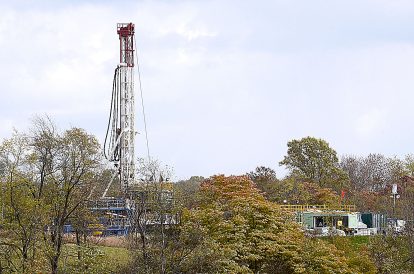
The latest inventory of air emissions from unconventional natural gas operations has found increases in several categories of contaminants, according to data released by the state Department of Environmental Protection.
The inventory, released Wednesday, represents 2014 emissions from Marcellus Shale natural gas production and processing operations as well as compressor stations that receive gas from coal gas, conventional and unconventional well sites.
The industry is required to report air emissions to the DEP under the state’s Air Pollution Control Act.
“As pipeline infrastructure and natural gas production continues to grow in Pennsylvania, it is increasingly important that we ensure that natural gas stays in those pipelines and other facilities and isn’t leaking into our communities,” said DEP Acting Secretary Patrick McDonnell in announcing the latest report.
“With universal adoption of best practices that many companies are already using, we expect leaks to go down even as production goes up.”
According to DEP’s “2015 Annual Oil and Gas Report,” released two weeks ago, production from unconventional gas wells grew significantly, from 3.1 trillion cubic feet of gas to 4.1 tcf.
McDonnell noted the types and number of gas-related facilities from which the agency collects data has grown since its first inventory in 2011.
The number of midstream facilities that submitted data in 2014 increased by 12 percent from 2013, from 447 to 508, while the number of well sites reporting dropped 2.7 percent – from 10,275 in 2013 to 10,009 in 2014.
From 2013 to 2014, there was an increase from unconventional natural gas operations of nitrogen oxides (18 percent), fine particulate matter (25 percent), sulfur dioxide (40 percent), volatile organic compounds (25 percent), methane (1 percent) and carbon monoxide (19 percent).
According to supplemental data provided by DEP, counties with higher amounts of gas production and related activities, such as Washington, Greene, Susquehanna, Lycoming and Bradford, showed higher amounts of contaminants from the air emissions reported.
DEP noted however that the emissions reported by the natural gas industry represent “only a fraction” of all emissions from all industries in Pennsylvania.
“Although the reported emissions from the natural gas sector increased in 2014, overall our air quality continues to improve due to emissions reductions from other point sources such as electric generating units,” McDonnell said.
“Between 2011 and 2014, Nitrogen Oxides and Sulfur Dioxide emissions from electric generating units have decreased by 18 percent (27,246 tons per year) and 17 percent (54,973 tons per year), respectively.”
“We remain committed to developing and implementing the most effective ways to control and reduce emissions from Pennsylvania’s natural gas sites,” McDonnell said.
In 2014, there was a slight (1 percent) increase in reported methane emissions, a highly potent greenhouse gas that contributes to climate change. In January, Gov. Tom Wolf announced an ambitious strategy to reduce emissions of methane from natural gas well sites, processing facilities, compressor stations and along pipelines through state-of-the-art leak-detection programs, improved operational practices and updated permitting requirements.
DEP began collecting emissions data from owners and operators of unconventional natural gas sources in 2011. A year later, the agency expanded the data-reporting requirement to include midstream compressor stations that support the conventional natural gas industry. It again expanded the reporting requirements in 2013 to include data from midstream compressor stations that support coalbed methane formations.
In addition to compressor stations, other sources of natural gas operations that DEP identified as part of the inventory include dehydration units; drill rigs; fugitive emission sources such as connectors, flanges, pump lines, pump seals and valves; heaters; pneumatic controllers and pumps; stationary engines; tanks, pressurized vessels and impoundments; venting and blow-down systems; well heads and well completions.
David Spigelmyer, president of the Marcellus Shale Coalition said the latest data “once again confirms that Pennsylvania’s air quality is making extraordinary gains, with sulfur dioxide and nitrogen oxide emissions (at electric plants) – which contribute to acid rain and aggravate asthma – down more than 17 percent over the past three years.
“This positive and shared environmental progress further underscores the fact that additional, burdensome regulations are unnecessary as Pennsylvania’s natural gas operators are focused on working with regulators and stakeholders alike to protect and enhance our environment.”
Aaron Jacobs-Smith, coordinating attorney for the Clean Air Council in Philadelphia, said he has “some degree of skepticism” that the data reported is an accurate picture of how much air pollution is released from the gas operations.
According to Jacobs-Smith, the accuracy of the data depends on whether it was done by a “flyover,” which looks at sites from above, or whether data was collected by direct measurements.
“When they sample the air” the readings are more accurate, he said.
While noting the 1 percent increase in methane emission appears to be minimal, Jacobs-Smith said his organization is waiting to see how Gov. Tom Wolf’s call to reduce methane leaks from gas sites, a program being implemented this year, will play out.
“We’re glad they’re taking these steps,” he said.