

Pterosaur revival at Carnegie Museum
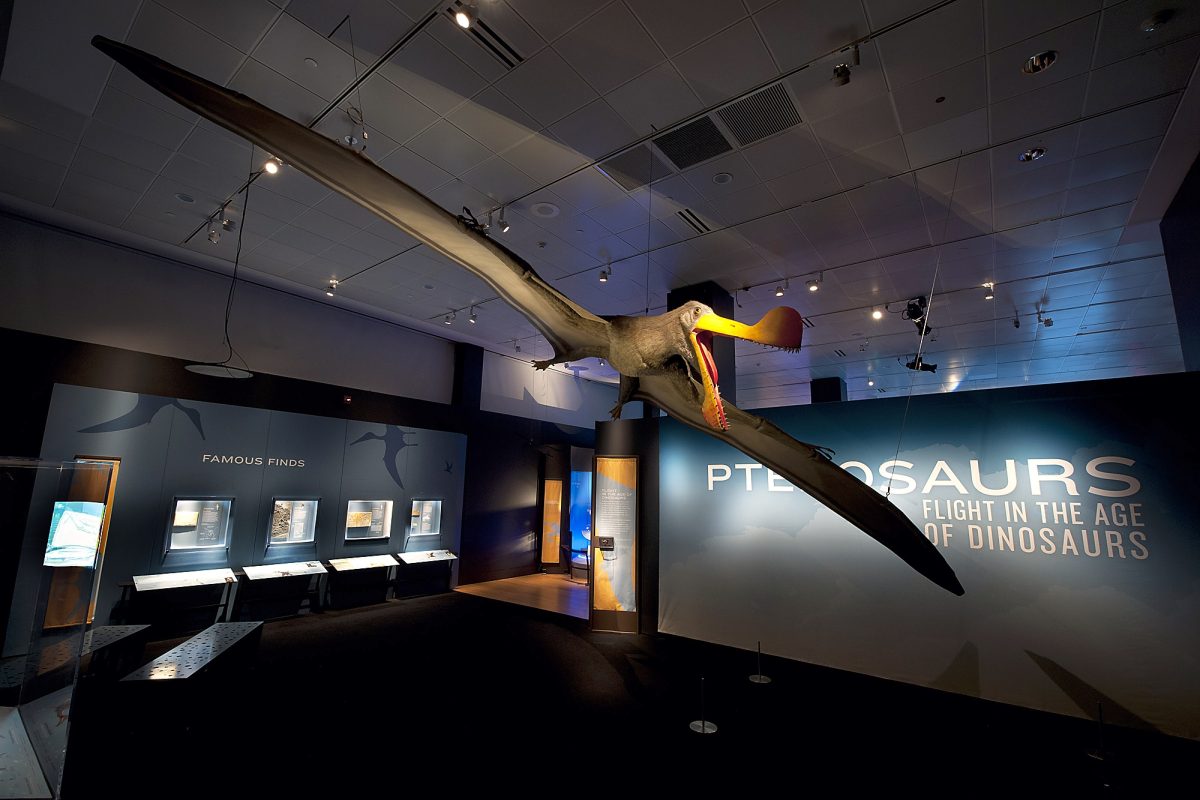
The colossal Tropeognathus mesembrinus model, with a wingspan of more than 25 feet, soars overhead at the entrance to the Pterosaurs: Flight in the Age of Dinosaurs exhibition.
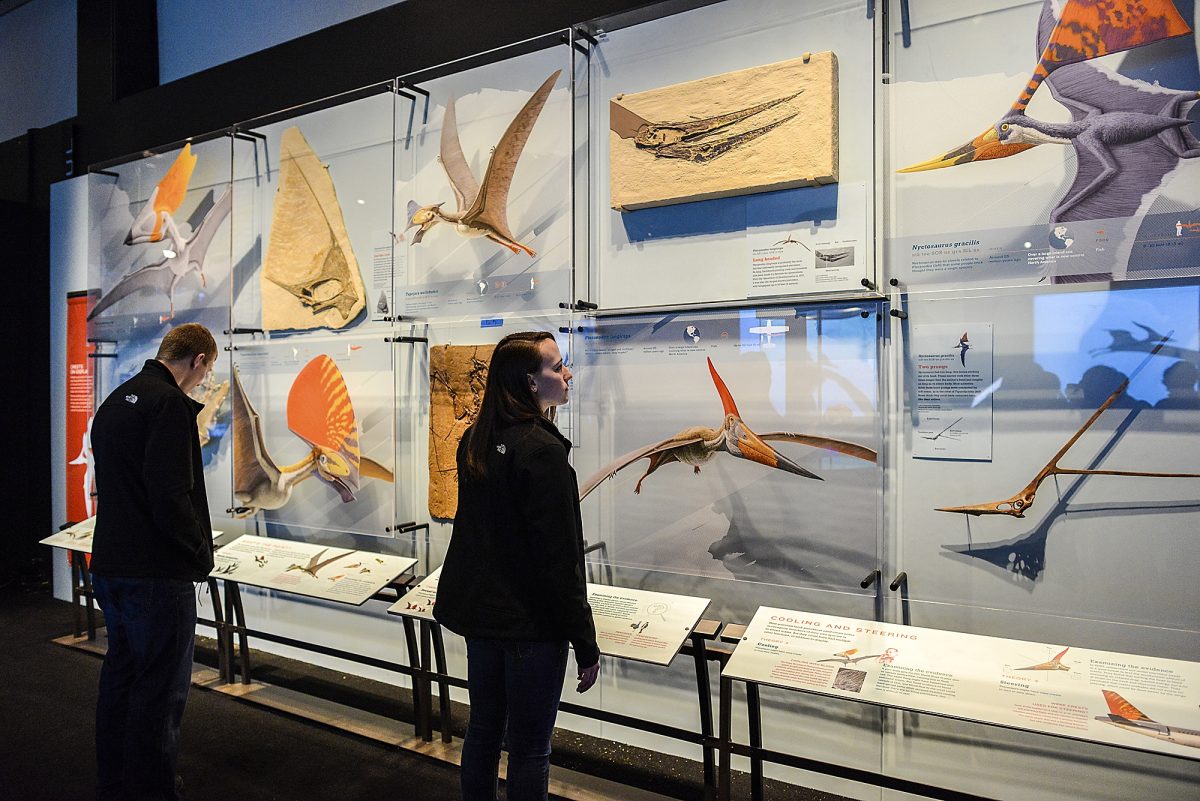
A gallery display illustrates the incredible variety of pterosaur crests – from a dagger-shaped blade that juts from the head to a giant, sail-like extension.
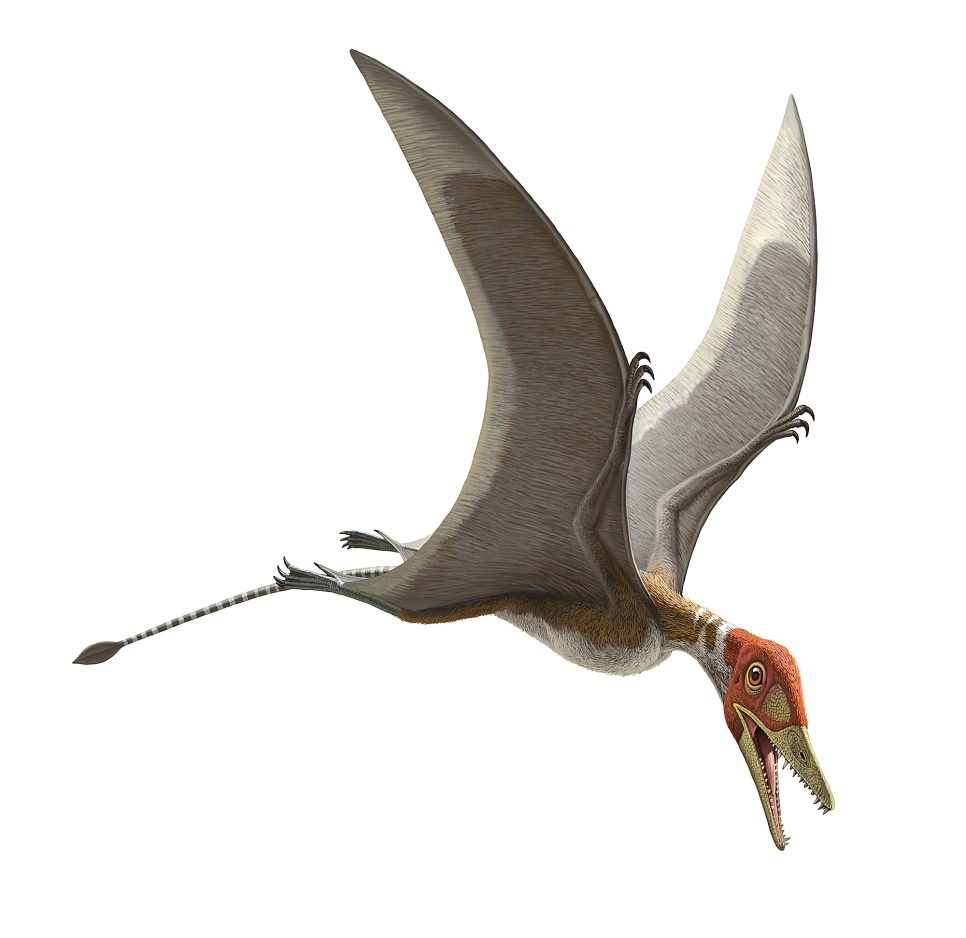
One of the oldest known pterosaurs, this species lived around 220 million years ago near an inland sea in what is now northern Italy. Like many early pterosaurs, Preondactylus buffarinii had relatively short wings (wingspan of 18 inches), long legs and a very long tail.
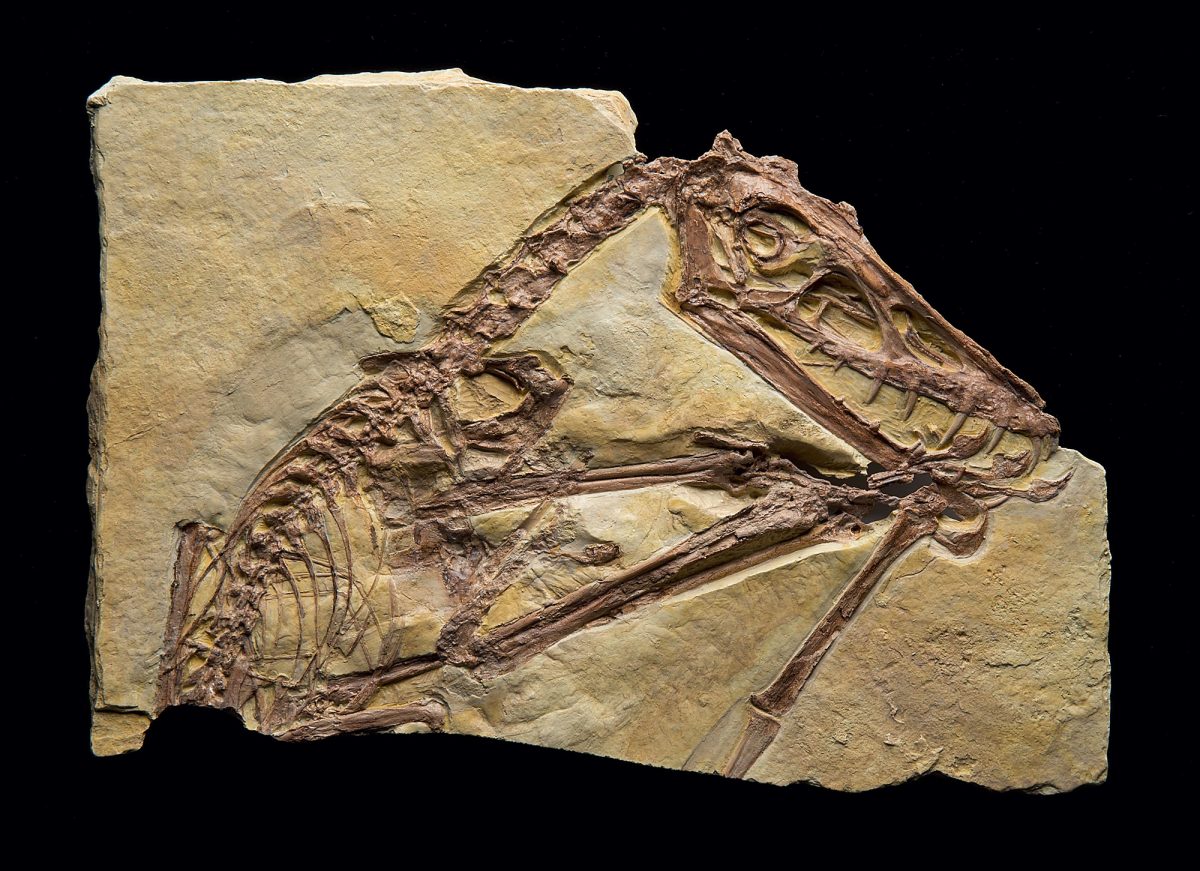
Scaphognathus was a pterosaur that lived in what is now Germany during the Late Jurassic about 150 million years ago. This fossil preserves an incomplete adult with a 3-foot wingspan and was recovered from the Solnhofen strata near Eichstätt, Germany.
PITTSBURGH – Pterosaurs had a good run.
They were on the scene for about 150 million years, gliding across the Earth’s skies for millenia after millenia. The first animals with a backbone to fly under their own power, they had streamlined bodies, narrow jaws and long forelimbs. There was also a great deal of variety within the pterosaur family, with more than 150 different species being discovered in excavations around the world over the last 200 years.
Pronounced “tear-o-soar” – the “p” is silent – these creatures looked like a cross between a bat and a flamingo, but were not birds, were not bats and were not even dinosaurs, even though they met their end at the same time as dinosaurs. They can most readily be classified as “flying lizards.”
More than 60 million years after the last pterosaur crashed to earth, they are undergoing a revival at the Carnegie Museum of Natural History in Pittsburgh through the exhibit Pterosaurs: Flight in the Age of Dinosaurs, which opened Saturday and will be there through May 22. Created by the American Museum of Natural History in New York, it features an array of fossils, interactive exhibits, videos and lifesize models of what pterosaurs probably looked like.
According to Michael Habib, a paleontologist with the University of Southern California who was involved in assembling the exhibit, pterosaurs “flew with their fingers, walked on their wings, and had a vast range of sizes.” Habib and other paleontologists believe that some were as large as an airplane, “and others could fit in the palm of your hand.”
“They were the kings of the air,” he added.
The first pterosaur fossils were uncovered in the late 1700s as part of a motherlode of fossils disovered in limestone near the town of Eichstatt in southern Germany. Unable to place the pterosaur, it was initially believed to be an aquatic creature. But paleontologists have since been able to discern much more detail – they were colorful, they nibbled on fish and insects, were likely warm-blooded and mostly made their homes along shorelines.
But, even though a great deal is known about pterosaurs, “there’s still plenty of controversy surrounding pterosaurs, and we still don’t know a lot of things,” Habib said. “We still have heated debates about things.”
Experts are still hashing over how pterosaurs raised their young, mated and ate.
Those debates can either be clarified or fueled by a pterosaur fossil known as “Dark Wing” that was uncovered in Germany in 2001, and is perhaps the best preserved and most detailed of all the pterosaur fossils out there. It features preserved wing membranes and long fibers that extended from the front to back of the wings, which are thought to have stabilized them. The fossil is being shown for the first time outside Germany in the exhibit.
Also included in Pterosaurs: Flight in the Age of Dinosuars are inspection scopes that allow visitors to compare pterosaur bones with those of dinosaurs, and an interactive exhibit with motion-sensing technology that enables visitors to “fly” a pterosaur over a landscape.
For additional information call 412-622-3131 or go online to www.carnegiemnh.org.