

Panel sees massive changes, investment for power grid
Editor’s note: This story has changed from a previous print version to add clarity to sources of some figures presented.
Dianne Anderson’s Nest thermostat lets her remotely change the temperature of her Morgantown, W.Va., condo whenever she wants, keeping the unit at 55 degrees when she’s away until she tells it to increase the temperature to 68 degrees when she’s on her way home.
But Anderson, an energy consultant and former executive with BP for 25 years, wonders what would happen on the aging U.S. power grid if all 225 million electric customers across America migrated to Nest-style remotely programmable thermostats. Would the system be able to handle hundreds of millions of customers changing their thermostats an infinite number of times during the day or night?
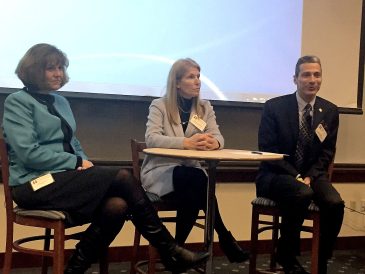
Anderson’s observation was one of several thought-provoking examples made Wednesday during the third of four installments of the “Grid Academy” presented by Washington & Jefferson College’s Energy Lecture Series in the Howard Burnett Center.
The 90-minute presentation was delivered by Anderson, Maria Hanley, an energy industry analyst in the Office of Electric Reliability of the Federal Energy Regulatory Commission, and Greg Reed, director of the Center for Energy, the Electric Power Initiative and the Electric Power System Lab at the University of Pittsburgh, where he is a professor of electrical engineering in Swanson School of Engineering.
The trio’s observations on the rapid technological changes and their impact on the century-old grid and its accompanying regulatory system were the essence of Wednesday’s session titled “Managing Uncertainty: The New Economics of the Power Industry.”
One of the most salient points came from Hanley, who noted that the creation of the power grid more than 100 years ago propelled the U.S. ahead of the rest of the world with its ability to provide homes, offices, shops and industries with instant access to reliable electricity.
“The grid has been named one of the greatest engineering marvels of the 20th century,” she said of the original system that was naturally monopolistic, but seen as providing an essential service for the common good of the public.
But in the 21st century, she quickly added, changing and growing consumer demand, as well as a movement away from coal as the primary fuel source to a mix of everything from natural gas, to solar, wind, hydro and nuclear, are ushering in the biggest change in the history of the venerated system.
As one of Hanley’s slides stated, “Changing Resources + Changing Users = A New Business Model.”
But arriving at a new business model is fraught with challenges, from both a regulatory and technological standpoint, the speakers agreed.
Reed, who provided a brief history of the grid, which developed rapidly after George Westinghouse and NikolaTesla’s alternating current model won a hard-fought battle with Thomas Edison’s direct current design, charted the accompanying regulatory changes that were adopted to keep up with the rapidly growing grid.
As power systems grew – by the 1920s, most cities had electricity – there was still limited federal regulation of multi-state utilities. That brought about the creation of the Federal Power Commission in 1930. By 1935, President Franklin Roosevelt signed the Rural Electrification Act to extend electricity to rural areas.
From 1930 to the early 1970s, Reed noted, the electricity business grew rapidly, in line with new applications for homes and businesses.
However, the energy crisis of the 1970s halted four decades of steady expansion in the power industry, bringing in a quarter century of under-investment in technology and infrastructure.
The stagnation of investments opened the door for deregulation in the late 1980s and early 1990s, making the grid a healthy sector for investment, which is necessary for the future.
The changes have continued, and include the passage of the Energy Independence and Security Act of 2007, which included incentives to encourage development and production of electric driving technologies, established stricter efficiency standards for numerous appliances, expanded research programs for carbon capture and storage technologies, and encouraged deployment of smart-grid technologies.
The Environmental Protection Agency’s 2015 proposed Clean Power Plan would step up the trend toward lower carbon fuels generation.
In some ways, rapid efficiency improvements in the collection and delivery of renewables are occurring even faster than some projections by the U.S. Department of Energy.
Anderson noted the cost of solar energy has declined by more than half since 2009.
Hanley said that initiatives to conserve, as well as the increasing numbers of people who install solar panels, raise some key challenges to make improvements to the grid.
“As you conserve, you’re not selling as much” power, she said. “Consumers are not just consumers anymore, they’re now becoming producers.” That development raises the question of who will be responsible for reliability, long a hallmark of the grid.
One of the most popular slides of the evening came from Hanley’s presentation, which depicted a man juggling three chain saws under the title, “What today looks like for regulators.”
And while Reed believes regulatory agencies will adapt to keep up with the changing grid, Anderson said the most recent long-term projections from BP on global electricity demands for 2020 to 2035 show the need for massive investment to the grid here and elsewhere. She said energy expert and author Daniel Yergin stated that 10 percent of total capital investment in the United States is now being spent on electricity and its infrastructure. She added that a 1998 article by a San Francisco newspaper projected that $10 trillion will be spent worldwide on the electricity business through 2035.
“The world needs a lot more energy,” she said.
And it’s not just traditional utilities doing the investing.
Anderson noted Google purchased Nest and also had itself registered as a utility.
“They could have purchased Nest to make a profit, but they could have purchased it so they could study the market,” she said.