

Meadowcroft commemorates Independence Day

Retired Mt. Lebanon School District teacher Gary Ford recites the Declaration of Independence during an impassioned reading at Fairview Church in Avella.

Gary Ford of Meadowcroft Rockshelter and Historic Village explains how a typical school day went for children of farmers inside the Miller School Sunday.

Maria Villotti sweeps the Miller House, built around 1800, which housed eight family members on two floors.
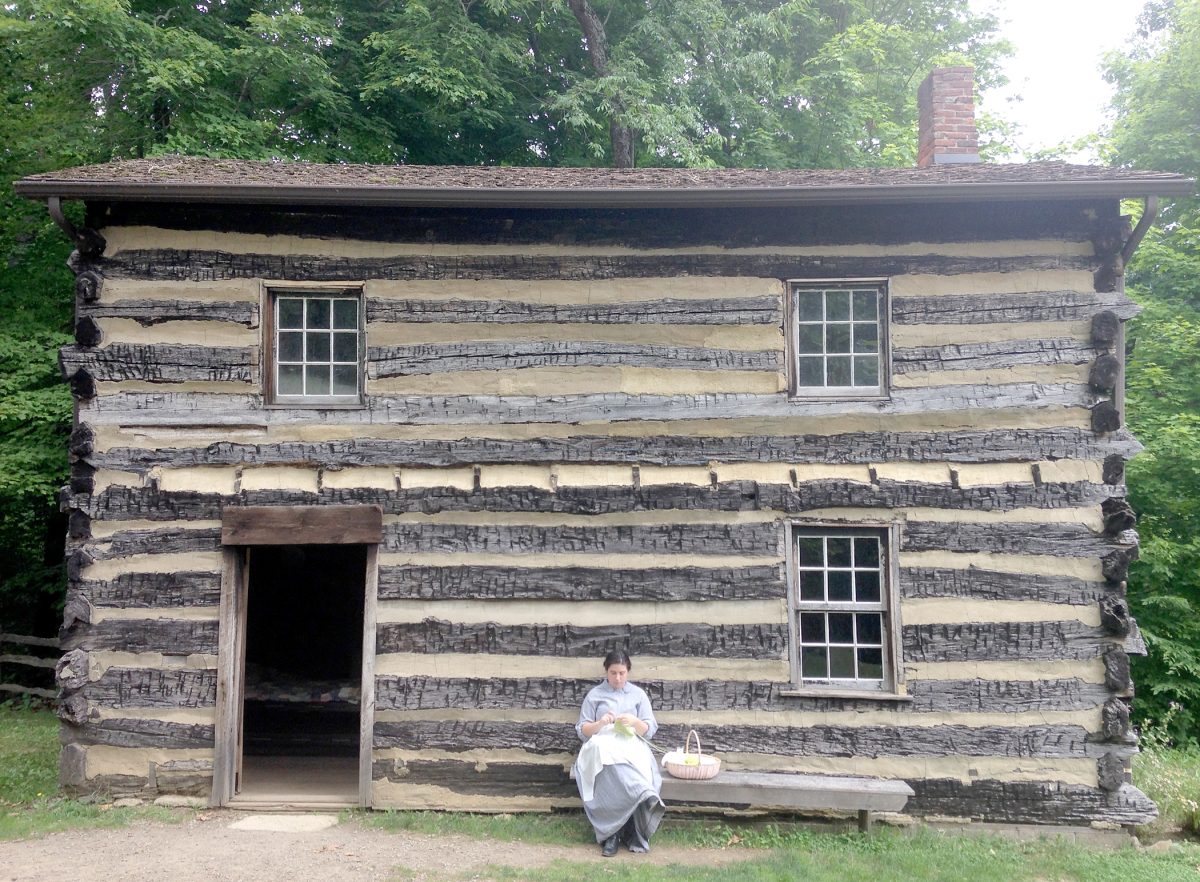
Maria Villotti crochets outside the Miller House.
AVELLA – Today marks the 240th anniversary of America’s “Brexit.”
The “real” Independence Day, which John Adams envisioned the newly born country celebrating as Anniversary Day, was July 2, 1776, when the Second Continental Congress voted to break away from Britain. But the final version of the Declaration of Independence wasn’t read and ratified before Congress until July 4. This and other misunderstandings about America’s birthday were clarified Sunday by Meadowcroft Rockshelter and Historic Village guides as part of the historical museum’s celebration of Independence Day.
Tour guide Gary Ford, a retired teacher from Mt. Lebanon School District, gave an impassioned recitation of the Declaration of Independence, the catalyst document that set into motion the Revolutionary War. Ford slammed the podium inside Fairview Southern Church at times to accentuate the document’s words as philosophical poetry. He recited the founders felt after a long train of abuses “it is their right, and their duty,” banging his fist to the words, “to throw off such Government, and to provide new Guards for their future security.”
Following that clause in the Declaration comes a long list of abuses attributed to the King of England and the country’s rule over the colonial states. Some of the document’s language shows the hypocritical peculiarities of a people asserting control over life, liberty and happiness, but scrapping language submitted by Thomas Jefferson – a slave owner himself – to abolish the ownership of slaves in America. Such clauses include accusing King George III of having “excited domestic insurrections … (by) the merciless Indian Savages …”
Some of the culture of the indigenous Monongahela tribes from 1570 are preserved at Meadowcroft. Most theories about the tribes’ culture are drawn from archaeology and not documents like the contemporary ancestors of colonial settlers, and thus distilled through a historical lens without written language or recorded events.
After the Declaration lays out its case, saying “these truths to be self-evident,” it formally announces its separation from England in its final sentences. “… by Authority of the good People of these Colonies, solemnly publish and declare, That these United Colonies are, and of Right ought to be Free and Independent States; that they are Absolved from all Allegiance to the British Crown … and that as Free and Independent States, they have full Power to levy War, conclude Peace, contract Alliances, establish Commerce, and to do all other Acts and Things which Independent States may of right do.”
Much like the politically contentious “Brexit,” in which Britain voted to absolve itself from the European Union, the newly born country of the United States was mainly interested in its own economy represented by its own interests. And like the blistery modern-day separation, the signers of the document signaled in its final sentence a fight was likely to be brought upon them once Britain received word of America’s intent to separate from the country’s rule. The signers inked the document, its final message that “… we mutually pledge to each other our Lives, our Fortunes and our sacred Honor,” a not-so-subtle promise that the newly minted capitalist economy was worth fighting and dying to maintain.
General George Washington and his untrained army received word July 9 in Manhattan, N.Y., the States were considered free. That meant the fight they were preparing for against the British wasn’t merely about fighting for the colonies’ people and their well being, but their freedom as independents from Britain.
The country’s legacy set into motion by Thomas Jefferson and John Adams would have historical irony on July 4, 1826, as each man – former friends, compatriots and U.S. presidents who saw their philosophical differences turn them into bitter rivals – would die. Adams, at 90, said his last words, “Thomas Jefferson still survives,” but he was mistaken. Jefferson died about five hours earlier at Monticello at the age of 82. A further irony between the two is they essentially disobeyed the Declaration’s language calling for America to see Britain and other countries not allied with the United States as “Enemies in War, in Peace Friends.” Adams and Jefferson were mutual collaborators and allies in war, but when the peace came they fought so hard for, they had become bitter enemies.