

The soul of the department Chief Patrick Curran’s life of service, sorrow
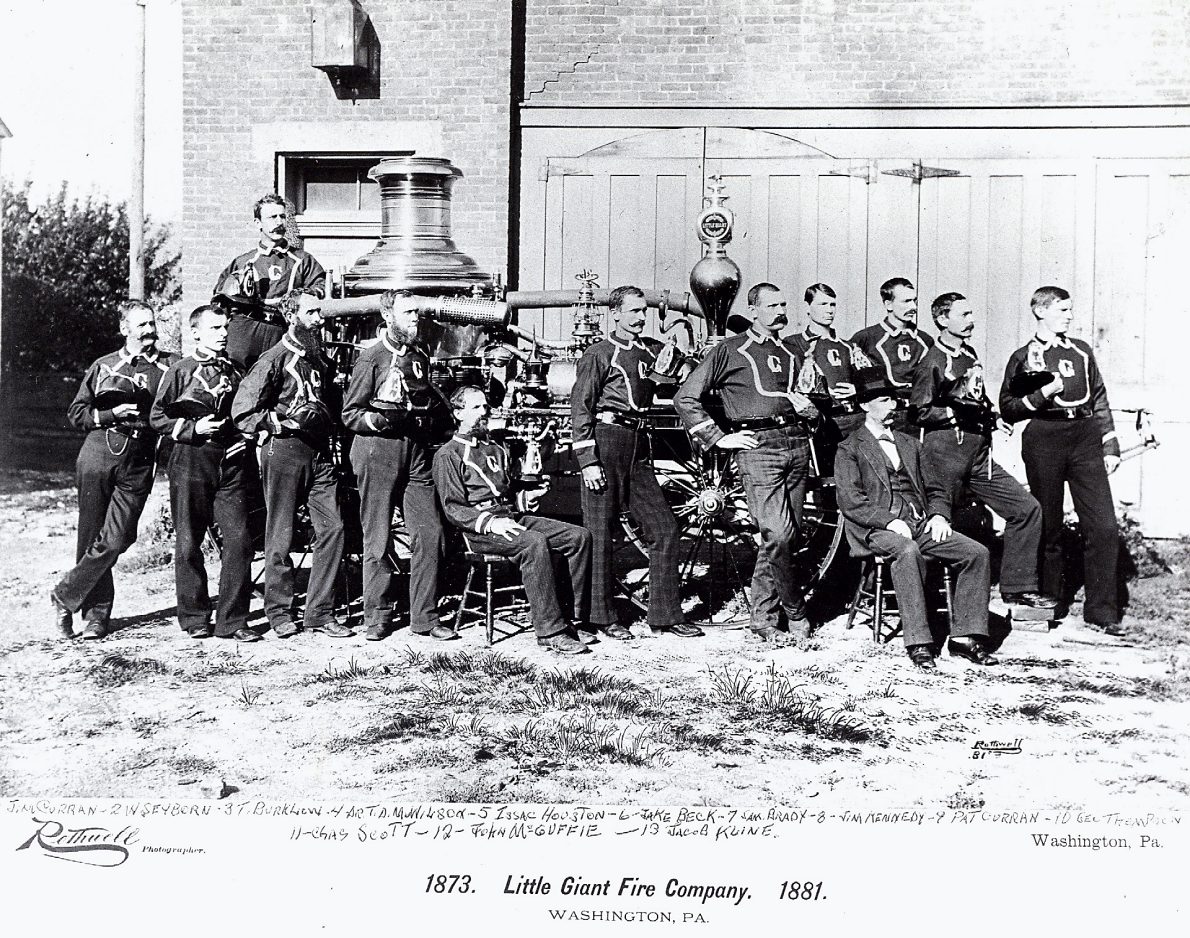
The Little Giant Fire Company in 1881 included Patrick Curran, who is the fourth man standing from the right.
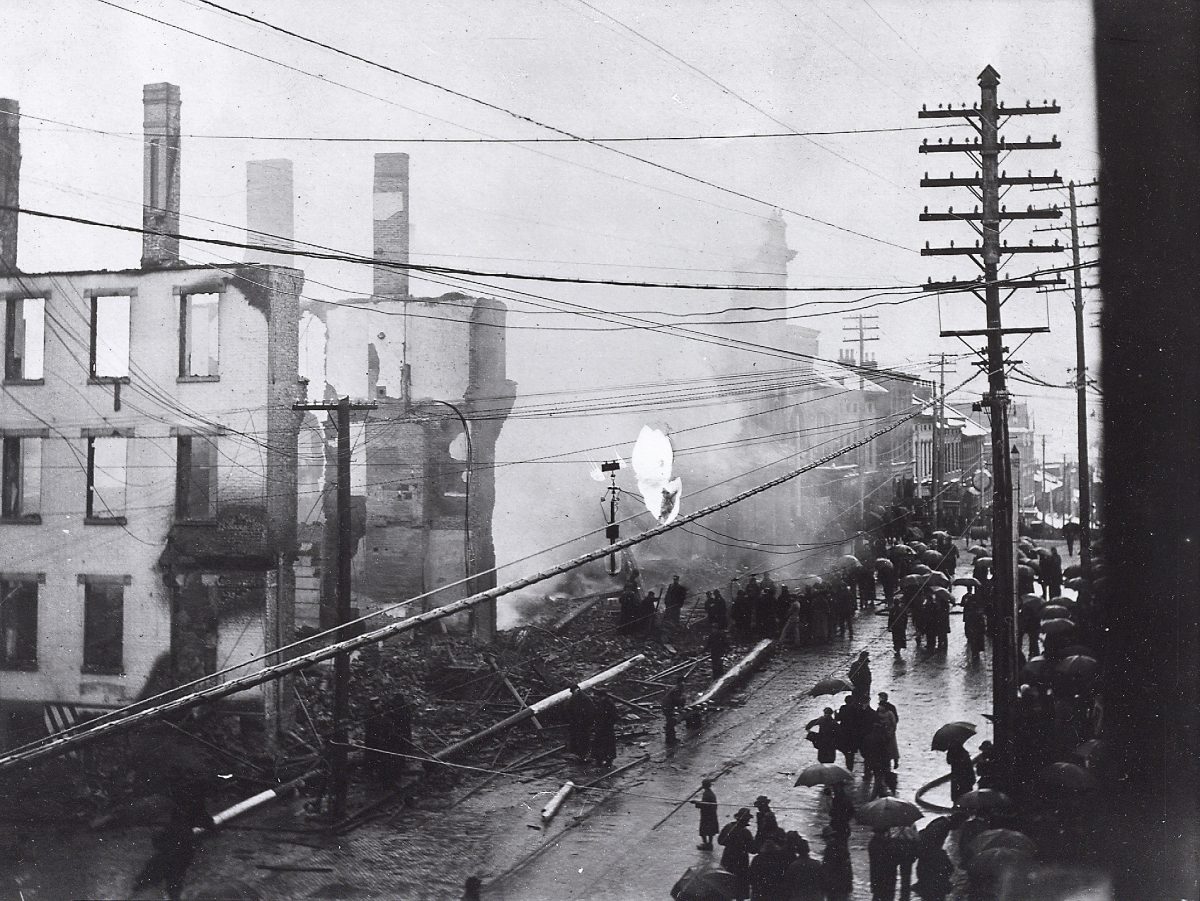
Patrick Curran was a member of the Little Giant Fire Company when it fought the fire that destroyed the Hotel Main and adjoining Levino block on Jan. 6, 1899.
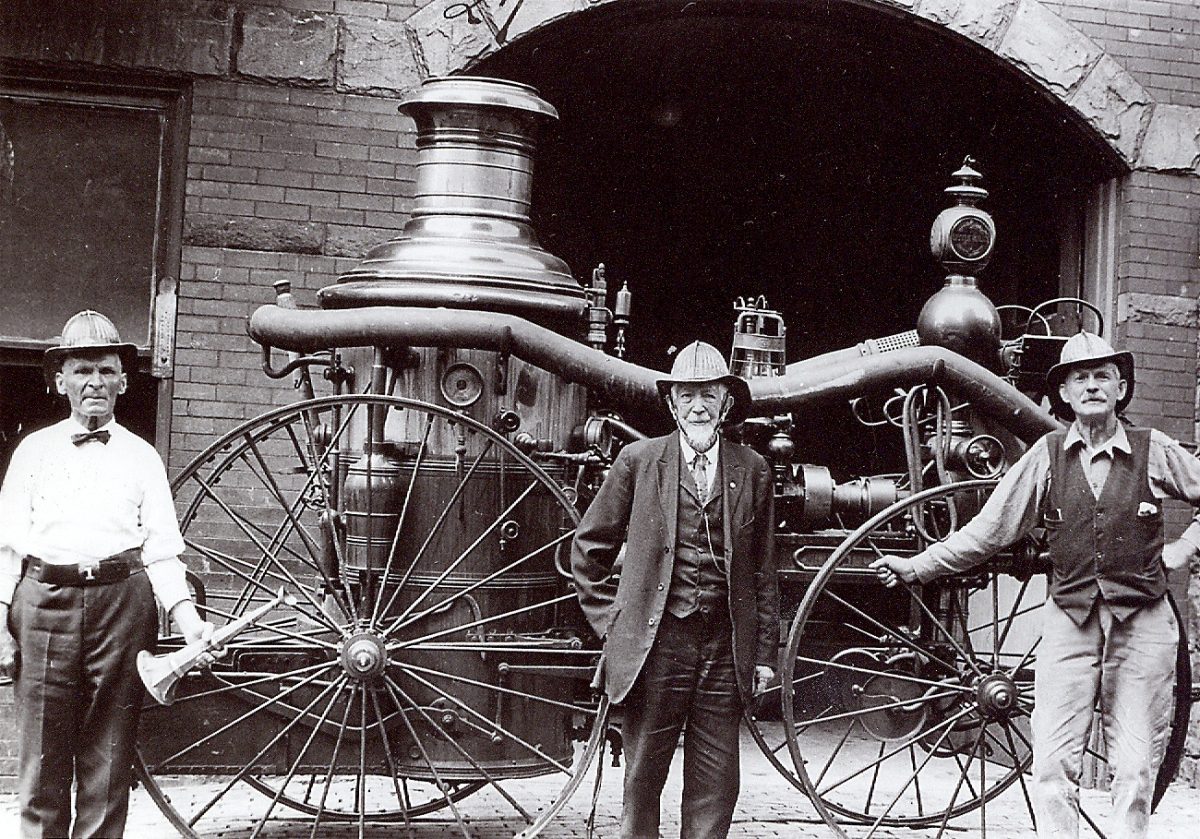
Chief Patrick Curran, left, James Harter and James Curran stand with the Little Giant in about 1915, after the engine’s retirement.
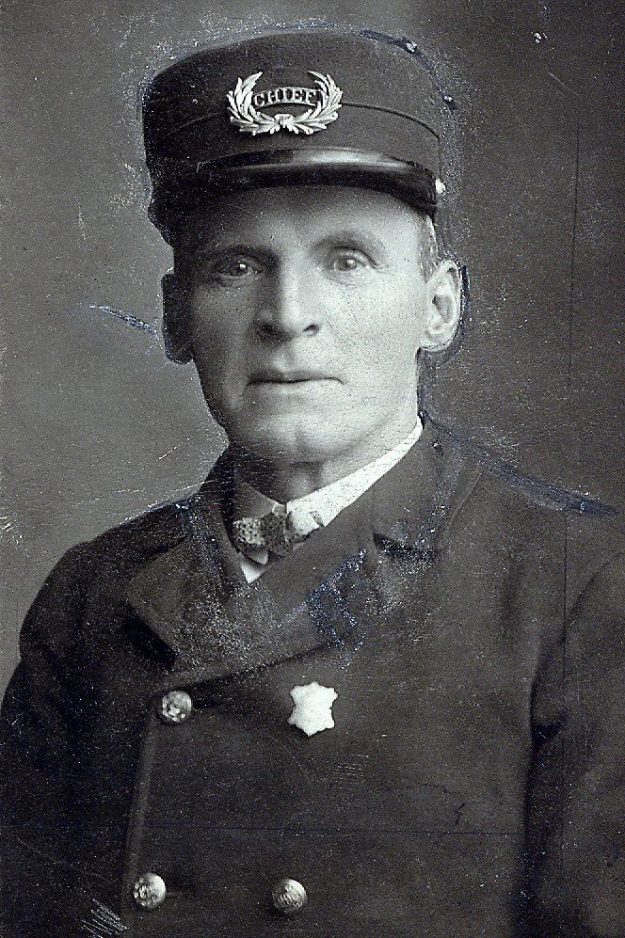
Patrick Curran became Washington Fire Department’s first chief in 1903.
If you drive out of Washington on Locust Avenue, past Immaculate Conception Cemetery, you’ll come to the old Catholic cemetery on your left. It’s a hillside rising to a huge silver maple, dotted with tombstones, some of them tilting, some of them toppled, either by shifting earth or vandals.
The stones tell a history of the congregation and its diverse heritage. Many of the epitaphs of Italians, Poles and Slovaks are written in their own tongues. The majority of the dead buried here, however, are Irish: Not the Scots-Irish who came earlier to settle the frontier, but some of more than one million people who fled famine in their homeland from 1845 to 1852 to work in the factories of the East and to build the railroads and canals that would push civilization west.
They were the McNamaras and Sullivans, the Farrells from Cork, the Finns and the Roneys from Galway, the Darrahs, the O’Shaunessys and Malones, and so many more. In the shelter of a rhododendron bursting in springtime with brilliant pink blossoms rest the remains of Michael Curran, born in County Clare in 1824, and his wife, Bridget, born in Limerick in 1831. They are surrounded by the graves of some of their 11 children.
I first came across the graveyard nearly 40 years ago, at a time when it was overgrown with brush and weeds. I hacked my way up the hill then and came across the stone of Patrick Curran, Washington’s fire chief at the time he died in 1925. I wrote an article about what I’d found that ran under the headline, “How soon we forget.” A little later, the cemetery was cleaned up and has been maintained ever since.
Returning to the same place all these years later, I was at first unable to locate the chief’s headstone. I thought it might have been one of those toppled. But it is still there, most easily located just after Memorial Day, when firefighters place a blue flag next to it. It is an obelisk about four feet tall. On one of its four sides is the name of Patrick Curran, the dates of his birth and death, and the words, “May he rest in peace.” The other sides commemorate the brief lives of his wife and three of his young children. It is not possible to look upon this stone and not feel a wrenching sorrow from so long ago.
Beneath every gravestone is a story, and Patrick Curran’s should be told and remembered.
•
Curran was born Jan. 30, 1852, in Lucas, Ohio, to Michael and Bridget Curran, who came from Ireland a couple of years earlier. When Patrick was just 2 years old, the family moved to Washington, where his father worked on the old Hempfield railroad, later the Baltimore & Ohio, laying tracks from Washington to Wheeling.
When the Civil War broke out, Michael Curran left his wife and five small children to fight for his country. Wounded twice in battle, he would not return until war’s end.
At age 12, Patrick ran away from home and tried to enlist in the Union Army but was turned away because of his extreme youth. He did not abandon the idea of being a soldier, though. Several years later he and his brother Cornelius joined the Washington Guard, which was the original Company H of the old 10th Regiment, when it was organized in 1873 under the command of Capt. Alexander Hawkins, later colonel of the regiment when it fought in the Philippines during the Spanish-American War.
Patrick’s career as a firefighter dates to the days of the bucket brigade and hand-pump engines. In 1866, at the age of 14, he joined the Good Will Fire Company, a volunteer organization. He was at the time learning the blacksmith and wagon-building trade and came in contact with wagon and stagecoach makers and with many of the stagecoach drivers of that day, and in later life loved to talk about those times.
Those were the days when fire equipment was hauled by horses, often with firemen running alongside the wagon, especially up hills, so as not to wear out the teams.
“There were no fire plugs at the time and water had to be secured from some nearby well or cistern,” Earle R. Forrest would later write in Curran’s obituary.
“A bucket brigade was formed of citizens and firemen and the water passed along in large leather buckets made especially for that purpose. When the bucket reached the engine it was handed to the captain of the company, who poured it into the water box, and then it was passed along another line to the source of the supply.
“Four men stood on each side of the galley and worked the handles, and eight worked the handles from the ground. This forced the water by means of a force pump through the nozzle on the platform, which worked on a swivel, and would send a stream 30 feet high. It was hard work and it was fast work, for a continuous stream of water in buckets was required.”
One night during winter, when leading the company during the final illness of its chief, a young Lt. Curran stood on the engine, pouring water into the box until his feet were frozen to the platform by splashing water.
Curran, still earning a living as a blacksmith, later moved to the Little Giant Fire Company, operating the first steamer in Washington. While captain of that company, he fought perhaps the worst fire in the city’s history on Jan. 6, 1899, when the Hotel Main and the adjoining Levino block were destroyed. It was the same year that fire destroyed the Union School, which was at Beau and Lincoln streets.
The Washington Fire Department was organized in 1903, and Curran became its first chief and one of three paid firemen.
Early in his career as a fireman, Curran married Ellen Farrell, born here to parents from Cork who fled with other Irish during the Great Famine, which would claim more than one million lives. They had five children and lived with Patrick’s mother and other Curran family members in adjoining houses on West Maiden Street.
Ellen died at age 34 in June 1885. Within the next 18 months, three of their children would also die: Clare, 10, Maggie, 9, and Richard, 2. The cause of their deaths is not known; there were no obituaries or even mentions of their deaths in the local newspapers of the time.
It would not be the last time death called at the Curran home.
On the night of Saturday, Feb. 1, 1913, Bridget Curran, 84, rose from bed to check the clock on the mantel of her bedroom. Although the house had natural gas service for heat, Mrs. Curran insisted on the warmth of a coal fire in her room. As she stood at the mantel, fire from the coal grate ignited her gown.
The woman’s screams awoke her daughter Mary, 51, who was asleep above on the second floor.
The Washington Observer provided this account two days later:
“It was shortly before 11 o’clock when the alarm came into the fire station from Box No. 14, in the First Ward. When it became evident that the blaze was in the home of his mother, Chief Curran leaped from the hose truck, and with a fire extinguisher in his hand, burst into the house.
“In the smoke-filled house he stumbled over something on the floor and reaching down picking up the burned body of his mother … The fire chief carried his mother to the second floor but finding the smoke too thick there he carried her from the house and into the home of his brother James Curran, next door. Mrs. Curran lived about two hours, dying from the frightful burns she had received.”
She survived long enough to receive last rites from the Rev. James H. Gilmore of Immaculate Conception Roman Catholic Church.
Mary Curran was horribly burned in the attempt to save her mother.
“Her condition was such that she could not be removed to a hospital, and everything possible was done by physicians and nurses to alleviate her suffering,” The Observer reported. “All day yesterday she struggled valiantly for life, but toward last midnight her condition became critical. Practically no hope was held out for her recovery, and when she died at 3:15 all her brothers and sisters were at her bedside.”
Mary’s brother Michael’s hands were also badly burned in his attempt to save his sister.
At the time of that tragic fire, Chief Patrick Curran was living in the home of his brother James, his two surviving children having left to establish their own lives. Daughter Katherine had joined the Sisters of Mercy; son Cornelius, a tailor, and wife Ellen had three children and were living on McKennan Avenue. Three more births in the next three years would give Patrick six grandchildren.
The fire department had purchased a gasoline-powered engine by then and had begun retiring its horses. The Little Giant steam engine became a revered relic of the department.
Jack Curran, 88, whose grandfather, Cornelius, was Patrick Curran’s brother, recalls the pasture where the retired teams grazed.
“The center of the block between Burton and Gibson avenues and Main Street was where my grandfather, who was a contractor, had all his equipment,” Jack Curran said. “Patrick Curran kept his horses there, and I was told that was where the retired fire horses grazed.”
Many in the Curran family had risen to prominence, both in the borough of Washington and in the church. Before her death a few years earlier, Patrick’s oldest sister had been mother superior of the Mount de Chantal Convent in Wheeling, W.Va. Brother John was a member and president of borough council and a founder and member of the board of directors of Washington Hospital. Brother Cornelius was a contractor whose work included the county courthouse, jail and the Washington Trust Building.
Together, the Currans probably had more influence than any other family in Washington, a town growing by leaps and bounds. The oil and gas boom at the end of the 19th century had given birth to steel and tin mills and glass factories. People from all over Europe came to work, and the borough grew to a city, and the fire department grew along with it.
Cornelius Curran, who had served with his brother Patrick as a volunteer fireman and soldier in the Washington Guard, died June 25, 1923. While his company was doing work at the Molybdenum Corp., climbing to a roof to check on scaffolding, his head touched a 25,000-volt electric line. He was killed instantly.
His brother’s electrocution must have been a terrible blow to Patrick, who had already lost so many family members. It would not be the last.
On the afternoon of Nov. 10, 1924, Patrick stopped in at the garage on East Pine Alley then operated by his son, Cornelius, known to everyone as Neil. The younger Curran had left tailoring six years earlier to open a business in automobile repair in a building that once was the Hallam stables.
Neil was sitting at his desk in his office but did not respond when his father spoke to him. Upon further examination, Patrick realized his son was dead. His heart had failed at age 52.
Through all his travails, Chief Patrick Curran fought grief by fighting fires.
“The fire department to which he had given his life’s service was his world; and his ‘boys’ loved him like a father,” The Washington Reporter wrote. “No matter what the weather, early or late, he always turned out on the fire truck to answer to all alarms, unless prevented by sickness.”
By autumn of 1925 the chief was still responding to fire calls, despite his declining health. Then in October, he suffered a stroke. He died a week later, on Oct. 16, in the East Chestnut Street home of his brother David, to the shock of a community unaware of his illness.
From The Reporter:
“At the time their beloved chief died, the firemen were fighting a blaze at the Tyler Tube and Pipe company’s mills; and it seemed as if the spirit of ‘Pat’ was with them, for what threatened to be a disastrous fire was extinguished with small loss. And when they returned to the fire department a short time later they learned of their leader’s death. Then they tolled the fire bell for a long period, and everyone in Washington who heard knew that ‘Pat’ Curran, loved by all, was dead.”
It was said at the time that no one in Washington knew more people or had more friends than Chief Patrick Curran. On the day of his funeral, all of the stores in the city closed while it was in progress as a tribute to his memory.
•
The Currans’ influence would not stop with Patrick’s generation. Councilman John Curran’s sons, John and Alexander, for example, would become prominent local lawyers, the latter appointed judge in 1963 and elected to the bench in 1966.
Patrick’s only surviving child at the time of his death, Katherine, graduated from St. Vincent College in 1925 and became Sister Mary Patricius of St. Xavier Academy at Beatty, Pa. She earned her master’s degree from the University of Notre Dame in 1930 with her dissertation, “The Part Played by Pennsylvania in the Nomination and Election of Abraham Lincoln.” She died at age 90 in 1969.
There are, of course, remnants here of the Irish who came to Washington in the middle of the 19th century. But most of the descendants of those buried long ago in the old Catholic cemetery have scattered across the country as do the drifting seeds of dandelions.
The remains of Patrick Curran lie buried in this once-neglected graveyard, but in the fire department founded 113 years ago under his leadership his image still stares from photographs hanging on its walls. His was a life of selfless public service, and he will remain, for many years to come, the soul of the department.