

‘It’s not very far away at all’
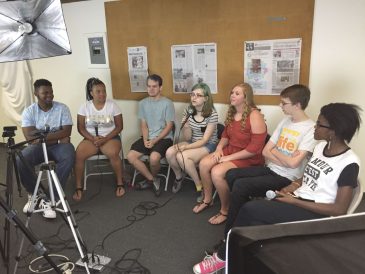
The shooting death of 19-year-old Alexis Barnett in early May brought reports of violence from other parts of the country close to home for students in the Washington area.
“I could feel … the collective heart sinking,” said Sasha Edwards. “We’re about to graduate. What’s going to happen to us if we stay here?”
Edwards, LaShauna Carruthers, Ben Williams, Maci Ward, Landan Weakland, Unique Levy and Matt Stroop, members of Washington Health System Teen Outreach, came together Monday for a discussion of violence and race in the Observer-Reporter office.
The teens agreed that, while racism and prejudice are not new, the number of violent incidents seem to be growing at an alarming rate.
“Racism comes out of someone’s mouth and actions at least once in their life. But in today’s world, it’s just getting out of hand,” said Levy.
Washington is not immune to the violence, said Williams.
“It’s not so far away,” he said. “It’s basically when it’s dark out or (you’re) in the wrong neighborhood at the wrong time or you’re just outside enjoying yourself. It’s random, but it’s not very far away at all.”
They’ve witnessed or experienced discrimination and violence in their schools and neighborhoods, but the group agreed a large amount of intolerance is spewed online.
Treating others with respect is a cardinal rule in the Teen Outreach group, and, while they don’t think there’s a simple solution to discrimination or violence, the teens agreed respectful speech and actions can help.
“You can’t change racist people, but you can separate (from) them and be respectful,” Williams said.
The group also suggested reaching out and forming relationships with a variety of individuals.
“When we get isolated within ourselves and within groups of people that are similar to us, and when we only have friends that look and act like us, we lose sight of how everybody else is an individual and we see other groups of people as … one big monster,” Edwards said.
Carruthers, who said she’s the only African-American in her Trinity class, said she doesn’t feel different from any other student, but said some classmates look at her like an outsider.
“That’s why I don’t like to refer to myself as colored or black. I like to refer to myself as LaShauna,” she said. “We’re ourselves, and that’s all that matters.”