

Restaurant, supermarket operators applaud wine modernization law
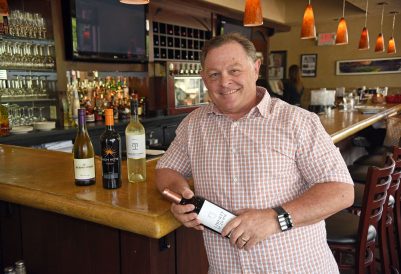
Michael Passalacqua had an immediate reaction when he learned Wednesday morning that Gov. Tom Wolf was signing a wine modernization bill into law.
“This is huge; it’s good for our industry,” said Passalacqua, who owns Angelo’s Restaurant in North Franklin Township.
A portion of the new law will enable licensed restaurants and hotels to sell as many as four bottles of wine per customer for takeout.
He said the passage of House Bill 1690 was something Pennsylvania Restaurant and Lodging Association, of which he is a member, “has pushed for, for privatization or modernization (of the state’s liquor system), every step of the way.”
Passalacqua, who served in 2003 as chairman of Pennsylvania Restaurant Association (predecessor to the current organization that was expanded to include the state’s lodging industry), explained the law also will make it cheaper for licensed restaurants to sell wine.
Until now, he said, a restaurant would purchase its wine through an “SLO,” or special liquor order, from a wine broker who would ship it to a nearby state store, where its price was marked up by 30 percent before the restaurant picked up the order.
According to Passalacqua, restaurants will now pay a markup of only 10 percent.
While acknowledging the new law also will enable hotels to sell as many as four bottles of wine to their guests, Passalacqua said the hotel across from him in the Washington Square development doesn’t have a restaurant, so he expects to benefit whenever its guests visit Angelo’s.
Another business segment that now will be able to sell wine is grocery stores that have a beer license.
Bob Duritza, co-owner of Duritza’s Shop ‘n Save in Washington and six other locations in the area, said Wednesday his management team is discussing obtaining the beer license for the stores – with the exception of one that’s out of state.
“We already have been selling beer, wine and liquor at our Weirton, W.Va., store,” Duritza said.
While acknowledging he wasn’t up to speed on all of the requirements of Pennsylvania’s new law, Duritza said, “We’re going to look into it, and get the legal help we need.”
He said selling beer and wine would probably require building a separate retail area within a store, but he was glad to learn that the law was being changed.
“It’s long overdue from a customer convenience standpoint,” he said, noting with the Washington store’s location along the Interstate 70 corridor, he’s had to explain its lack of alcohol sales to many disbelieving out-of-state customers over the years.
“You would get that ‘look,’ then give them directions to the nearest state store or beer distributor,” he said.
Ed Bedwell, owner of the Beer Store in South Strabane Township, said because he hadn’t “seen the entire bill,” he was uncertain how the legislation would affect his business.
“I don’t know for sure whether I can sell wine,” he said. “If we could, we would.”
He was supportive of what he did know about the legislation.
“I think the (increased) availability of wine is a positive for the state,” Bedwell said.
He added that allowing grocery stores, restaurants and hotels to sell as many as four bottles of wine to a customer “will help the state. The real benefit for consumers is they can buy more conveniently.”
Giant Eagle has more than 400 retail operations, about half of them supermarkets, the rest fuel and convenience stores. It operates in four states: Pennsylvania, Ohio, West Virginia and Maryland.
The chain currently sells wine in every state except the one that is run out of Harrisburg.
Spokesman Dick Roberts said the company embraces this change.
“Giant Eagle customers in other markets have long enjoyed the convenience of purchasing wine in our supermarkets,” he said in a statement. “We look forward to introducing the offering to Pennsylvania consumers.”
Wendell Young IV, president of United Food and Commercial Workers Local 1776, which represents 3,500 state store clerks, said Wednesday the union opposes the new law for a variety of reasons.
“It’s a bad bill,” Young said.
He disputed projections of legislators who said the change would bring an additional $150 million a year in revenue to the state.
According to Young, LCB will offer the wine at a deeper discount to the markets to sell, meaning that the state will realize far less revenue on each bottle sold.
At the same time, he said, foot traffic to state stores will be drastically reduced as shoppers decide to buy their wine at supermarkets.
“This isn’t going to be new revenue, but a transfer from the LCB to the stores,” he said.
“This will be the beginning of the end for the PLCB,” he said.
“Our job now is to fight like hell to promulgate changes at the legislative level,” he said. “We’re going to fight like hell to soften the impact.”
Not all supermarket operators were ready to embrace the change.
John Brodak, who owns the Shop ‘n Save plaza in Carmichaels, said he doesn’t plan to start selling wine in his store because there is a beer store and a liquor store in that plaza, and he doesn’t want to affect the business at those stores.
Another major change being ushered in by the new law would allow licensed wine producers from anywhere in the nation to ship directly to consumers in the Keystone State.
“It would have to be a producer, not a broker,” said state Rep. Brandon Neuman, D-North Strabane Township.
Neuman is pleased the legislation has been approved.
“This is a significant modernization of our system, which really protects all workers in (state) stores and promotes what consumers want in terms of convenience,” he said. “This has the potential to help small businesses and, hopefully, get more employees out of this.”