

Never forgotten Lt. James Parker died more than 70 years ago, but in Belgium and here, his memory lives on
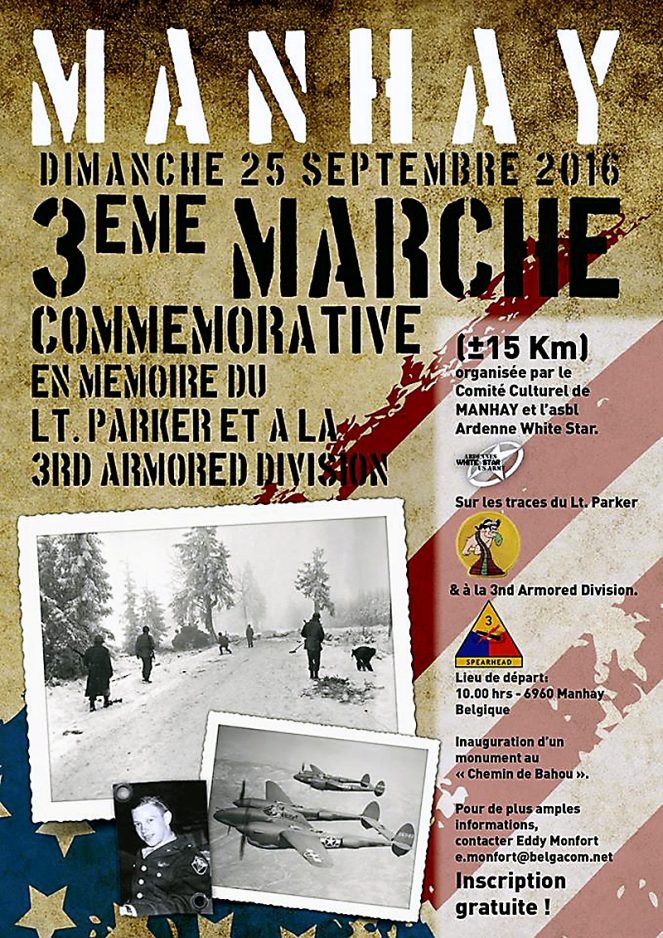
A poster for the ceremony in remembrance of Lt. James Parker
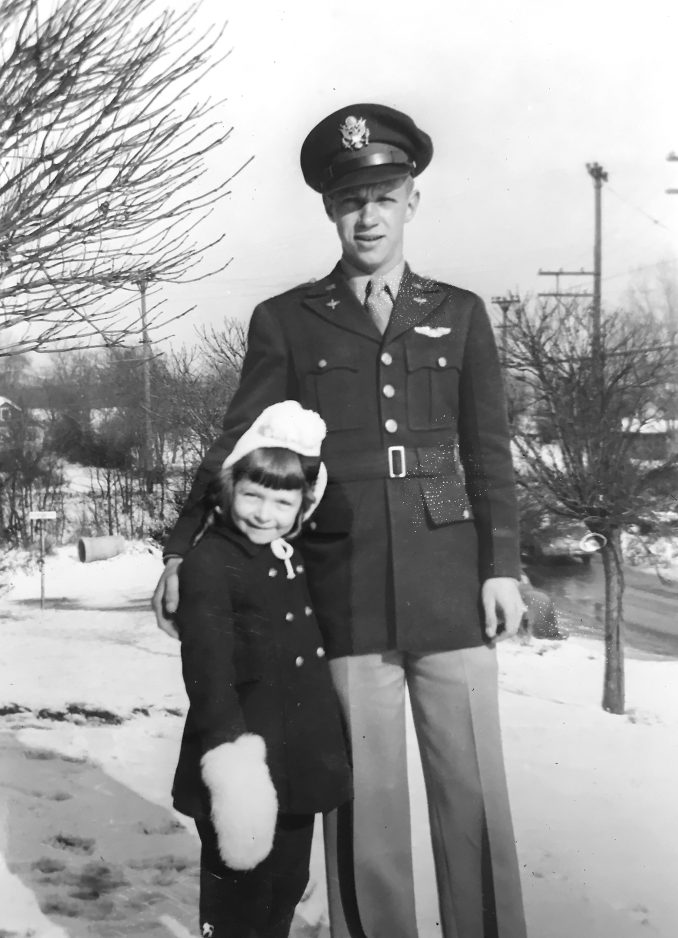
Jean Parker Mace didn’t know this snowy day in 1944 would be the last time she would see her brother, Lt. James Parker.
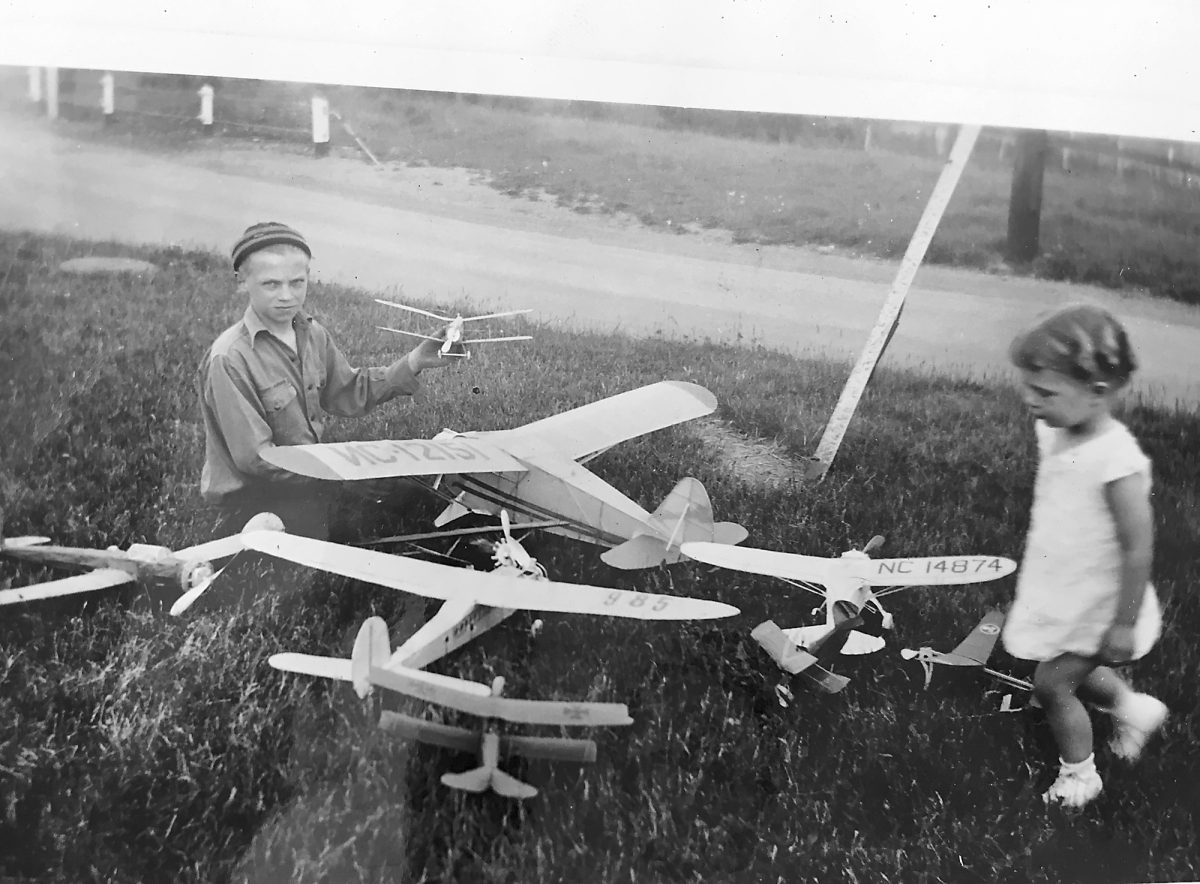
Planes always fascinated James Parker, and he enlisted rather than be drafted in World War II so he would have a better chance of becoming a pilot. Toddler Jean Parker is at right in the yard of the family’s Bethel Park home.
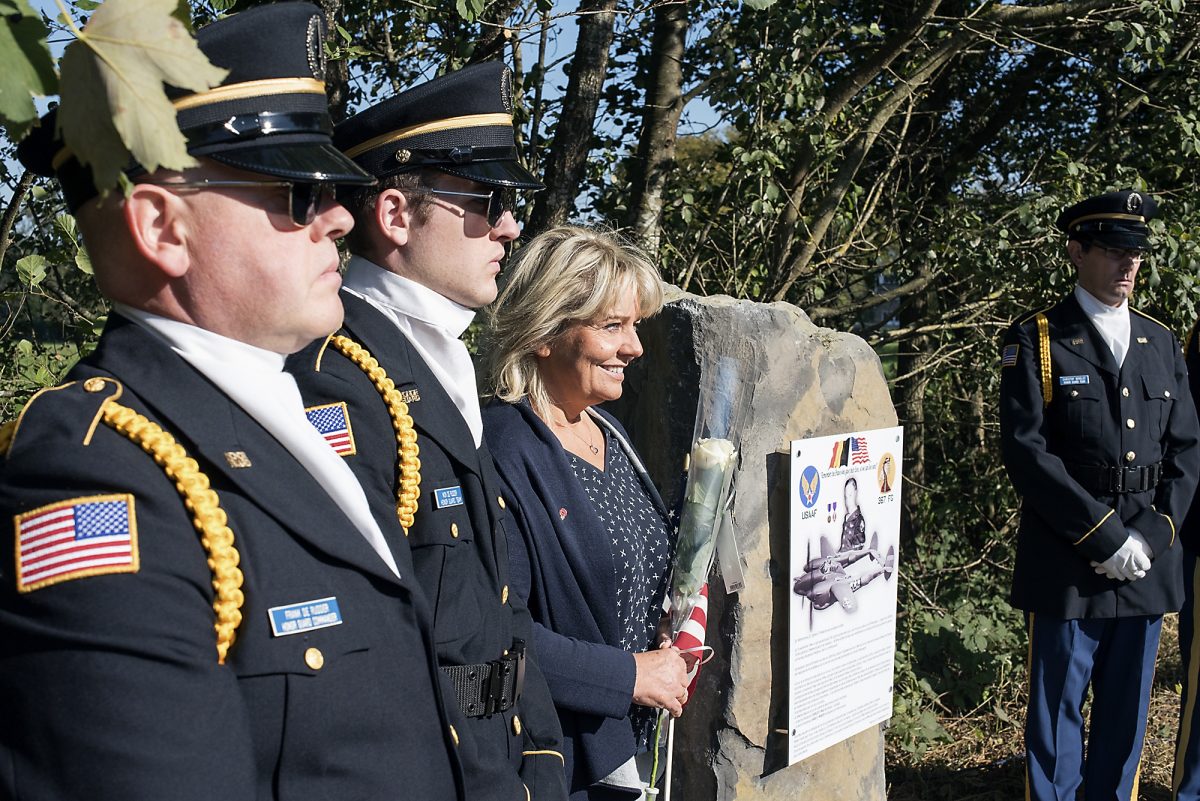
Benedikte Gijsbregs and the Honor Guard of Europe, trained by an American honor guard at Arlington National Cemetery, participated in a tribute last Sunday in Manhay, Belgium, to Lt. James Parker. Attached to the monument, under the depictions of Belgian and American flags, is the message, “Remember the brave who gave their lives so we can live ours.”
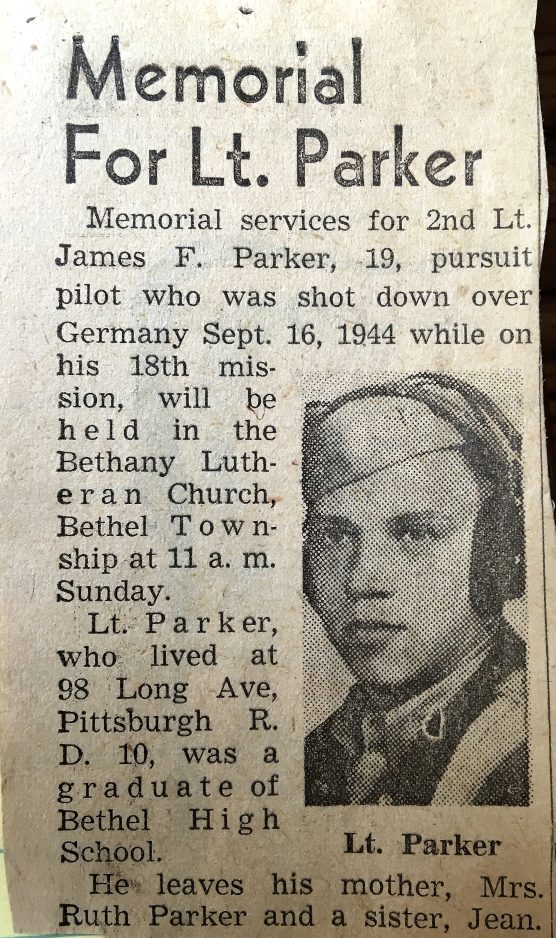
Jean Parker Mace said the church service for her brother made her realize he was never coming home from the war.
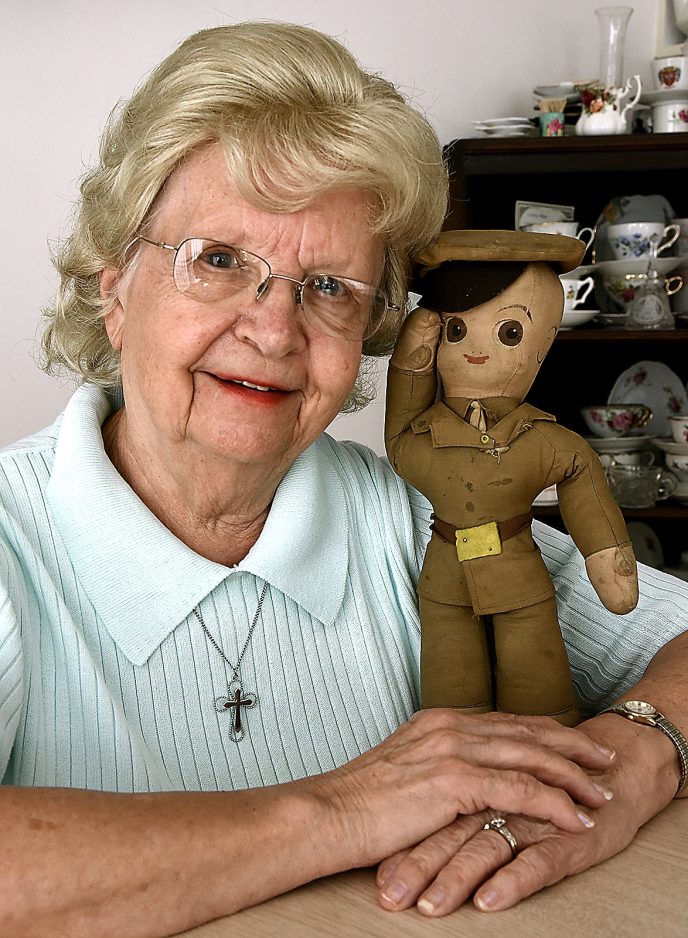
Jean Parker Mace of Peters Township holds a doll given to her by her brother, James Parker, during World War II. James was later killed in action in Belgium, and Jean named the doll Jimmy Parker after him.
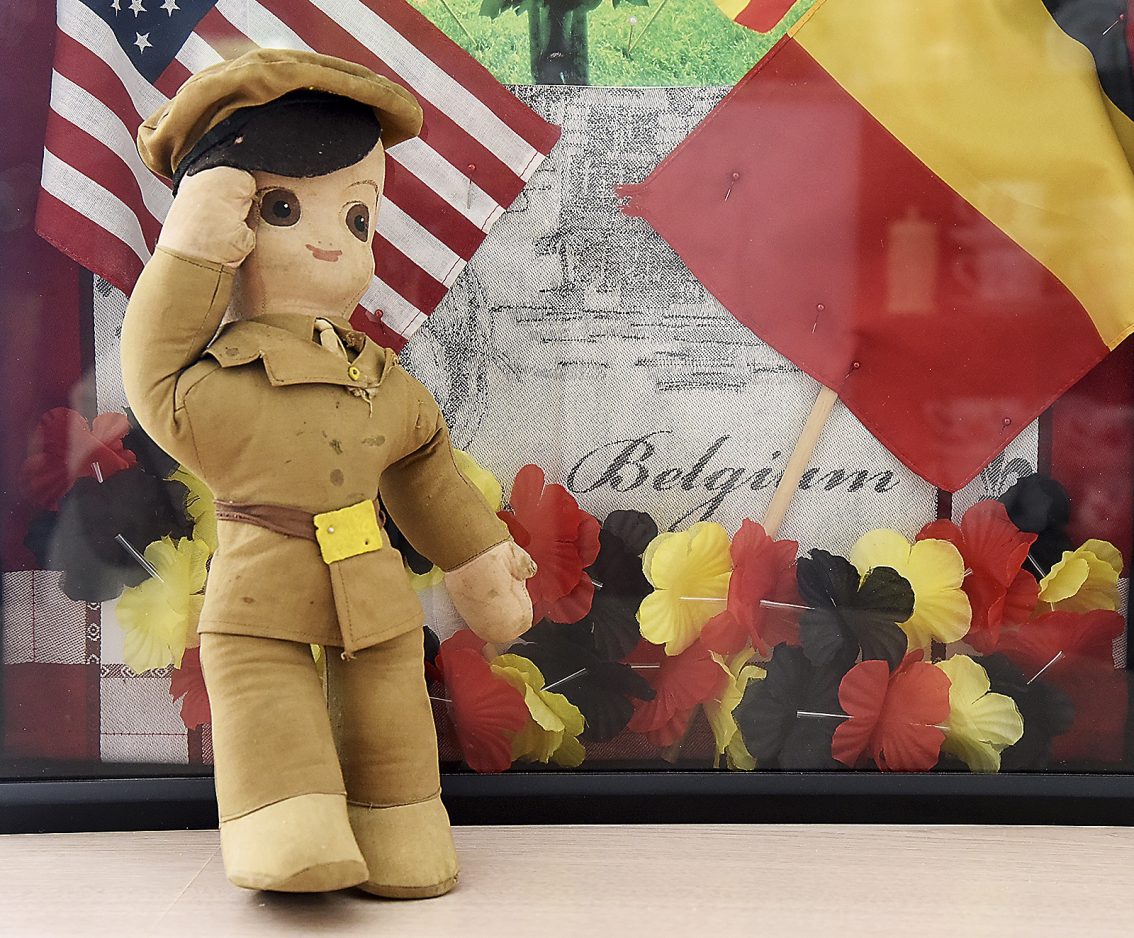
A soldier doll given to Jean Parker Mace by her brother, James Parker, stands in front of a display case in Jean’s Peters Township home.
Members of an immediate family never forget someone who was taken away from them all too soon.
But to find out a town on another continent would memorialize her loved one – 72 years later – has deeply touched a Washington County resident.
James Francis Parker Jr. was killed during World War II while serving as a U.S. Army Air Forces pilot.
For decades, his family thought his plane had been shot down over Germany on Sept. 16, 1944. The date was correct, but the other information was not.
This year, his sister, Jean Parker Mace of Peters Township, learned otherwise.
Her Jimmy, or Junior, as she knew him in childhood, and as she still calls him to this day, went down with his plane due to a midair collision with the aircraft of another American pilot over Belgium, where residents buried him and, eventually, enshrined parts of his P-38 Lightning in a museum. And, this past weekend, in his honor, they walked in tribute to those who gave their lives in the overthrow of Nazi Germany.
“I just wish my mother had known this,” said Jean Mace, a Peters Township resident, in a recent interview.
Jimmy and Jean’s mother, Ruth Parker, died in 1995, outliving a son, Harry, who died in infancy; her husband, James Francis Parker Sr., who died in 1942; and her son, Jimmy, whose plane left the skies when the aviator was just 19.
Jean Mace was invited to the memorial Sept. 25 in Manhay, Belgium, but having just turned 80, she wasn’t up to making the trip.
That she knew of the esteem in which the residents of the Belgian town held Jimmy Parker is due in large part to the Internet.
As hostilities subsided in the aftermath of World War II, the United States government offered to return Parker’s remains to his family for a local burial.
Little Jean Parker remembers her mother questioning, “What would there be to bury?” when her mother declined, fearing that his body had been desecrated in enemy territory. Neither did the War Department send the survivors any of his personal belongings. His final resting place became an American cemetery in Belgium.
Years later, Mace speculates that stateside cemetery rites would resurrect a flashback that her mother hoped to avoid. The deaths of both Ruth Parker’s husband, who was a civilian, and son, just two years apart, had led the widow to leave her home and factory job with her barely school-aged daughter and drive cross-country in an attempt to start a new life in the state of California.
Their home just held too many bad memories.
Young Jean had returned from a cherry-picking outing July 4, 1942, and found her father lying dead just inside the doorway. He had suffered a heart attack about six months before, but he seemed to be on the road to the recovery and was on the verge of returning to his job as an electrician at Crucible Steel on Pittsburgh’s South Side. James Francis Parker Sr., however, suffered a second heart attack, this one fatal.
Jimmy Jr. walked out that door in the Hillcrest neighborhood many times on his way to Bethel High School (the township had not yet come to be known as Bethel Park), or to launch his model airplanes. Making the planes from balsa wood was a hobby father and son had shared, and after his father’s passing, Jimmy Jr. was determined to fly for real. After high school, he followed in his father’s footsteps at Crucible Steel, but he had another goal: enlisting in the service and becoming an airman.
“He could have gotten a deferment,” Mace said, “because he was sole support for mother and I.”
Instead of opting out, Jimmy Jr. had his mother sign a document that allowed her son to volunteer for military service at age 17.
Out the door of the house he went again in 1943, this time getting into a car headed for Pittsburgh and a troop train. Mace remembers crying that day, mostly because her mother wept with such depth that she could barely be consoled.
Jimmy wrote often from an air base in Texas, addressing envelopes to his mother but writing notes in the margins of his letters to his sister, telling her to behave.
“He and my mother were very close because they had gone through a lot together,” Mace said.
One day, a package arrived and young Jean opened it to find a soldier doll, dressed not in aviator blue but in khaki. It made no difference to the little sister. She named her doll Jimmy and has kept it to this day.
In the winter of 1943-44, Jimmy Parker came home on leave. When he exited the doorway to pose for family pictures in the snow, his mother and sister did not know they’d never again see him alive. He boarded a troop ship bound for Europe.
“I knew he was bombing the Germans,” Mace recalled of her big brother, a dozen years her senior. Technically, that wasn’t correct, but who is to fault a child? Jimmy Parker was a fighter pilot of a P-38 Lightning, escorting bomber squadrons to protect them from the Luftwaffe.
In the fall of 1944, someone knocked at the door of the Parker home. It was a telegram courier. The news was bad: James Parker Jr. was missing in action.
“For a long time, we didn’t know if he was living or dead,” Mace recalled.
About three months later, the words in the next telegram were definitive: James Francis Parker Jr. was dead.
It was during the memorial church service that young Jean realized her brother was never coming home.
The enormity of experiencing the unexpected demise of her father and brother affects her to this day. Because what should have been a fun time picking cherries ended with such a ghastly discovery, she could never again eat the fruit. In what sounds almost like an echo of the 23rd Psalm, she has a vivid recollection of going “through the valley of the shadow of death” – Death Valley, Calif. – with bags of water fastened to the outside of her mother’s automobile.
“I suppose I was traumatized,” she said. What had been a family of four was now a family of two. After returning from California, Ruth Parker never remarried, but Jean Parker grew up to become a student nurse and a bride. She and her husband, Bill, named their first-born child James,after the pilot.
Their son, James Mace, visited the grave of his namesake, James F. Parker Jr., at Henri-Chapelle American Cemetery in Belgium, among the 7,992 buried there, and returned with photographs to show, for the first time, his mother and grandmother.
Belgium has a program in which citizens can “adopt” a grave of a serviceman, caring for it as they would for a family member.
The name Henri-Chapelle is one Mace will never forget, so when a story appeared in the Observer-Reporter in 2011 about a Belgian teacher who contacted, via email, Washington County to try to find out more about Donald Ward, whose grave she had adopted at Henri-Chapelle, something clicked. Benedikte Gijsbregs and Mace began corresponding. Gijsbregs traveled to the United States in the summer of 2015, meeting with both Ward’s relatives and Jean Mace.
“She showed me old family albums, and of course she talked a lot about Jimmy,” Gijsbregs wrote in an email for this story. “At that moment I realized the mental and emotional impact of war. Even after 70 years, I could still feel so much pain and sorrow for his passing. It really touched my heart.
“So when I came home, I was motivated to find out what really had happened because the family had been given so little information.”
Gijsbregs searched the Internet and had help from Ben Savelkoul of the Netherlands and Bob Konings, who guided her to Jean-Francois Noirhomme, director of the (Battle of the) Bulge Relics Museum. Noirhomme was aware of two P-38 Lightning planes that crashed in the area, probably after a midair collision in bad weather as part of a mission to or from Bonn, Germany. Both crash sites had been found, “and there were documents, written by the local police in 1944, that confirmed James Parker had died here, a few hundred meters from this spot. They even mentioned that they took care of his remains, and that the local community of Grand-Menil gave him a proper funeral service on Sept. 18, 1944,” Gijsbregs wrote. Monfort had spoken with an altar boy who served in the 1944 funeral service, which he remembered very well.
In January, Gijsbregs visited the site and was met by Noirhomme and Eddy Monfort, the Bulge Relics Museum’s curator of photographs and film. Through them, she was introduced to a man named Choque who witnessed the plane crash of Charles Page of Denver, Colo., pilot of the other plane.
When Gijsbregs emailed Mace with the results of her research, it warmed the hearts of both women.
“Knowing that her brother didn’t suffer but that he died instantly upon impact in a country where people showed respect to him, that meant the world to her,” Gijsbregs wrote.
“Benedikte found out all that for me,” confirmed Mace, who doesn’t fault the War Department for giving her family incorrect information. “At that time, the world was in such a mess. Imagine how many men were killed.” A few years ago, she saw the World War II memorial in Washington, D.C., which commemorates more than 400,000 Americans who died, “with all those stars on it. When I looked at that, it was hard to fathom.”
At the Sept. 25 ceremony, the anthems of Belgium and the United States played, and red, white and blue flowers from the Mace family were laid at the base of the newly unveiled monument to James Francis Parker Jr. According to Gijsbregs, about 120 people attended the commemoration, some in tears. She placed a white rose, an American flag and the message, “You have done your duty, to honor you is ours. Thank you for our freedom.” She added in an email, “I don’t like people who take everything for granted. I found out that Charles Page, the other pilot, was given a memorial stone in the 1990s. That encouraged me to make sure that James also received a plaque.”
The final part of the event was a memorial walk of more than nine miles in honor of all units and soldiers who fought near Manhay.
Of the remembrance in Belgium, Mace said, “I cannot believe or begin to say how it makes me feel to know I have someone like Benedikte in my life.”