

Recommendations on battling opioid epidemic presented
The region’s top federal prosecutor said Wednesday “tough love” from a family can be dangerous for someone in the throes of heroin addiction – especially with the exponentially more potent fentanyl also appearing on the street – “and the simple ingestion of a small quantity leads to immediate death.”
“You can’t let people find their own bottom when that’s what you’re talking about because their bottom will be death,” said U.S. Attorney for the Western District of Pennsylvania David Hickton.
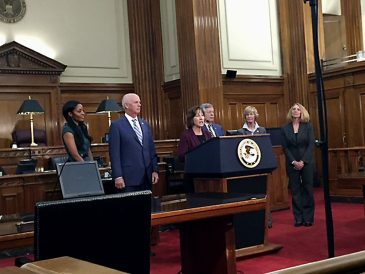
The senior Department of Justice official was among those who discussed the conclusions of a report released by the University of Pittsburgh Institute of Politics during a news conference at the federal courthouse that examined the region’s response to the epidemic of opioid use and overdoses. A working group convened by Hickton prepared the report.
The number of drug-related deaths in Pennsylvania increased 23.4 percent last year to 3,383, according to a release from Hickton’s office.
Other speakers included Cheryl Andrews, executive director of the Washington Drug and Alcohol Commission; Terry Miller, executive director of the University of Pittsburgh Institute of Politics; and Mark Nordenberg, chairman of the institute.
The report said area hospitals started in June 2015 implementing “warm handoffs” that help patients get rehabilitative treatment.
In Washington County, Andrews said after the conference, the Drug and Alcohol Commission has two workers embedded at Washington Hospital. The first, a case manager, started there two months ago. A certified recovery specialist began working there within the last month, Andrews said.
Those workers engage patients and help find a spot at a residential detox facility if he or she is interested in treatment.
The commission uses overdose data to help plan how it offers services.
“We did a study – overdoses are occurring between 5 and 8 p.m.,” Andrews said. “We have a worker (at the hospital) who works until 9 or 10 p.m.”
Asked whether the report included recommendations related to funding, Hickton said he is “not in the legislative business and I’m not in the funding business.”
Hickton stressed efforts to gather data on overdoses to help identify “hot spots.”
“The data tells us where the problem is really raging, and we can infuse law enforcement resources or community health resources to those places to save lives.”
The report also included as a goal developing and implementing a protocol for “hard handoffs” that would allow emergency personnel to commit people involuntarily for treatment.
“This is an individual who may not be ready for treatment,” Miller said. “But if there is legislation out there, or if this is something that winds up in the courts, it would be a process where an individual would be involuntarily committed to a treatment program.”
Asked whether the report included any recommendations for funding the various measures it discussed, Hickton said he’s “not really in the legislative business or the funding business.”
Instead, those are duties of Congress and the state legislature, he said; however, he continued, describing the opioid crisis as the “worst drug epidemic, certainly, in my lifetime” and pointing to a shortage in treatment available to those struggling with addiction.
“I don’t think it is proper for people to be able to case a vote against the problem and then not bring to the floor measures that would actually address the problem,” he said.