

Diocese collecting feedback for the future
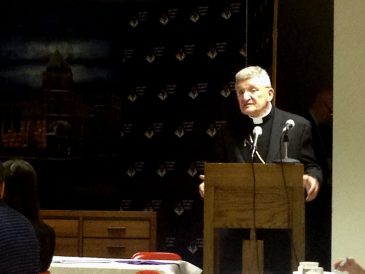
Editor’s note: This story has been modified from a previous version to correct a title and figures.
The tradition of Catholics attending Mass “just because that’s what you do” is a thing of the past.
“Cultural Catholicism is not really a driving force in the church today,” said Bob De Witt, spokesman for Roman Catholic Diocese of Pittsburgh. “People really need to know Jesus.”
The diocese, composed of 192 parishes in Washington, Greene, Allegheny, Beaver, Butler and Lawrence counties, is experiencing the same decline of parishioners and priests as the rest of the country’s Catholic communities.
The diocese reports the Catholic population has declined from 753,147 in 2000 to 632,138 in 2015. Active diocesan priests have decreased from 338 in 2000 to 225 in 2015 and about 50 percent of parishes now operate with financial deficits.
“On Mission for the Church Alive!” is the initiative to respond to the changes. It calls for new parish models, including mergers, closures and groups of churches sharing resources.
While restructuring is not a novel idea, De Witt said the Pittsburgh Diocese is attempting to do more than stitch together a temporary fix.
“The core of it, very simply, is to … grow in the relationship with (Jesus). It’s the kind of thing Catholics took for granted. When you always just went to Mass because everyone did it, it didn’t really matter how close your relationship was,” De Witt said. “Bishop (David A. Zubik) is trying to get to the core of what’s going on. He’s really trying to get to … what’s behind these numbers.”
The diocese is collecting feedback from the faithful through meetings in which participants are shown potential models of their parishes. They are given the opportunity to share their opinions through an automated response system and a questionnaire. Parish teams will then meet to refine plans and report them to the diocese. Recommendations to Zubik will be made by the end of 2017, and final decisions on consolidations will be made in spring 2018, with implementation in fall 2018.
The first meetings took place Monday in the North and East Hills of Pittsburgh. Meetings in Bentleyville, Meadow Lands and Washington begin Sunday. Future meetings in the area are being planned.
When creating the models, the diocese said it will consider the needs of all people in all areas, the best care for practicing Catholics, allocation of resources for at least the next 20 years, and how assignments of priests and deacons will work most effectively.
The plan calls for no more than 2,400 congregants per priest and for collaborations to be built upon existing relationships between parishes, when possible.
“We’re not just trying to reduce the number of parishes, we’re trying to make sure people collaborate,” De Witt said. “It’s not just about whose parish is going to be around. The big thing is, we’ve got to get to the core of what’s going on here. We’ve got to really focus on people’s relationship with Christ, and understand our mission as a church is not to come in, go to Mass and go home. … We’re called to come in and go out and make disciples, to get young people engaged to serve others.”