

U.S. entered World War I 100 years ago
One hundred years ago, Europe, Africa and the Middle East were embroiled in what was known as “The Great War.”
We call it World War I knowing, in hindsight, there was another even more massive conflict later in the 20th century. But before the Nazi invasion of Poland and the Japanese attack on Pearl Harbor, Winston Churchill had titled one of his history books “The First World War.”
The conflict began with the assassination of Archduke Franz Ferdinand, heir to the Hapsburg throne in the Austro-Hungarian Empire in the city of Sarajevo, capital of a Balkan land. Most Americans hoped to remain isolated from the hostilities, but word that Germany had offered to help Mexico regain territory from the United States, among other events, was enough to change sentiments.
April 2017 marks the 100th anniversary of President Woodrow Wilson’s request before a joint session of Congress to declare war against Germany.
Washington Countians mobilized. Dockets in the recorder of deeds office show an interesting wrinkle: birthplaces of local soldiers were sometimes allies – Italy and Russia, for example – but in other cases, those fighting on behalf of the United States who were from Germany or Austria-Hungary would be potentially fighting against their former countrymen.
New York, Pennsylvania, Illinois and Ohio provided the largest number of American soldiers fighting in World War I. The American death toll was 53,402 killed in action, 63,114 deaths from other causes, and about 205,000 wounded.
Young people left hometowns, mines, factories and farms for Europe. Although horses played a major role in transporting cavalry members and material during World War I, this conflict surpassed previous wars in the scope of mechanization. Biplanes took to the skies for both reconnaissance and combat in the air. The British introduced the tank as an all-terrain, armored vehicle that could give the allies an advantage in trench warfare. Germany’s chemical plants at the time were unmatched, and they innovated both poison gas and the flame thrower.
The peace achieved by this war of attrition was fleeting, due in part to the heavy reparations imposed on Germany, which created political and economic instability that led to the rise of Nazism. The cost of the war also proved to be a huge burden on the British Empire, paving the way for the United States to emerge as a world power broker.
Here are vignettes about three local people from various walks of life who served in World War I. Information was drawn from a yearbook-like publication called “Washington’s Part in the World War,” discharge papers filed with the county recorder’s office, and various websites.
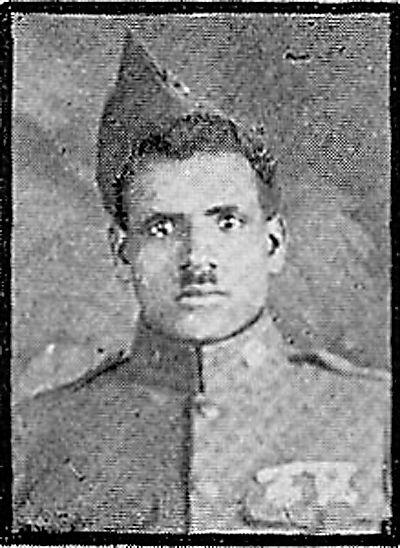
Alfred G. Platt, son of Mr. and Mrs. Frank Platt, 373 Fayette St. Born Dec. 2, 1892, he was inducted into service Oct. 27, 1917.
Platt was sent to Camp Lee, now Fort Lee in Prince Georges County, Va., and he was assigned to Company K, 370th Infantry, 23rd Division, later called the “Black Devils.”
The National Guard website features an article written last year by Army National Guard Staff Sgt. Michelle Gonzalez on the 370th Black Devils:
Although redesignated as the 370th Infantry Regiment during World War I, the unit’s history began nearly 20 years before entry into the war. Initially organized in 1895 as the 9th Battalion Infantry, the all-black National Guard unit was redesignated as the 8th Illinois Infantry in 1898. After federal service in the Spanish-American war, the unit was called again in 1916 for service on the Mexican border.
The 370th was assigned to the 93rd Division in 1917, and the regiment arrived in France in April 1918. Platt went overseas April 28 of that year. After being attached to a number of French divisions for training and “seasoning,” the unit was assigned to the French 59th Division, which took part in the Oise-Aisne offensive where the Germans abandoned their defensive lines.
The 370th had the distinction of being the only black regiment completely staffed with black officers. For its actions during the war, members received 21 Distinguished Service Crosses, one Distinguished Service Medal and 68 Croix de Guerre.
Platt returned to the United States Feb. 7, 1919. He was honorably discharged from service March 4, 1919.
After World War I, the Black Devils regiment reorganized and is known today as the Illinois National Guard’s 178th Infantry.
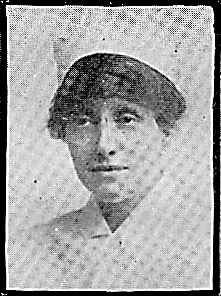
Rita Z. Jacqmain is listed in the October 1917 Journal of American Nursing, digitized by the Library of the University of Michigan. Daughter of Mrs. Octave Jacqmain of 1094 Allison Ave., Washington, she was born July 4, 1893. Jacqmain was assigned to U.S. Army General Hospital No. 20, Whipple Barracks, Ariz., and she enlisted June 1, 1918, reporting to Camp Hancock for duty. She sailed overseas Nov. 14, 1918, which was three days after the signing of the peace treaty known as the Armistice.
Jacqmain was assigned to duty at Brest Hospital No. 105 in Finistere at the Pontanezen Barracks Type A Unit, according to “Doughboy Center,” the story of the American Expeditionary Forces and a list of base hospitals. Even after combat ceased, there were thousands who needed care.
Gen. Smedley D. Butler describes the Pontanezen Barracks as offering “scant refuge, being little more than a wretched sea of mud and pup tents. It rained almost constantly. Medical facilities were overwhelmed by the influx of sick and dying coming in off the transports, providing Brest, according to a recent scholarly study, with ‘a greater and more constantly replenished supply of fresh victims for influenza than at any other location in Europe.'” A photograph also shows one-story wooden barracks.
The nursing journal exhorted its readership to support the war effort.
“In the great movement to provide nurses to fill the places of those called into war service, no group of people can so ably assist as can the nurses who are readers of the Journal,” an editorial read. “If each reader of this magazine will make it her business to find one good candidate for a training school, this war situation would be taken care of, and what a simple way to accomplish it! A strong pull all together, and the deed is done.”
An article titled “Narratives from the War” referred to the Germans as “the Boches” and talked of melting church bells in Hamburg into gun metal for cannons, and shortages “Prussians” were experiencing:
“Coffins in Germany are made of cardboard and the covers are glued in place. Most of the uniforms of German soldiers are woven of various fibers, which prove useless in heavy weather. Water soaks into them and they shrink and crumble. The underclothing is of pulp paper.”
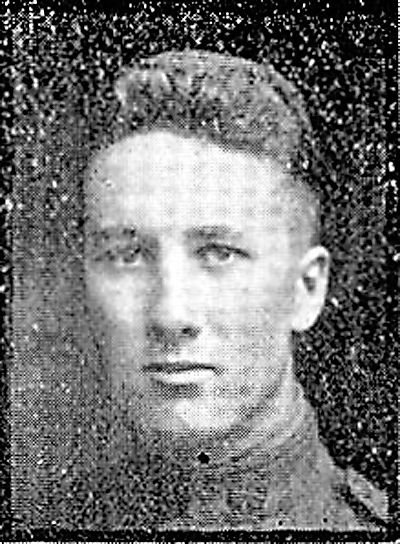
Guy Rutherford Day, son of Mr. and Mrs. Minor H. Day of 90 Allison Ave., Washington, was born Sept. 23, 1896. He enlisted in April 1917 with Company H, 110th Infantry, 28th Division and was, like Jacqmain, sent to Camp Hancock. He sailed for France May 3, 1918, and attained the rank of sergeant. He was wounded July 30, 1918, by a machine gun bullet. The Army kept him in France for several months after the war’s end, and he shunned a chance to become a commissioned officer. When he returned, he worked for the Pittsburgh Sun-Telegraph and became an editor of the Washington Reporter. In a remembrance published in the Sun-Telegraph’s successor, the Pittsburgh Post-Gazette, his granddaughter, Katie Doyle, revealed the letters that turned up in an attic shoebox decades after he wrote to his wife-to-be, Hazel Henry, from France.
Doyle included this poem her grandfather wrote:
“There’s a little girl I’m loving far across the sea,
I can see her in the shadows stretching forth her arms to me;
As she stood that night of all nights with a smile so sweet and rare,
Bidding goodbye to a soldier bound to do his bit o’er there.”
Doyle notes that both Guy and Hazel Day died in 1962.
The National Cemetery of the Alleghenies, 1158 Morgan Road, Cecil Township, plans a wreath-laying ceremony for 9 a.m. Wednesday at the assembly area as part of a nationwide effort to commemorate U.S. involvement in World War I. Locally, the wreath-laying coincides with the cemetery’s monthly “moment of remembrance” ceremony to honor veterans recently laid to rest.