

Downtown transition
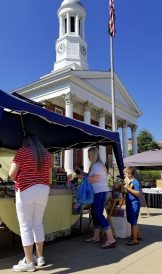
WAYNESBURG – Shoppers who walk along High Street in Waynesburg will find most downtown storefronts occupied.
It’s a welcome sight in a time when retailers in most small towns have moved to the suburbs.
But High Street appears to be in a transition, of sorts, right now.
In addition to the typical churn of small businesses, the state’s unemployment office is moving away, a historic structure has been saved, a new senior housing complex recently opened, and construction just ended on downtown’s first new commercial building in years. Even the popular weekly farmers market has moved from the shadows of Church Street onto the sidewalk in front of the courthouse stairs that lead to High Street.
“I think it is (in transition), but I’d still like to see more small businesses,” said Blair Zimmerman, a Greene County commissioner and former Waynesburg mayor. “Anything can happen. It’s improving and getting better.”
That opinion is felt by many others.
“The one thing we hate is empty storefronts and dilapidated buildings,” Waynesburg Councilwoman Lynne Snyder said.
Still, there seems to be a perception around town, she said, that there’s nowhere to shop and fewer places to park. Snyder rattled off a list of florists, clothing stores, art shops and antique stores. But there still isn’t an anchor on High Street, she said.
“We just don’t have anything that’s mainstream. It’s artisan, which is good, to an extent,” she said. “We would like to have another grocery store that isn’t a dollar store.”
She admitted she’s become concerned in recent weeks by the closures of several stores.
However, Larry Marshall, the council president and leader of Waynesburg Prosperous & Beautiful, sees those changes as the normal transition of small businesses – which he said can be “good and bad” – and pointed to a new coffee shop opening soon at Victoria Square. It’s sometimes difficult to keep anchor businesses from moving closer to the interstate interchange where they have more space and are closer to travelers, he said.
The biggest target for the borough in recent years was updating its comprehensive plan, which gave property owners more leeway when trying to develop a parcel or open a new business.
As with any older town, dilapidated buildings are a big problem, and the borough has worked to cut down the number of blighted properties from 48 four years ago to 25 to 30 today, he said. The borough has worked with Habitat for Humanity to have some restored, while others have been demolished.
“We’re still working on blight, but the amount of money it costs – as you’ve seen in Washington – it gets really difficult,” Marshall said, citing the recent collapse of the Montgomery Building in the city to the north. “It’s an ongoing process. You think you’re making progress and then something happens.”
The new 52-unit Gateway Senior Housing complex on East High Street opened last June for low-income residents. It hasn’t had the desired effect, however, of driving more customers to local shops, both Snyder and Marshall said.
A few blocks closer to the courthouse, the century-old Ganiear’s Building has been saved after Greene County Redevelopment Authority financed a project to demolish the rear of the structure and gut the main section to give the building a second chance. While the authority so far has spent at least $320,000 on the project, it hopes to recoup some of those expenses by selling the building to someone who will finish the work, since it doesn’t have enough money to complete the restoration.
“I’m hoping we get something good in there,” Zimmerman said.
But possibly the most impressive addition to High Street is First Federal Savings and Loan of Greene County’s new administrative office building at 25 E. High St. at the site of the former Allison Building. Although not identical to the Allison, the new brick façade building is similar and harkens back to the site’s Rain Day heritage.
“We knew we were tearing something down very important to the community – and important to us – but we wanted to build something very similar,” said Judi Goodwin Tanner, the bank’s president and chief executive officer.
A plaque describing the origins of Rain Day at the site is situated over a few bricks salvaged from the Allison Building when it was demolished in 2013.
“We hope it means something to the community,” she said. “We look at it as an investment in the community.”
All of those additions are good signs for retail, said Lauren Stauffer, who owns Ruff Creek Crafts & Antiques across High Street from the Ganiear’s Building. More important, though, is the Waynesburg Merchants Guild that formed three years ago and has banded together 15 businesses to coordinate advertising and events.
“Being a small town in a rural county, we’re sparsely populated,” said Stauffer, who is the group’s treasurer. “(We) work together to see what neighboring communities are doing and how they can help and try to make it from there.”
Stauffer said the group also helps to engage the community and fight off stiff economic winds that blow against small businesses.
“To be successful in a small town, we need to cultivate the community,” she said. “If that’s through redevelopment or any strategic plan the partners within our community have, organizations and leaders need to connect on a regular basis and take it from there.”
More changes could be on the way with the explosion of online shopping. Robbie Matesic wants to face that challenge head-on.
The executive director of Greene County’s Department of Economic Development said her agency is focused right now on bringing manufacturing jobs and agricultural options to the county. But on the horizon, she said, is a digital initiative that would embolden small business owners to dabble in “e-commerce” to advertise and sell products online.
“It would be great for retailers not just on High Street, but across the county,” Matesic said. “I have it as a goal that I would like to figure out how to bring the parties together to put together a digital marketing program in the county. It’s going to take partners. It’s not something we could do on our own.”
Those partners could include Waynesburg Prosperous & Beautiful, Greene County Chamber of Commerce, Community Action Southwest and local business leaders. The biggest hurdle is the lack of reliable broadband internet services in the county, which would need to be significantly upgraded to give the digital initiative – and local business owners – any chance of success.
“It brings (sales) into the way that commerce moves in 2017,” Matesic said. “More and more, even large retailers are failing because of internet sales. The real promise is in e-commerce for small businesses, and that’s certainly true for rural communities.”
As for the borough and High Street itself, Snyder said some of the biggest fights among council members involve whether to cater to retail or residential needs. While Snyder has pushed for more housing options, including townhomes, she said Waynesburg will never be able to move forward without local leaders working together for the betterment of the community, both on High Street and in the neighborhoods.
“There must be a vision from council to get on the same page,” she said.