

Trying to reach agreement on property assessments
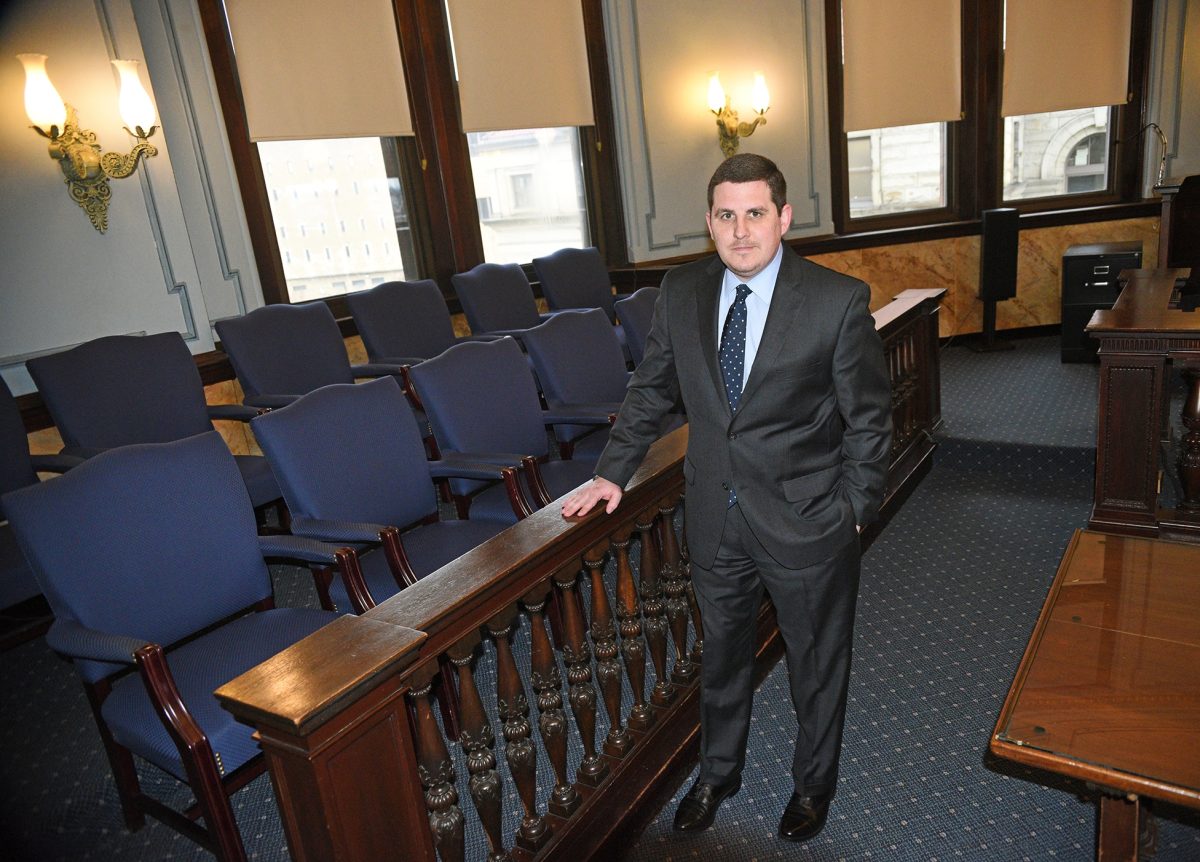
In this file photo, Patrick Grimm, Washington County Court administrator, stands next to a jury box in the county courthouse.
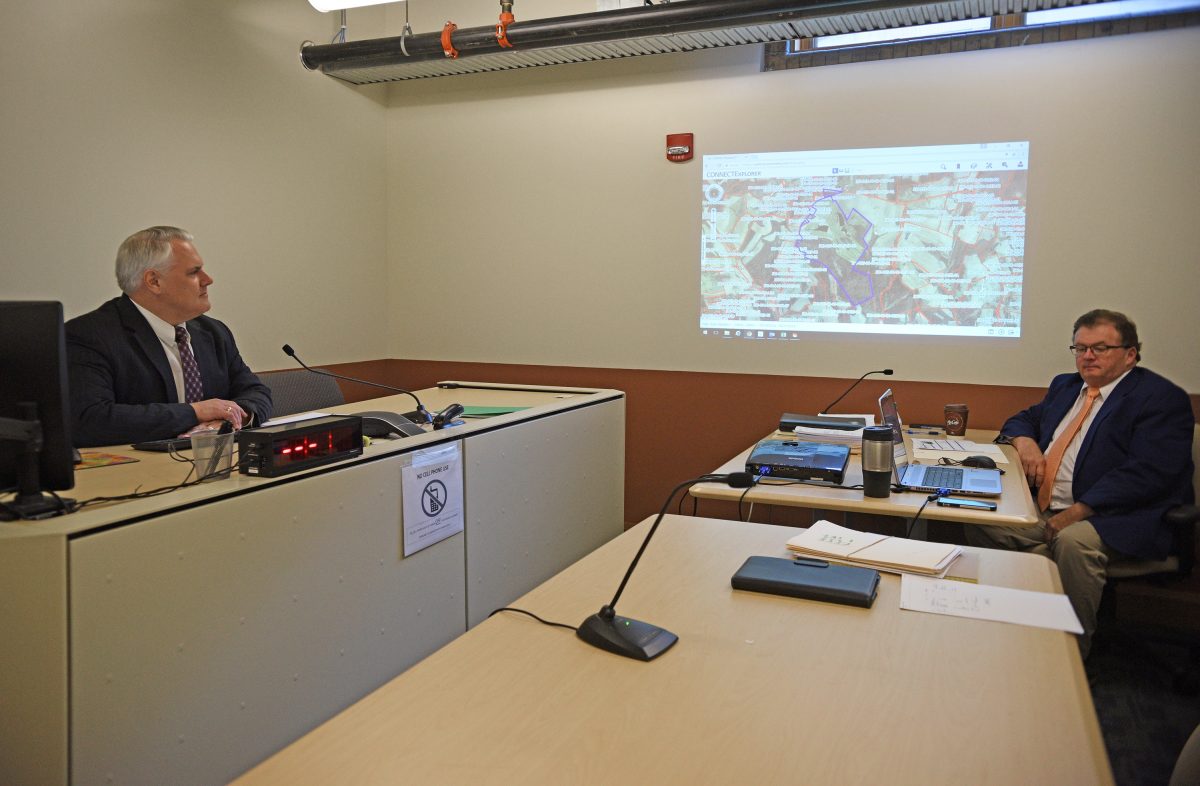
Joseph M. Zupancic, left, court-appointed master for tax assessment appeals, and Washington County Tax Revenue Department solicitor Blane Black await the start of a conciliation conference.
A year ago last week, the Washington County prothonotary’s office was swamped before a deadline to appeal property assessments scheduled to take effect Jan. 1, 2017.
This summer, appeals are still being filed, and the deadline in a nonreassessment year is Friday, Sept. 1, the same as in Greene and Westmoreland counties.
“We’re getting a few of them,” said Prothonotary Joy Schury Ranko last week. “Not an excessive amount. It’s hard to say as far as how many people are going to appeal.” She speculated property owners were waiting to see how the reassessment, Washington County’s first in 35 years, “was going to affect their taxes.”
School districts, which follow the state’s fiscal calendar that ended June 30, were the last to set a tax levy. The school district’s tax bite is by far the largest when compared with a municipality’s and the county’s.
At the behest of Washington and McGuffey school districts, the county commissioners in 2013 entered into a $6.9 million contract with Tyler Technologies to reassess property in Washington County, and the reassessment saga has come full circle, returning to the courts where the impetus began.
From his second-floor office at the courthouse, Washington County Court Administrator Patrick Grimm speculated, “I suspect the number of appeals would be much smaller than last year. From the experience of the other counties and from the process itself, I would be surprised if the number of appeals would match the number from last year.
“With higher value, larger properties, you were going to appeal regardless.”
Cases that went before a three-person board of assessment appeals last year at the Chapman Building in Washington between Aug. 10 and Oct. 31 numbered 9,500.
Washington County has 121,000 individual tracts of land, and owners of 1,156 of them questioned the fairness of the value placed on their property by Tyler Technology Inc.’s reassessment and the three-person boards, so they took their cases to court. Not surprisingly, 39 percent of the appeals originated in the communities with the highest populations and most commercial development.
A breakdown of the largest number of total appeals by municipality stacks up this way: Peters Township, 65 residential, 36 commercial; Washington, 25 residential, 59 commercial; South Strabane, 17 residential, 64 commercial; North Strabane, 30 residential, 43 commercial; Cecil Township, 22 residential, 44 commercial; and Canonsburg, 18 residential and 28 commercial.
Once the appeals were filed with the prothonotary, the next step was a conciliation conference, the first round of which began in late February.
The vast majority of conciliation conferences resulted in just that – settlements that ended the assessment appeals.
“We’re dealing with 1 percent of the parcels in the county,” said Grimm. “There are 121,000 parcels, approximately, and about 1,000 to 1,200 were appealed. In the assessment process, 99 percent did not feel the need to go to court afterward.”
According to Grimm, as of July 31, 782 assessment appeals have been disposed of because the parties reached an agreement. Another 15 settled in early August. Among the properties settling at this level was the South Strabane Township Trinity Point Walmart store, part of the world’s largest retail chain as measured by revenue. Court records show an assessment of $4.8 million was agreed upon in April.
Sixty-three assessment appeals ended because the taxpayer withdrew or failed to appear for a scheduled conference. Grimm speculated that perhaps some of those in this category “saw a tax bill and they realized ‘this isn’t so bad,’ or they got an appraisal that matched that of Tyler Technologies’.”
The rest of the cases resulted in postponements with new dates. Although the seven court-appointed masters in tax assessment appeals had hoped to wrap up their task by Aug. 9, what Grimm called “stragglers” will be scheduled during the rest of August and into September.
At their June 30 meeting, the commissioners extended the contracts of Blane Black, who is also solicitor to the tax revenue department, and attorney Dorothy Milovac to represent the county in reassessment cases appealed to court. Each will be paid $25,000 in what was termed “a flat contract amount.”
“If you take the continuances out of it, we have an 86 percent rate of disposal without going to a hearing. If if we end up having hearings on 10 percent of 1 percent, that’s a pretty successful outcome, in line with what we saw in Indiana and Allegheny counties,” Grimm said. “Now, they may have gone through the (three-person) board proceeding, but at the end of the board level, at least, only 1 percent overall saw the need to go to court.”
Indiana County began its reassessment a year before Washington County, and Allegheny County’s base year is 2012.
On-the-record hearings before a master in tax assessment, which can include testimony, are the next step for cases not disposed of during the conciliation process. Of those, four have been withdrawn and 36 have ended with agreements among the parties. The first of these hearings convened in May.
At this level, for example, property appeals of MarkWest, which processes and transports natural gas, were consolidated because they affected 11 municipalities and seven school districts.
The master in tax assessment appeals will make a written recommendation to a judge, presenting conclusions of law and findings of fact. If a property owner continues the assessment appeal, the matter will go before a judge, who will not hear testimony but could schedule the case for argument.