

City defends handling of complaints about now-collapsed building
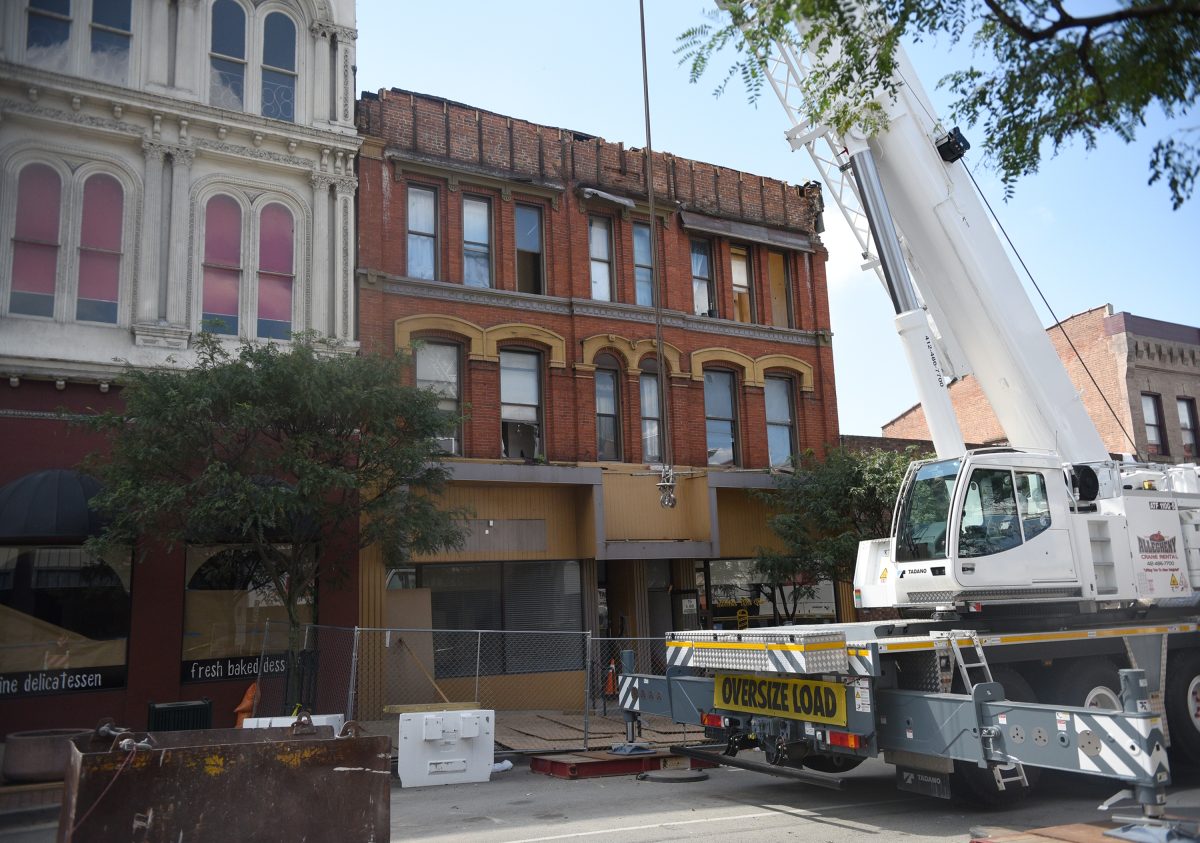
Demolition continued Wednesday on the partially collapsed building owned by Mark Russo on North Main Street in Washington.
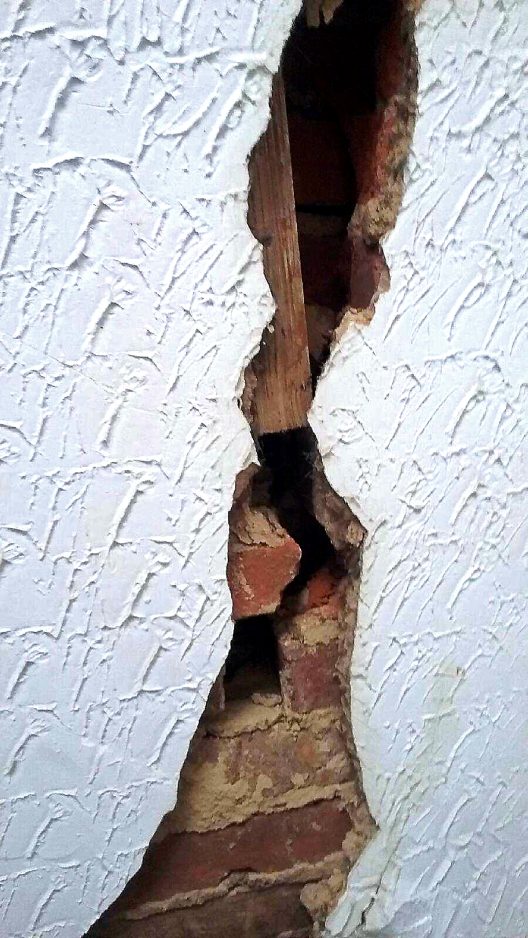
At left, Susan Vandevender said cracks like this one started appearing on the wall in the stairway between the second and third floors of the building at 15 N. Main St. a few months ago, and started growing. She said the landlord had someone fill the cracks, but new ones appeared shortly thereafter.
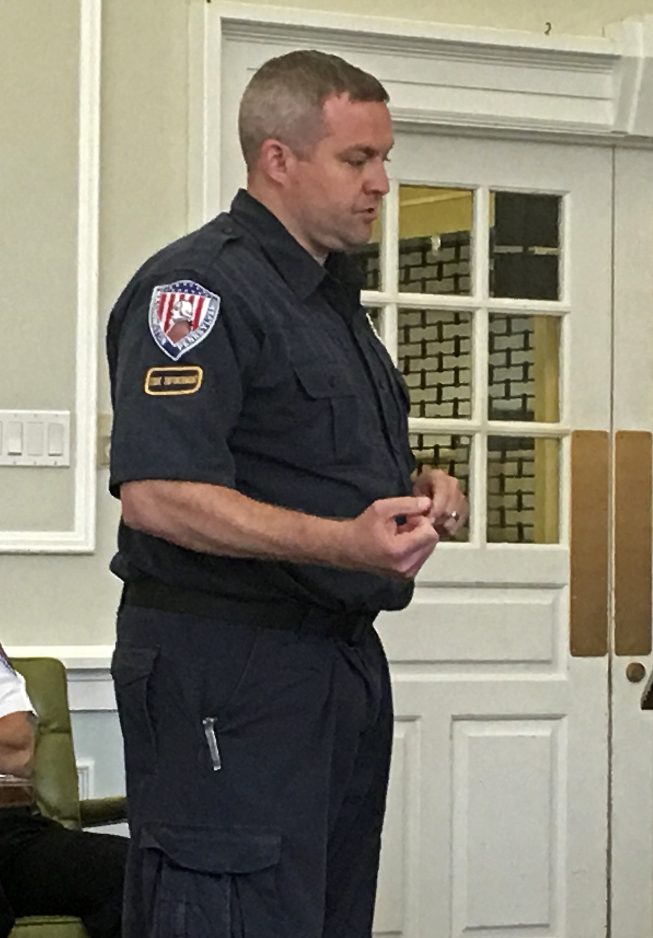
Ron McIntyre, Washington code enforcement officer, speaks during a city council meeting Aug. 10.
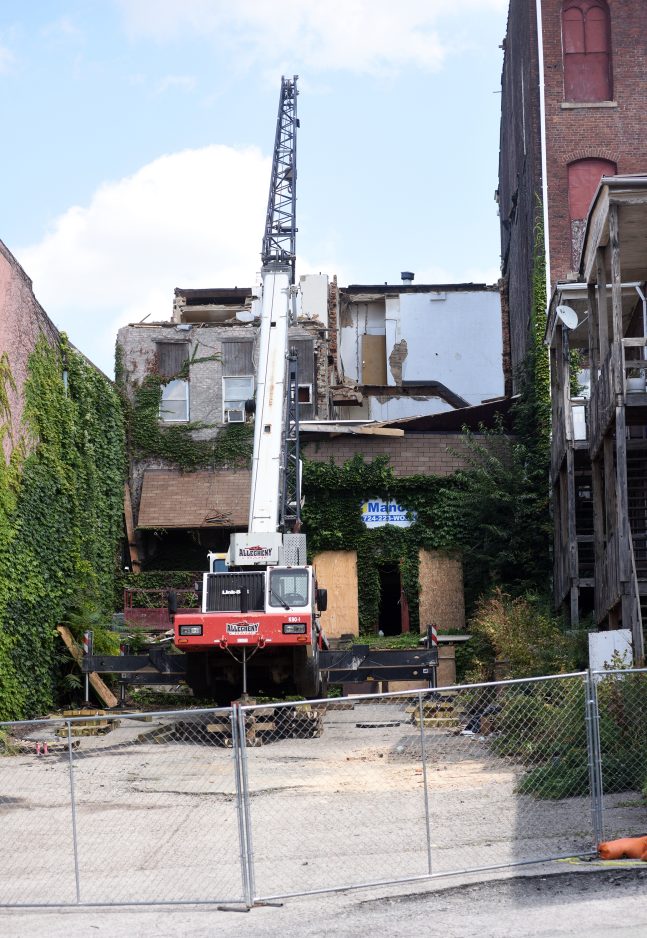
Demolition continued Wednesday on the partially collapsed building owned by Mark Russo on North Main Street in Washington.
Months before a downtown Washington apartment building caved in, trapping a woman for more than nine hours, a longtime tenant told the city code enforcement officer the conditions of the building’s foundation were “severe and dangerous” and complained of a “massive crack” in the wall.
“(I) also want to know if the foundation is fixable,” Dennis McCullough wrote to code enforcement officer Ron McIntyre in a March 18 email. “I’m also curious if 15 North Main (is) done, condemnable?”
McIntyre cited the owners of the three-story “Montgomery Building” two days later, alleging they “failed to replace failing wall cracked NOT structurally sound.”
An attorney representing the owners said the purported issues the tenant described in that email didn’t cause the building to partially collapse four months later, when rescuers worked more than nine hours to free resident Megan Angelone, 37, from under a refrigerator and rubble.
Regardless of its cause, the July 12 incident touched off a heightened focus from city officials on code enforcement at rental properties.
In the weeks following the collapse, city officials employed a provision of the International Property Maintenance Code, evicting tenants from several other properties – some of which also belong to the owners of 15 N. Main St. – they deemed uninhabitable; however, the city mayor and the attorney representing building owners Mark Russo of Washington and his sister, Melissa, of Colorado, rejected the idea they should have taken stronger steps prior to the collapse.
“I don’t think the city could have – or my client would have – known that the roof was going to collapse,” said Elizabeth Tarasi, the Russos’ attorney.
McIntyre said he had hoped the owners would bring the building into compliance.
“I guess I just never foresaw this occurring,” he said.
Mayor Scott Putnam said McIntyre did everything he could in filing the citation.
“We had cited the building owner. We were slated to go to court on that property six days after the collapse. So I don’t know that we missed the mark. It’s the timeframe given by magistrates, given by the law, that kind of holds us back,” Putnam said. “We cited (Russo). And it takes that long to get to a hearing in front of the magistrate.
“If you find a situation, if code enforcement finds a situation, that’s what you can do. Other than going and condemning and getting everybody out, that’s what we can do,” he said.
Tarasi said a lack of maintenance didn’t cause the collapse.
Mark Russo was “in the process of making repairs. This had nothing to do with the roof collapsing,” she said.
She cited stormwater that was draining from a neighboring roof and a “really heavy, heavy rain” before the incident as “contributing causes.”
Tarasi also said the collapse was not caused by the cracked wall described by McCullough.
“That wall is still standing,” Tarasi said.
She added previous concerns about the building’s foundation had been “resolved, like seven years ago” and “had absolutely nothing to do with the collapse.”
Mark Russo appeared with Tarasi and his mother, Loretta, before District Judge Robert Redlinger July 25 for a summary trial on the March 20 citation and others the city filed following the collapse.
After a discussion with Redlinger and Tarasi, city solicitor Steve Toprani said both attorneys asked for a delay as negotiations between the parties continue, and Redlinger rescheduled the trial for Aug. 24.
Putnam said the city is “working with” the Russos’ insurance company to fund the demolition, which is expected to cost hundreds of thousands of dollars and is still in its initial phase.
McIntyre’s March citation concerning the wall stated he’d sent notice of the problem to the owners Feb. 6.
In the intervening weeks, McCullough sent McIntyre more complaints.
In a March 5 message, the tenant cited bricks “falling from (the inner) frame of the building” and an area in the rear of the building where “brick is cracked and pieces of cement and brick are falling off” on the top-right side. “I see a hazard and a danger, 15 North Main is in poor condition,” he went on.
Elsewhere in the message, McCullough asked, “Can I or anybody request the building, 15 North Main & 9 North Main (which is connected to 15 North Main) be inspected?”
“I will take a look at it,” McIntyre answered the next day.
McIntyre said he inspected “just the exterior” of the building before he filed the citation, and “to my knowledge” neither a structural engineer nor Jarrod D’Amico from Harshman CE Group, contracted by the city to perform code official duties, were consulted about the building before its collapse.
McCullough continued sending emails after the citation was filed, claiming repairs made to the wall, which was in a stairwell, “did nothing toward stopping the foundation sinking, which is causing the problem.”
McCullough said in a recent interview it “would be like guessing” to say whether the city should have anticipated the collapse.
“I think some people are guessing, overreacting to the situation. Now that the disaster has happened, it’s a good time to have an opinion.”
McCullough said he thought “Ron McIntyre was handling it. I didn’t expect it to fall down, either.”
Officials subsequently inspected other properties owned by the Russos, declaring two unfit for human habitation and ordering tenants to leave in the week following the cave-in. They also inspected the vacant former Clark School on Jefferson Avenue, which belongs to other owners.
McIntyre later filed 33 more citations for alleged violations at rental properties owned by the Russos. Most concern the two properties the city closed to tenants. Officials allegedly found “overcrowding in units” and “no electrical service in kitchen/bathroom” at an apartment building on Duncan Avenue, and at a two-unit dwelling on Hall Avenue, walls were allegedly “bowing out (and) may collapse” and “toilet/bath leaking into basement,” according to citations.
“I think the community’s been trying to make sure the properties are safe,” McIntyre said. “I think everybody’s trying to work together to make sure we have safe properties in the city.”
Tarasi said she is “very disappointed that Mr. McIntyre has to continue to issue citations.”
Mark Russo “really wants to get this resolved, and do the right thing, and get this behind him,” she said.
With approximately 4,500 structures in a historic city with one code enforcement employee and limited funds for blight demolition, Putnam said he and council are exploring options to handle the workload.
“I think the city needs help in that department. The code enforcement department needs help,” Putnam said. “The money acquired from citations doesn’t fund it.”
He also is open to considering a reduction of the city’s fee for construction permits, which are required when property owners make structural changes, in order to encourage landlords to maintain their properties.
Dilapidated structures have long been identified as a problem for Washington. Putnam has prioritized tackling the city’s blight since he ran for mayor in 2015.
“Why is the city in this position? I think it stems from the fact that residential home ownership is down in the city. Over 60 percent of our buildings are renter-occupied. So the building owners may not care what that building looks like as long as they get their check every month,” he said. “So the grass isn’t cut. The garbage piles up on the side of the buildings. The weeds grow up. The bushes aren’t trimmed. Because the landowner can’t see it from his house, he doesn’t care. That’s not to say they’re all like that. There’s quite a few that do a great job. But there are some that ruin it for everybody.”