

Local colleges take great pains to educate, monitor athletes on medications
The superstar world of Kevin Stevens, possessor of two championship rings and skills almost unparalleled in hockey, began to unravel in 1993. A Penguins left winger, Stevens was knocked out while skating in a game and violently struck the ice, shattering a number of facial bones. He had reconstructive surgery and was hospitalized for a month when, he said, he became addicted to prescription painkillers Percocet and Vicodin.
That launched Stevens on a harrowing, 23-year descent that hit a nadir 12 months ago, when he pleaded guilty to two oxycodone charges and faced a jail term. He was sentenced, instead, to three years’ probation, fined $10,000 and ordered to speak to organizations about addiction and the perils of prescription drugs. Terms of his sentence included being subjected to random drug tests.
Nearly a quarter-century after becoming hooked, he appears to be finally emerging from the depths. A two-time Stanley Cup winner with the Penguins, Stevens said he has been alcohol- and drug-free for the past 18 months. The Penguins trusted him enough to hire him as a special assignment scout in early September.
Stevens, to his good fortune, is prevailing over addiction. Other athletes have not fared as well over the past decade or so, including an assortment of teenagers. Some began using pain medication in the aftermath of injury, then became ensnared in their use and not only couldn’t wriggle off, but graduated to something worse. A top pitching prospect, coveted by major league baseball teams eight years ago, ended up dying of a heroin overdose.
Educating and steering young athletes away from the tentacles of this beast is among the missions school officials have embraced nationwide. At a time of pervasive heroin addiction in their region, administrators of Washington & Jefferson College, Waynesburg University and California University of Pennsylvania spoke out about policies, rules and laws that are in force related to young athletes and pain management.
Prevention is key
The National College Athletic Association oversees interscholastic sports at all three schools. Cal U. competes at the Division II level, below the so-called “major colleges” of Division I, but above Division III Waynesburg and W&J.
On its website, ncaa.org, the NCAA said it shares the responsibility of drug education and testing at an annual cost of $6 million. The organization said it tests athletes during national postseason competition at all levels and, randomly, year-round in Divisions I and II. The NCAA, for example, tested random W&J players during the Division III baseball championships last spring.
Athletic departments at Division III colleges are responsible for random testing outside of the postseason.
The overriding message from the NCAA: A ton of prevention is worth a megaton of cure.
At Cal U., the Division II status can put an added spotlight on drug abuse, either with performance-enhancing supplements or addictive painkillers. Sports are a little more serious at that level than Division III.
Spokeswoman Christine Kindl said the university’s athletic trainers discuss with athletes the use of prescription medication and supplements. The NCAA, she added, provides each college with information on drug use – and abuse – that is distributed to all athletes, along with other information at the athletic facilities.
“Anyone on an NCAA team roster, even if they have surgery, is eligible for drug testing, I’m told – a strong incentive to avoid any medications that would result in a positive test,” Kindl said.
Mike Lesako, co-head trainer at W&J, said: “We talk with all teams at the beginning of the school year, about how to handle injuries, classes, time management and use of drugs and alcohol. We also give them a pamphlet with substances (banned by the NCAA).”
He and Andy Palko, his counterpart at Waynesburg, stressed they and their training staffs cannot prescribe pain medications.
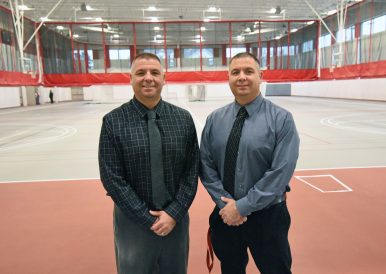
“All we have in our facility are over-the-counter items – Advil, Tylenol, sinus decongestant, antacids. We don’t distribute anything other than that,” said Lesako, who shares head trainer duties with Mark, his twin brother. Mark, who also is associate athletic director, and Mike are Bethlehem-Center High School graduates.
“Any prescription medication an athlete may need,” Mike Lesako added, “comes through our team physician, Dr. (Tony) Canterna. He would have to write a (prescription).”
Palko, a former Yellow Jackets football player (2001-05), said: “We have to ensure that things we do for the student-athlete are in the best interest of the student-athlete. Trainers cannot prescribe meds; only a doctor can do that. (Trainers) do what we can do to help you recover.”
Over-the-counter meds, which are often considered helpful and harmless by comparison, enter into the equation, as well. If misused or abused, they, too, can become addictive and/or cause organ damage.
Waynesburg’s team physicians, Palko said, also “shy away from prescribing over-the-counter medications that can lead to potential addiction.”
“We even keep our over-the-counter medications locked up,” Mike Lesako said. “We don’t keep anything in house. I don’t want the liability.”
Although random drug testing outside the postseason is not mandatory in Division III, the respective trainers at Waynesburg and W&J say their schools do so.
“We’re not bound to test, but we have tested and fairly often,” Palko said.
The W&J athletic department, Lesako said, “does random drug testing of all athletes over the year. Not every Division III school does it. We want to make sure everyone is OK.”
Each of the trainers said he has observed few drug issues among athletes at their schools, which is likely due to the young people who matriculate there. Few of their athletes are considered prospective pros coming out of high school, and many have enrolled because of the colleges’ academic pedigrees.
“They’re just that – student-athletes with a very slim chance of getting to the next level,” Palko said. There’s more of a concentration on academics.”
“I haven’t seen anything significant here (drug-wise),” said Lesako, a W&J employee for 19 years. “Here, the kids want to get a good education – and play sports, too.”
Regional editor Mike Jones contributed to this story.