

Area schools work to improve, maintain graduation rates

Ringgold High School student Montell Carlock does class work in the cyberschool lab. The district has a cyber program with a lab at school with specific teachers assigned who can answer student questions as part of its effort to keep raising graduation rates.
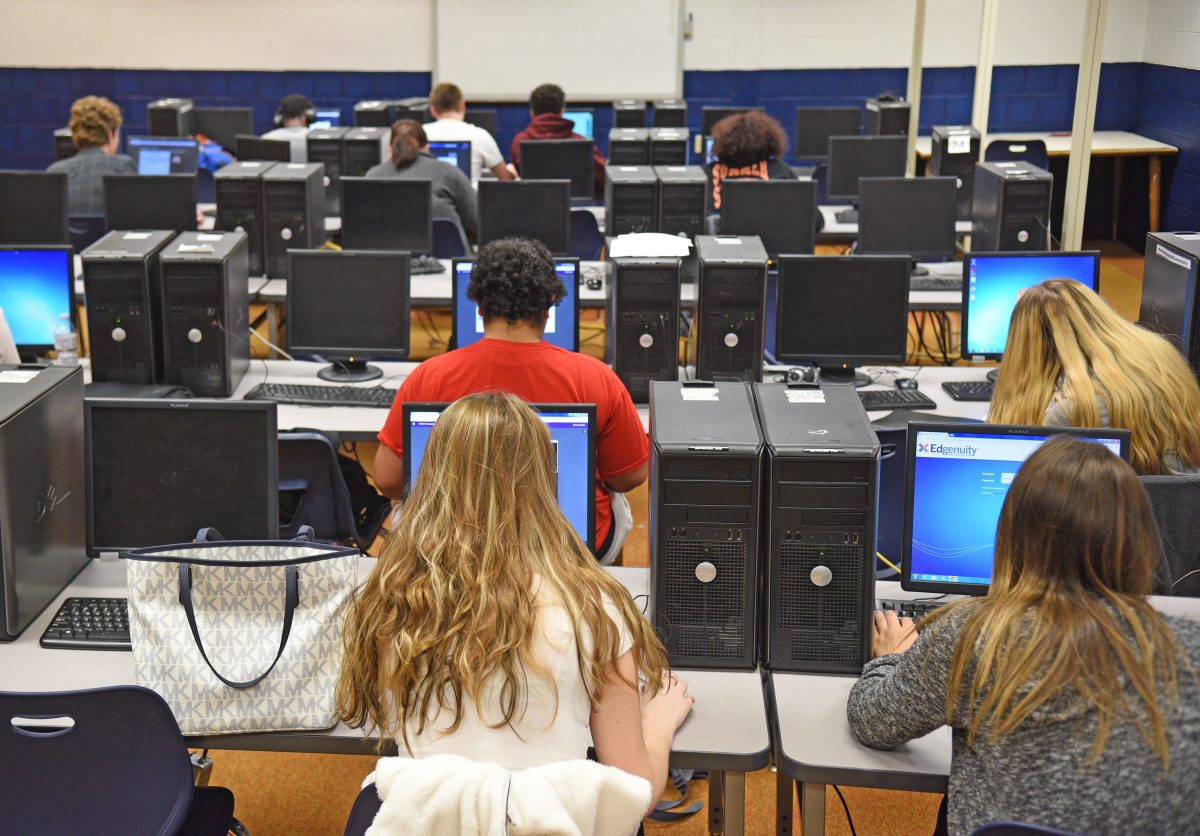
Students study in the cyberschool lab at Ringgold High School.
Two-thirds of the school districts in Washington and Greene counties and the Mon Valley have four-year graduation rates higher than the state average, but several districts are working to improve or maintain their numbers of high school graduates.
Pennsylvania’s 2014-15 school year graduation rate was 84.75 percent, the most recent year of information available from the Pennsylvania Department of Education website. In Washington and Greene counties, graduation rates ranges from a high of 98.32 percent in Peters Township School District to a low of 71.13 percent in Washington School District.
After a low of 62.07 percent in 2011-12, Washington’s numbers have been improving. Superintendent Roberta DiLorenzo said the district has put multiple plans in place to help more students graduate because it’s so important.
“The best foundation is a free, public education,” she said, “It’s your springboard to your future. There are few jobs where you are not going to have to school yourself (after high school.)”
That means an emphasis in Washington in raising the graduation rate.
DiLorenzo said the district tries to be more student-friendly for students who are falling short of the requirements. District officials found that many students who were less than five credits short of graduating were not returning to finish.
So Washington created an after-school program that is more friendly in regard to scheduling. The district also created a cyberschool that allows flexibility for students.
The cyberschool was started for credit recovery for students who failed a class but has morphed into helping kids who need classes to graduate. DiLorenzo said the classes are not shortened or streamlined.
“We are accommodating fifth-year students, and we are graduating more of those,” she said.
For students who need to work, the district created a work-study program. Students must still come to school for part of the day, but then can be released for work. They must work at least 60 hours a semester to get credit for that experience. A volunteer internship is also available for credit for students who want to volunteer in the community.
DiLorenzo said the district also uses data to determine which students need more help if they are not passing state standardized tests. Those students take academic support classes, which are not repeats of reading and math classes, but instead are targeted to areas where each child needs help.
“It’s personalized for students,” she said.
At Carmichaels Area School District in Greene County, the downward trend in graduation rates has caught the attention of school officials. In 2010-11, the graduation rate was 89.29 percent. In 2014-15, it was 77.33 percent.
High school principal Lisa Zdravecky said the district changed its attendance policy over the summer. Too many students were coming in late or leaving early without reason, she said. And truancy typically does not deal with being tardy or leaving early, she said.
The new policy calls for after-school detention after an unexcused tardy arrival or leaving early five times. Each subsequent violation will lead to an additional after-school detention.
She said the district is sending a message: “We want you in school and we want you in school on time.”
She said positive results already have been seen from the attendance policy change.
Carmichaels also pulled the senior project out of English class and put it in a nine-week class rotation. The students create a portfolio and have an exit interview based on the career they choose for the senior project. They also must job shadow or visit a college as part of the senior project.
She said that has helped because, “Not every student has a plan when they start their senior year.”
If Carmichaels officials think a student is at risk of not graduating, they do not wait until they are seniors to talk to them, she said.
“We do an intermediate intervention. We bring in parents,” she said, adding that they talk about the importance of graduating from high school. “All of the research shows that without a high school diploma, a lot of doors close,” she explained.
They also welcome students who need to return for a fifth year.
“We want you to have that diploma,” she said.
While some area districts are working to increase graduation rates, others are looking for ways to keep theirs high.
Ringgold School District’s numbers keep creeping up. In 2010-11, the district’s graduation rate was 90.03 percent. In 2014-15, it was 93.75 percent.
Superintendent Karen Pokabla credits the high school administration and staff with that success. She said they are very creative in offering a variety of ways for students to schedule the classes they need. Ringgold has a varied curriculum to meet different interests, she said.
Many students attend the Mon Valley Career and Technology Center to learn about a career field of interest, she said. They spend a half-day at the high school and a half-day at the technology center.
The district has a cyber program with a lab at school with specific teachers assigned who can answer student questions. Students can also use the cyber program at home, however they are more successful if they do cyberschool in school, she said.
Ringgold also has an alternative school that runs from 11:30 to 4:30 p.m. Typically students attend that for disciplinary reasons. However it has been helpful for some students for graduation, she said.
Central Greene’s graduation rate dipped to 71.65 percent in 2012-13 and jumped to 85.52 by 2014-15.
Superintendent Brian Uplinger said teachers sit down with kids who are in danger of not graduating and talk to them about the fact that high school is almost over and they are going into the real world. They ask them how they will handle the transition if they cannot graduate from high school.
“We are just being real with them,” he said. “We are not sugar-coating anything.”
He said district officials try to catch kids at risk of not graduating early, even in middle school. They talk to them about how courses get more difficult as they move through high school.
“So let’s come up with a plan,” he said.
California Area School District’s graduation rate slipped just a bit from 95.71 percent in 2013-14 to 94.81 in 2014-15. However, both are higher than 79.52 percent, the district’s graduation rate in 2010-11.
High school principal Leigh Ann Folmar credits a grant-funded position for an academic monitor as one of the reasons for the change in graduation rates. The monitor tracks down students at risk of failure, retention or dropping out.
The monitor works with students to get incomplete work done and is an advocate between teachers and students. That teacher also reminds students to study for tests and monitors the district’s online credit recovery system to make sure the students get their work done. Attendance and truancy are also monitored.
California also has an after-school tutoring program to help kids who need it.
“We have very dedicated teachers who are all moving in the same direction of doing what’s best for kids,” she said.
She said the community also supports the district and that has been a huge help as well.
“I feel that they truly value education,” Folmar said.