

State reps gather heroin testimony
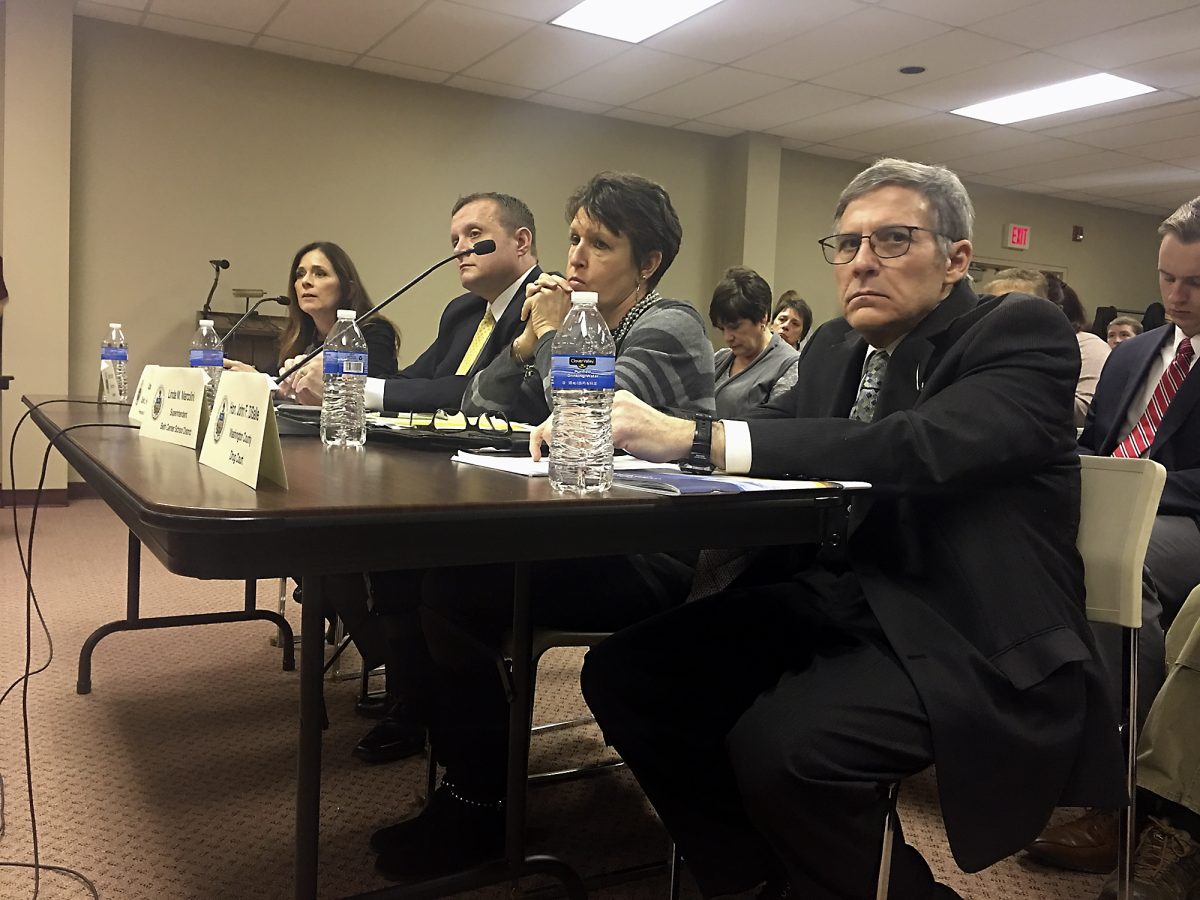
From left, Washington County Commissioner Diana Irey Vaughan, state police Capt. David J. Heckman, Bethlehem-Center Superintendent Linda Marcolini and Washington County Judge John DiSalle testified Monday before state legislators in Donora regarding the effects of the heroin epidemic in the area.
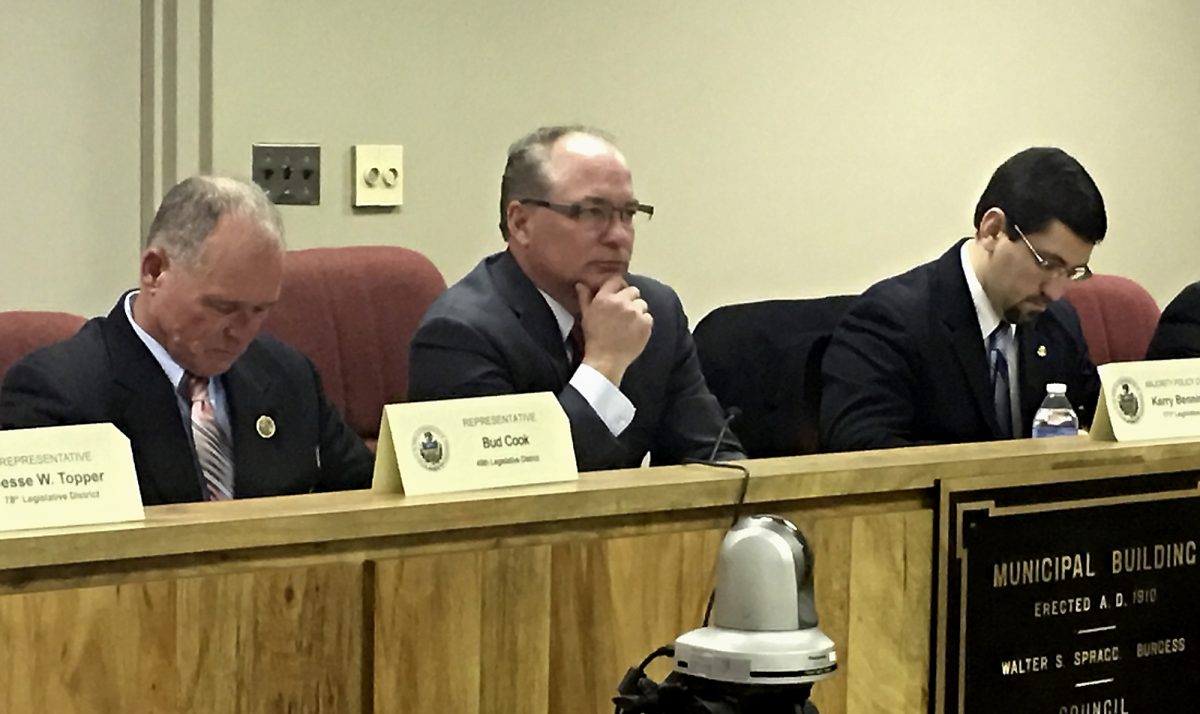
From left, state Reps. Bud Cook, Kerry Benninghoff and Jason Ortitay hear from panelists about the state’s opioid epidemic.
DONORA – In 2016, 109 people died from drug overdoses in Washington County. In 2015 there were 73, and in 2014 there were 36, according to a report from the Washington County coroner’s office.
“In two years, to jump from 36 overdose deaths to 109 is quite significant,” said Washington County Commissioner Diana Irey Vaughan, one of seven panelists to give testimony to more than a dozen state legislators Monday.
State Reps. Bud Cook, R-West Pike Run, and Kerry Benninghoff, R-Centre, chairman of the House Majority Policy Committee, brought the legislators together to hear testimony on the opioid epidemic and how it’s affecting communities.
In addition to Irey Vaughan, panelists included state police Capt. David J. Heckman, Bethlehem-Center School District Superintendent Linda Marcolini, Washington County Judge John DiSalle and Michael Cipoletti of Waynesburg University, who all gave testimony in Donora Municipal Building.
“This is about trying to gather data … and (asking) what can we do with that going forward,” said Cook.
The hearing was one of about 10 that have taken place across Pennsylvania.
Irey Vaughan talked about the county’s attempt to diminish blighted properties and cited a recent study that found a direct correlation between blight and crime.
She spoke of the county’s recently developed land bank, an attempt to streamline the process of getting blighted properties back on the tax rolls.
In Washington County, almost 75 percent of crimes involve drugs, Irey Vaughan said.
DiSalle runs the county’s drug court, in which addicts who are charged with crimes take part in the program, potentially in lieu of jail time. Frequent drug testing and group and individual counseling sessions are required.
With caseworkers and parole officers, the judge helps those addicted to drugs get treatment in order to reduce their chances of re-entry into the court system.
DiSalle testified that his program has a 70 percent success rate.
“We expect relapses, maybe at first. But as we move on, we really get tougher with them,” DiSalle said.
Since the program launched in January 2013, there have been 215 participants, 87 of whom have graduated.
DiSalle said the cost savings are significant for those who graduate as opposed to those who don’t go through the program and serve time in jail.
“It’s not foolproof, but we are seeing a lot of success,” he said.
Heckman said the Fusion Center, where investigators have standardized the collection of evidence relating to heroin overdoses and are training police across the region on overdose protocol, helps to ease the flow of information among departments. And more units have been deployed on state highways along traditional routes of drug transportation.
He said a lot of the drugs flowing into Western Pennsylvania come from Philadelphia, Baltimore and New York City.
Several panelists said there is no easy solution to the problem, but that the effort needs to be a community one.
“I agree … that it is a community problem. And one of the things I try to preach to my drug court participants is that there’s certainly not only a negative connotation about addiction, but about recovery,” said DiSalle. “A lot of the public doesn’t feel that there’s an ability to recover. I try to preach to them you have to put on the face to show that it is possible, that we can recover and that we can lead positive lives.”
DiSalle said the county would benefit from employers giving those in recovery a chance and from improved access to housing. He said there is a shortage of three-quarter houses, a stepdown from halfway houses.
“Neighbors will jump up and say, ‘Not in my backyard.’ So we need to have better attitudes about recovery,” he said.
Cipoletti, assistant professor of forensic science, explained the connection between prescription opioids and heroin and synthetic drugs, such as fentanyl.
“This stuff has been around for a long time. So a lot of the question are, ‘OK, why now? Why this particular region?’ And I think that’s what you’re attempting to do is figure that out,” said Cipoletti. “If you can figure out why this is a problem, then maybe you can figure out how to attack it in some way, shape or form.”