

Buchanan, the one and only president born in Pennsylvania
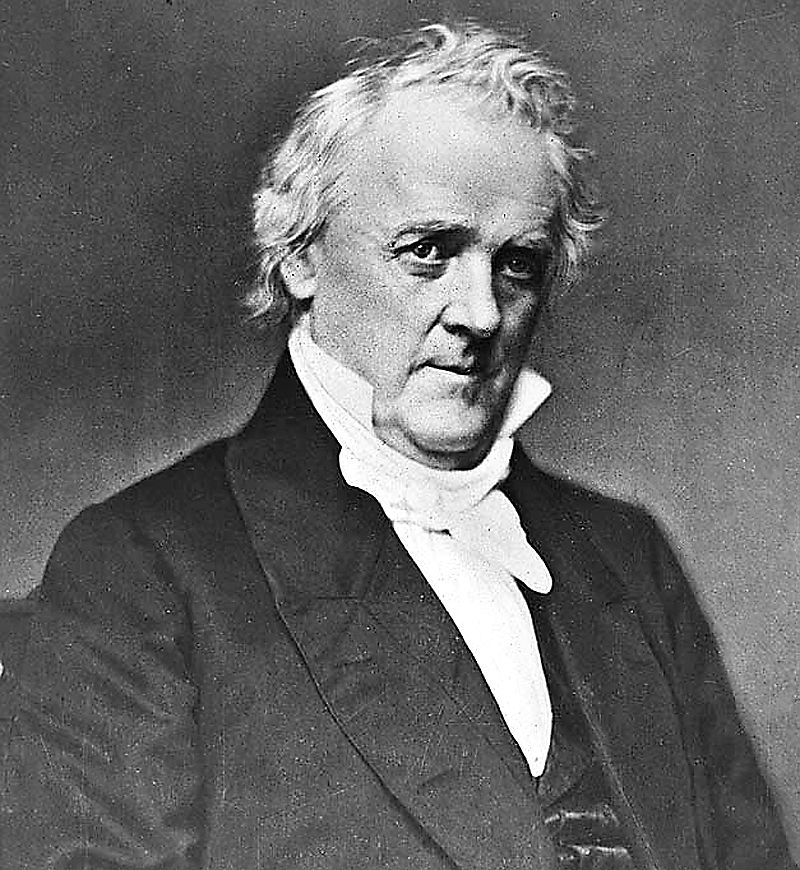
President James Buchanan
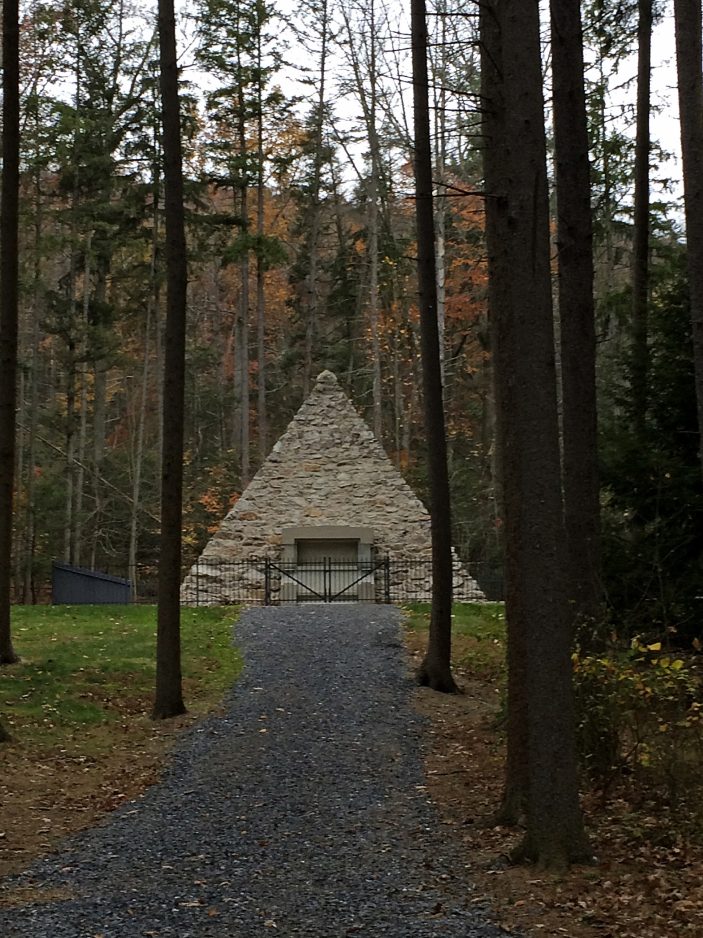
This pyramid marks the birthplace of President James Buchanan.
Ask most people to name the U.S. president from Pennsylvania, and you’re apt to get blank stares. Historians largely portray Keystone Stater James Buchanan as a sort of 19th-century Nero, fiddling around, not while Rome burned, but as the United States crumbled.
Buchanan, a Democrat, logs in at No. 15 in the presidential chronology. Elected in 1856, if this one-termer made his mark at all, it’s on the list of the worst presidents. He stands in the shadow of Abraham Lincoln, No. 16, who always shines among the top five.
During their era, whether slavery should be permitted in new states was a contentious question swirling around the nation. There were 33 states when Buchanan began his term in March 1857. Seven Southern states seceded after Abraham Lincoln won a plurality in the 1860 four-candidate presidential contest.
Was civil war inevitable? Should Buchanan have marshaled the then-meager ranks of U.S. soldiers and sailors as soon as South Carolina pulled out in 1860 and held the state with a show of force to dissuade other Southern states from joining the Confederacy? These questions are still being debated some 150 years later.
Buchanan’s legacy looms large in several parts of the commonwealth. A pyramid, of all things, stands in James Buchanan Birthplace State Park in Cove Gap, Franklin County. His family’s log trading post/home stands about 18 miles away on the campus of Mercersburg Academy – not its original site – and the family store is just one of several places that hark back to his life in Pennsylvania.
“As I understand it, the cabin sat several miles west of Mercersburg and was rescued by the academy a number of years ago to prevent total deterioration, moved to its current campus site, and fully restored,” wrote Wallace Whitworth, senior director of Strategic Marketing and Communications for Mercersburg Academy, in response to an email inquiry.
Although a plaque states, “His personal integrity and honorable career are worthy of emulation by all true Americans,” the significance of the Buchanan log building didn’t quite register with one local student.
“I didn’t really care back in those days,” said Dr. Douglas Corwin, a physician from East Washington and a 1979 Mercersburg grad. “There was a marker there. I walked past it a million times” before becoming interested in Civil War history as an adult.
His take on President Buchanan? “He alienated both the North and the South,” Corwin said. “He didn’t deal with the secession. He just basically let it happen.”
One of Corwin’s history teachers at Mercersburg, Karl Reisner, has attempted to make a case that Buchanan should not be considered one of the worst presidents. In conjunction with the bicentennial of Buchanan’s birth in 1991, Reisner started researching the 15th president of the United States, and he decided on a one-man show in which Buchanan would defend himself, explaining why he should not be ranked among the worst to have held the office.
The teacher scheduled two performances, expecting to draw about 50 people, including his students.
“There were 700-plus people there, and it was standing room only both nights,” Reisner said.
Since then, he’s presented more than 300 shows and talks, including on C-SPAN, which had a slew of experts wanting to weigh in on Lincoln, but only Reisner and Millersville University Professor Richard Keller to discuss Lincoln’s immediate predecessor.
“He’s deserving of more praise and accolades that he gets,” Reisner said in a recent interview, describing Buchanan as consistent. “There were principles he held during his entire political career, and when things started to fall apart, he stayed with those principles.”
One of those principles was a laissez-faire view of the economy, even when the Panic of 1857 plunged the United States and other developed nations worldwide into what we would now call either a depression or a recession.
Economics aside, the question of slavery loomed large in Buchanan’s time in office. “He thought secession was totally unnecessary and that a compromise on slavery could be made,” Reisner said. “I think he was pro-Union more than anything else. Slavery had been outlawed in a number of states, including the one he came from. He thought slavery would die of its own weight because of mechanization. People wouldn’t have had slaves when they could buy machines.”
Among Reisner’s unusual stories about Buchanan is the 15th president’s elaborate behind-the-scenes plan to prevent Lincoln’s election. “Honest Abe” was so hated or misunderstood in the South that his name did not even appear on most ballots. Buchanan foresaw a scenario in which no candidate would have garnered enough electoral votes, so the election would go to the House of Representatives, where each state would get one vote and a hopeful would need at least 17 states to win. Buchanan predicted a deadlock in the House, so the choice of leader would go to the U.S. Senate, which would elect a vice president. Buchanan’s man for the job was Joseph Lane, a U.S. senator from Oregon, a well-known, moderate Unionist, and a leader who would have been acceptable to Southern politicos. Lane was a vice presidential candidate on a slate with Southern Democratic presidential hopeful John C. Breckinridge, Buchanan’s vice president for a time. The vice president elected by the Senate would then ascend to the presidency.
This series of events never came to pass because Republican Lincoln garnered Pennsylvania’s 27 electoral votes plus another 153 to win the White House.
Reisner said he admires Buchanan’s “ability to stand by his beliefs, and he didn’t abandon them when those positions became difficult.”
Buchanan had been a secretary of state, ambassador to both Russia and Great Britain, congressman and a U.S. senator. Reisner gives credit to Buchanan for avoiding war with Britain over the Oregon territory. Some historians also say his ties with Britain’s Queen Victoria kept Britain, home to many textile mills, from entering the Civil War on the side of the cotton-rich Confederacy.
Buchanan stands out in one respect: He was the only bachelor president of the United States. This has led to speculation that he was homosexual.
“He wouldn’t have been elected if they thought he was gay in those days,” Reisner said. “He did live with a man for a while,” Alabama Sen. William Rufus DeVane King.
Rooming in Washington, D.C., with a colleague was not uncommon at that time. Reisner also pointed out that Buchanan, a successful lawyer in Lancaster, was engaged to a millionaire heiress, Ann Coleman. Her father thought Buchanan, the son of an Irish immigrant, was marrying her for her money. Coleman died while staying with relatives in Philadelphia. “Many think she committed suicide,” Reisner said. “He never had a relationship that close again with a woman.”
During Buchanan’s White House years, his niece, Harriet Lane, acted as his hostess. He had long been her legal guardian. She became a philanthropist after his death in 1868, and she hoped to purchase his birthplace, called Stony Batter. This occurred after her death in 1895, and construction of a pyramid in what became a state park was completed in the early 1900s.
In his student days, Corwin often bicycled from the academy to the woodsy state park where a creek flows. “I go back and visit the academy here and there. The Cumberland Valley, it’s a beautiful part of the world in a fruit-producing region at the base of Tuscarora Mountain. Whenever I visit there I almost always stop in that park. If anybody’s in that area, it’s worth a look.”
In Lancaster, Buchanan’s estate, Wheatland, is privately owned but open to the public.
“It was like a rite of passage for Girl Scouts,” said Denise Bachman, Lancaster native and managing editor for production at the Observer-Reporter, of the visit she and others made. “That was always a trip, to go to Wheatland.”
Bachman visited there in childhood, but has no specific recollections.
“I just remember walking through it,” she said. Guides were dressed in period costume. “There’s an elementary school named for him out there, and there’s a Wheatland (Middle) School.”
The Bedford Springs Hotel was a summer residence for Buchanan. According to the Omni Hotels and Resorts website, in 1821 future U.S. President James Buchanan made the first of many visits to Bedford Springs, which became his “summer White House” during his time in office. A plaque installed by the state also notes this connection.
About 20,000 people attended Buchanan’s funeral in 1868, so he must have been held in some esteem shortly after the Civil War. He preceded Lincoln in the presidency, and was the next president to die, of “respiratory failure and rheumatic gout,” after Lincoln’s assassination in 1865.
“My opinion became that he’s misunderstood,” Reisner said. “There was not a single abolitionist who was ever elected to Congress before the Civil War.
“I’m not trying to argue that it was right. I’m not pro-slavery. My son-in-law is black. If that had happened (during Buchanan’s) age, we would’ve been run out of town on a rail.”