

Historian: Canonsburg’s known for Como and Vinton, but then there’s Letterman …
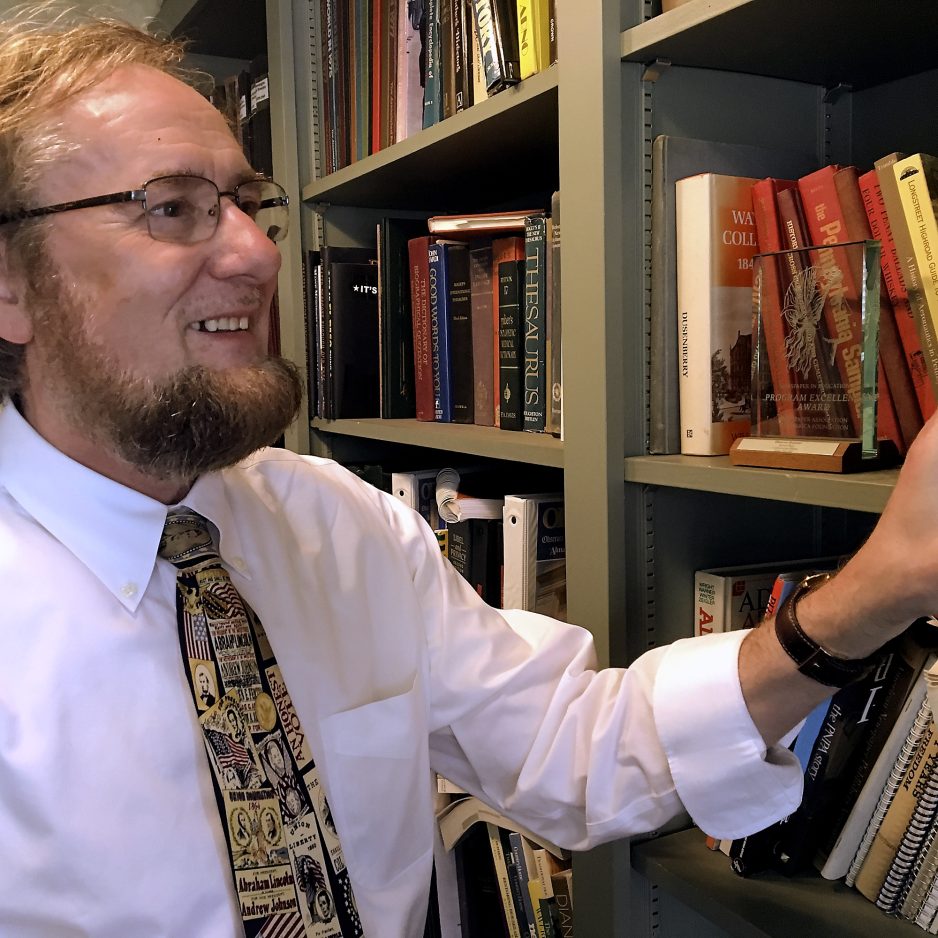
Civil War scholar Rea Andrew Redd, a Waynesburg University professor, library director and author, hopes Union surgeon Jonathan Letterman receives recognition for his medical advances.
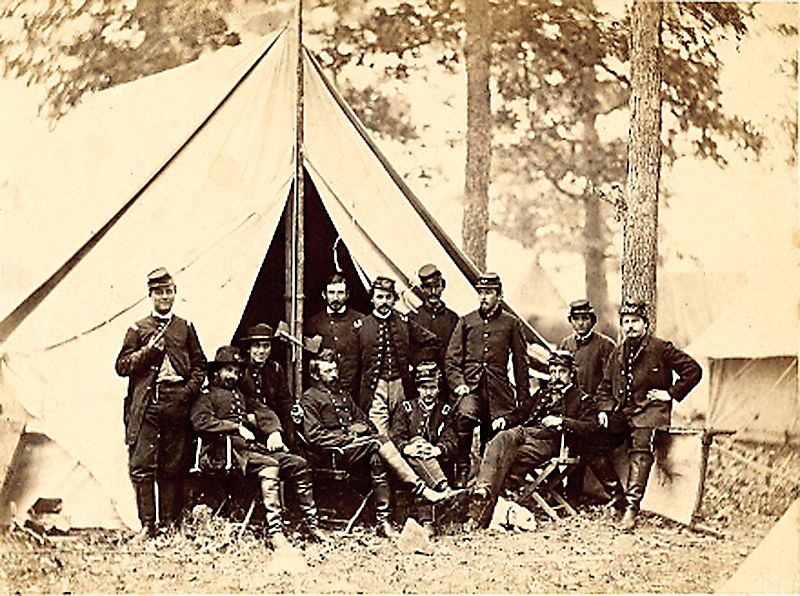
Dr. Jonathan Letterman, seated at left, medical director of the Army of the Potomac, is shown with his staff in November 1862 in the Eastern Theater of the Civil War.
Mention the name Letterman and people are likely to think of former late-night talk show host David.
But history professor Rea Andrew Redd is shining a spotlight not on an entertainer, but on Dr. Jonathan Letterman, a little-known hero of the Army of the Potomac whose protocol saved countless soldiers’ lives during the Civil War.
“Civil War Monitor” magazine placed Dr. Letterman at No. 9 on its 2013 list of the “most influential politicians, civilians, inventors, spies and soldiers that you’ve probably never heard of.”
Redd, 65, of McMurray, who teaches and directs the library at Waynesburg University, would like to raise Letterman’s profile locally, and especially in the doctor’s hometown of Canonsburg. Redd has won approval from the Pennsylvania Historical and Museum Commission to post a marker, a proposal he has taken before Canonsburg Borough Council.
Mayor David Rhome said he and council President R.T. Bell “have had conversations with Rea on several occasions, and we look forward to meeting with him once again after the holiday to finalize the presentation that was made to council.”
The topic “will then be discussed with council and hopefully we can make this historic project a reality,” the mayor continued.
Civil War soldiers from the Union and the Confederacy fought the Battle of Gettysburg 154 years ago today, and the carnage that had wreaked havoc south of the Mason-Dixon Line became a reality in the North. Southern invaders were turned away, but at great cost to each side.
The Gettysburg Foundation’s website places the number of casualties at 51,000 people killed, wounded, captured and missing. There could have been many more deaths if it were not for Letterman, the man the Civil War Trust calls “the father of battlefield medicine.”
How to deal with the wounded during the chaos of battle was a challenge Americans had not had to face on their home soil for decades. Military tradition had combatants removing their injured comrades from the front lines, which is hardly the most efficient way to fight.
Rating the urgency of treating a large number of injured people, known as “triage,” is believed to have first been practiced on the battlefields of Europe during the Napoleonic Wars of the early 19th century. Until Letterman put that type of system in place, there was no procedure for aiding casualties during the Civil War.
“After the first Battle of Bull Run, you walked back to Washington, D.C., to get help,” a 25-mile hike, Redd said of the July 21, 1861, confrontation in northern Virginia between forces of the Union and the Confederacy. Those who couldn’t move lay in anguish, most never having a chance to be treated.
A year later, Letterman became medical director of the Army of the Potomac. According to the National Museum of Civil War Medicine’s website, Letterman’s “selection as medical director for the most important Union army in the field represented a censure of the former medical officers who held the post during the first year of the war. They had largely failed in their duty to adequately care for those wounded on the battlefield and those sick in the hospitals.”
Who was this largely overlooked doctor?
Letterman was steeped in medical tradition. He was born in 1824, the son of a Canonsburg surgeon, also named Jonathan Letterman, and his wife, Anna Ritchie Letterman.
The younger Letterman graduated from Jefferson College, Canonsburg, in 1845 and went on to study at Jefferson Medical College in Philadelphia.
“Much to his father’s disappointment, he joined the Army after graduation, and he had a pretty interesting education there,” Redd said. “He was in Florida with its swamps, Minnesota, Virginia and New Mexico, and had treated arrowhead wounds and malaria.”
An enlisted man’s Army pay at that time was $8 to $12 a month, slightly less than what factory workers were earning. “I think he was attracted to the fact that people in situations of discipline didn’t have incomes to be able to afford a doctor,” Redd said.
Medical skills were desperately needed with the outbreak of the Civil War, and local historian Harriet Branton wrote in an article headlined “Canonsburg’s War Surgeon” that “Letterman’s predecessor, Dr. Charles S. Tripler, had found problems of organization and supply somewhat overwhelming.”
Townspeople were left to care for thousands of wounded and bury dead soldiers and horse and mule carcasses once a battle was over.
Letterman, who was promoted to the rank of major, brought order to battle scenes, commandeering houses and barns and using tents as field hospitals, and organizing ambulance corps, which used two-wheeled and four-wheeled carts to carry the wounded from the battlefield. At Gettysburg, for example, the Lutheran Theological Seminary was used as a hospital where 600 patients were seen in one day.
There was to be a doctor and a “medical steward” – which we would call a pharmacist – traveling with every regiment of 1,000. The medical professionals were kept two miles away from a battlefield, outside of the range of cannon fire.
Branton quotes Letterman, surveying the carnage at the Battle of Antietam in Sharpsburg, Md., as reporting, “Humanity teaches us that a wounded and prostrate foe is not our enemy.”
Someone on a Civil War battlefield who was shot between shoulder and hip would be given morphine and access to a chaplain, who would give the soldier paper to write one last letter because the man would likely be dead within 24 hours, Redd said. Bullets could not be removed much beyond the depth of a finger’s reach.
Wounded arms and legs were amputated with varying success, because sterile techniques and the causes of infection were not yet known. Through-and-through gunshot wounds that could be plugged were handled quickly enough to send the injured soldier back into battle.
Letterman was out of the Army in 1864, the same year that Congress officially adopted Letterman’s battlefield treatment protocol.
“I think this position just exhausted him,” Redd opined. “The war had another 14 months to go. He took his wife to San Francisco and said, ‘I’m starting over.’ I think he saw too many wounds and too many operations. Did he do operations every day? No, he was a coordinator who got the right doctors in the right spot with the right people and the right medicines.”
In San Francisco, Letterman became a coroner. He died in 1872 and was buried at Arlington National Cemetery. An Army hospital bearing Letterman’s name was built in the late 1800s on the Presidio. It closed in 1994 and was demolished.
Redd is a Civil War re-enactor, and when he heard of Letterman, he was curious enough to delve into the doctor’s past.
“I began to appreciate this unknown local guy who made a huge impact,” Redd said. “The first biography of this man was written only four years ago.”