

In midst of a downtown renaissance, city looks to tackle vacant buildings
From a business perspective, downtown Washington hasn’t had it this good in years.
Its Main Street is on a significant rebound, with two distilleries opened since 2016, a winery, several popular restaurants and a microbrewery expected to be open by late summer.
Money is being raised to create a business incubator on South Main Street, and a decade-old farmers market, now housed under two new covered pavilions, draws hundreds of people each week. The annual Whiskey Rebellion Festival, launched seven years ago, attracts thousands to celebrate Washington as the epicenter of one of the young country’s original taxation challenges, and a recently launched “First Friday” brings more people to town once a month for live music and other events aimed at giving people yet another reason to visit a Main Street that now offers more attractions than it has in decades.
All of the activity takes place with venerable buildings as an appropriate backdrop to dine, shop or enjoy the pageantry of a historical celebration.
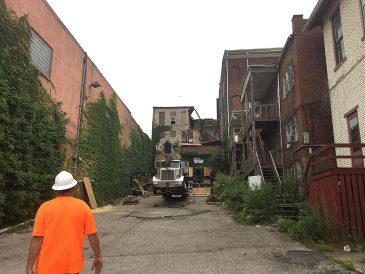
But the partial collapse of a building at 15 N. Main St. on July 12 has raised concerns about safety in a city abundant with buildings constructed in the mid to late 19th century.
Mayor Scott Putnam acknowledged last week that the city’s commercial rebirth comes at a time when he and other officials are trying to determine how to proceed with dealing with other derelict buildings in the business district before they meet the fate of the former Montgomery Building at 15 N. Main.
Putnam, who said the city is discussing “how are we as a city going to prevent this from happening again,” offered several scenarios toward getting at the problem.
For now, the city is focusing on completing the demolition at 15 N. Main, a painfully slow process because of the amount of debris and the building’s proximity to buildings at 3 N. Main and 19 N. Main.
During operations on July 12, emergency rescue teams working to free resident Megan Angelone from one of the structure’s upper floors put three holes in the wall of the adjacent building at 3 N. Main owned by Felix and Maria Magnotta. Debris from 15 N. Main also landed on the roof of a building at 19 N. Main, the former VIP Club owned by Mark Kennison, owner of President’s Pub.
Putnam confirmed that there is a possibility the foundations of the three buildings could be tied together, but said that won’t be known until the demolition is completed, a process that will take weeks.
“We’ll see once we have the building down,” Putnam said, adding that if a shared foundation is revealed, there may be additional steps to be taken to protect the two neighboring buildings.
In the meantime, the Magnottas’ building remains closed and the first block of North Main remains off-limits to vehicular traffic, with businesses there dealing mainly with walk-in customers.
Prior to the events of July 12, Chicco Baccelo, the coffee shop and deli, was in the process of moving from its current location at 239 S. Main to the Magnottas’ building, but the temporary closure of the North Main building means the business will continue at its current location for now.
While city officials were meeting last Sunday to prepare for the demolition at 15 N. Main, Putnam said they also began discussing ways to become more proactive in assessing the structural integrity of downtown’s buildings.
One of those could be asking for structural engineering reports on older commercial buildings that could point out potential risks so that owners could make repairs.
However, addressing buildings that are beyond structural repair and pose a danger to the public will require a more immediate response.
In at least one instance, the city appears poised to take action this is long overdue.
According to Putnam, the long-vacant building at 8-22 W. Chestnut St. has been slated for demolition for years, and should be the next one to see the wrecking ball.
“It’s been a condemned building in the 17 years that I’ve lived in Washington,” Putnam said, adding that the current owner did not attend the demolition hearing earlier this year – the third one for various owners over the years.
“We may just bite the bullet and take it down,” he said.
Records show the building being owned by Main Street Trust, with principal trustee Kim J. Gobert living in Moscow, Russia.
It’s not known how many downtown buildings have been cited for ordinance violations.
After the Observer-Reporter filed a “Right to Know” request under the state’s Sunshine Act on Wednesday, the city granted permission for a review of the records.
Clearly, derelict structures have been a bane for years in the city.
In 2014, during the administration of previous mayor Brenda Davis, city council passed a “Dangerous Building Ordinance” with the goal of becoming aggressive in demolishing properties that were vacant for years.
Putnam said last week he hadn’t read the ordinance.
But he acknowledged that finding money to take down derelict buildings is a challenge.
The city plans to use $50,000 left over from a state Community Development Block Grant, administered by the Washington County Redevelopment Authority, to cover a portion of the demolition costs for the Montgomery Building. It is currently using another $58,600 in CDBG funds for residential demolition.
But Putnam said it will be necessary to muster financial resources from a variety of sources to be able to rid the city of buildings that have moved beyond hope of rehabilitation.
That will involve reaching out to representatives at the county, state and federal levels to find funding, he said.
On Wednesday, state Sens. David G. Argall, R-Schuylkill, and Camera Bartolotta, R-Carroll Township, toured the ongoing demolition at 15 N. Main.
Both legislators noted several laws passed within the past year that allow municipalities to more aggressively tackle blight, including the creation of land banks, increased fines for code violations and decreased time to remedy violations.
“We don’t pretend to solve the issue, but we have given local communities a lot more teeth,” Argall said.
Bartolotta pointed to Act 152, which would give the county the authority to apply a fee through the recorder of deeds office of as much as $15 for each deed and mortgage that could be used for demolition.
Argall said the fee could generate about $200,000 for the county.
However, Recorder of Deeds Debbie Bardella, who discussed the legislation with commissioners, said she opposed it because the fee puts the burden on people who own property.
Putnam said he believes the turnaround in Main Street business can also encourage developers to purchase derelict properties and demolish them, then use the vacant lot to create new commercial enterprises.
He added that the city is “very close” to a deal with a developer on a vacant lot at the corner of North Main and Chestnut streets, the site of the former Pettit Building, which the city demolished last year using $88,000 in 2016 CDBG funds.
“Some of these developers just want to use the pad under the site,” he said.