

Tool to help police in opioid crisis draws privacy concern
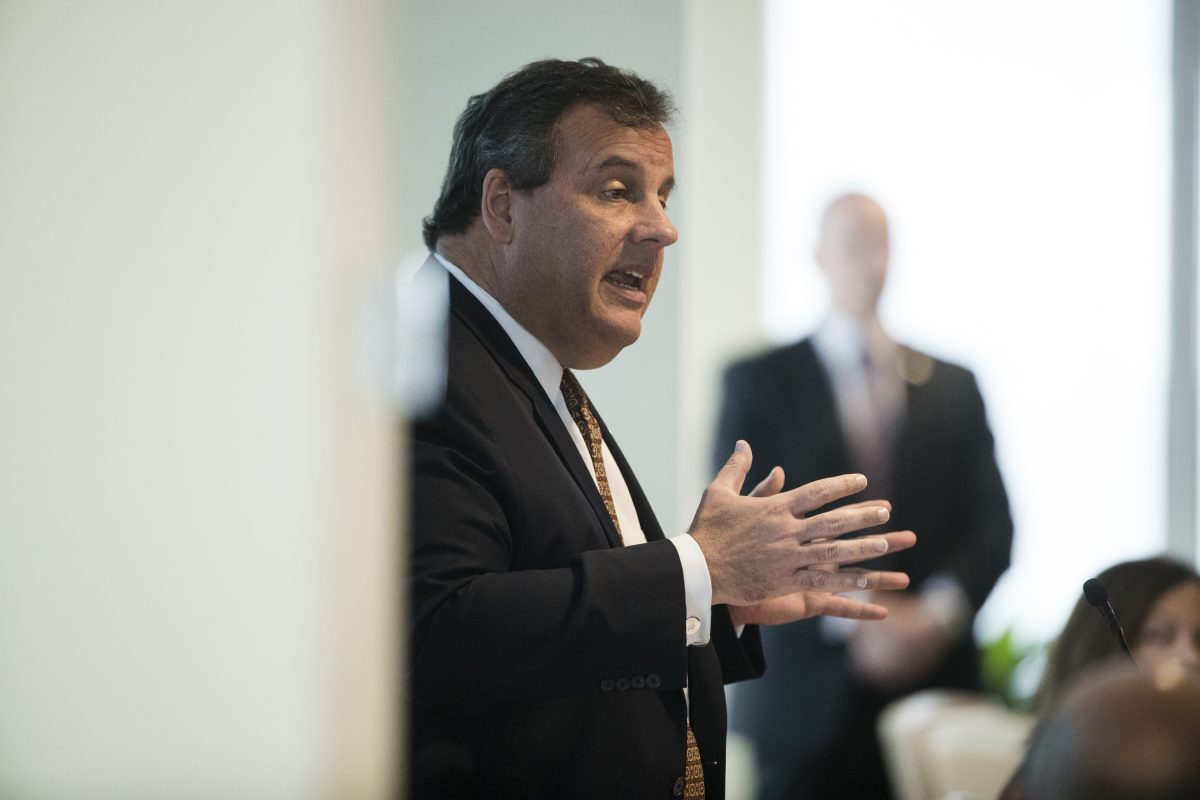
New Jersey Gov. Chris Christie speaks May 25 during Caron Treatment Center’s Executive Luncheon on the Opioid Crisis at the headquarters of Independence Blue Cross in Philadelphia.

A large crowd listens Dec. 21 as New Jersey Gov. Chris Christie, left, calls for an end to the “shame” associated with drug addiction at a vigil outside the New Jersey Statehouse in Trenton, N.J.
TRENTON, N.J. – New Jersey is the latest state amid a national opioid crisis to consider allowing police and law enforcement officials to access its prescription drug monitoring database without a court order, pitting patient rights to privacy against the government’s ability to investigate so-called doctor shopping.
Republican state Sen. Robert Singer introduced the legislation Tuesday after discussions with a county prosecutor, arguing the legislation will help officials target physicians who might be illicitly prescribing powerful prescription medications.
“We are in a crisis in this country, and when you’re in a crisis form, you have to take certain actions,” Singer said. “This action is another tool in their arsenal.”
But the legislation faces powerful opponents in New Jersey, chiefly Republican Gov. Chris Christie who said he’s opposed to the idea.
Nationally, the number of deaths from opioid drugs topped 30,000 in 2015, nearly double the rate from a decade ago, according to the National Institutes for Health. Across the country, states have implemented prescription drug monitoring databases that allow pharmacists, doctors and law enforcement to track who may be giving out too many controlled substances.
The proposed law in New Jersey comes as states across the country are grappling with how much leeway to give officials and law enforcement when it comes to examining the databases. In Rhode Island, Democratic Gov. Gina Raimnondo proposed a new law similar to Singer’s proposal.
In California, the Supreme Court ruled recently the state Medical Board can dig through prescription drug records without a warrant or subpoena.
Christie has made addressing the state and nation’s opioid epidemic his top priority, including chairing a White House commission on the crisis. A video showing him discussing a friend with an addiction to opioid painkillers was the moment during his failed presidential campaign that most connected with voters.
Christie put his opposition to the new bill in constitutional terms, saying he doesn’t want prosecutors to “troll that stuff.”
“You shouldn’t just be able to look at it for jollies,” said Christie, whose anti-opioid commission is set to publish an interim report by the end of July after its release was delayed by more than a month. “If you have a case and you have some probable cause, OK that’s fine. Go to a court and get a judge to give you permission to look at that information.”
Other opponents have privacy concerns about the New Jersey proposal. Roseanne Scotti, state director of the nonprofit nonpartisan Drug Policy Alliance, said allowing broader access sets the state down a “slippery slope” toward privacy erosion.
“Broadly allowing local police to look into people’s private medical records without a warrant or reasonable suspicion is appalling,” Scotti said.
Singer said he’s heard from New Jersey prosecutors who said they need the tool and the privacy concerns are overblown compared to the effects of the opioid crisis.
“Talk about things being tracked. E-ZPass, Amazon, your phone. Everything is being tracked today,” he said. “The world has changed on privacy.”
Monmouth County Prosecutor Christopher Gramiccioni inspired Singer to write the bill, according to Singer, who’s been in the Senate since 1993.
Gramiccioni said the legislation would loosen restrictions for the collection and analysis of valuable information in the database.
Singer also added his bill would require officials to “certify” they are engaged in a specific investigation, cutting back on concerns about fishing investigations.
“It’s not a hostile thing but the governor’s wrong,” he said.
Christie, a former U.S. attorney, didn’t rule out looking more closely at the bill if it gets to his desk, but said, as a prosecutor, he’s opposed to it.
“Prosecutions work best when you actually have facts. If you’ve got enough facts to be able to look at the prescription monitoring program then go to a court and prove that,” he said.