

The Mon Valley, where the middle of the street, census tracts and voting precincts have divided neighbors
When the late Frank Mascara was a congressman during a reapportionment year, his home wound up in the 12th District. But when he crossed Lincoln Avenue to get to his car on the side of the street where parking was allowed, he walked into the 18th District.
The congressional district boundary was the middle of his street.
Running in the district where his home stood would pit him in a Democratic primary against powerful U.S. Rep. John Murtha of Johnstown, Cambria County.
There’s no law against running for Congress to represent a Pennsylvania district where you don’t actually reside, so some counseled Mascara to run in the 18th District, which included a big chunk of Washington County and upscale bedroom communities in Pittsburgh’s South Hills. But he’d have to fend off claims that he didn’t live in the 18th District.
Between this rock and a hard place in 2002, Mascara chose to run against Murtha in the 12th District and lost in the primary.
One of the people who ran in the 18th District Democratic primary that year was then-Washington County Sheriff Larry Maggi. Some say another candidate from Maggi’s neck of the woods was put into the race just to cut into the popular sheriff’s vote totals. Whether due to fate, fluke or flim-flam, Maggi and his local opponent finished second and third, respectively, to a Westmoreland County candidate who went on to lose to then-state Sen. Tim Murphy, a Republican.
Maggi, as a county commissioner, ran against Murphy in 2012, another congressional election year following a U.S. Census in 2010, which also happened to be the year that Murtha died. In the most recent reapportionment, the Mon Valley part of Greene County was sliced off of the 12th District and placed, along with Washington County’s Mon Valley, in the 9th Congressional District, a seat held by incumbent Republican Bill Shuster.
That year, the poster children of congressional reapportionment were residents of the Washington County village of Van Voorhis, population 166, in Fallowfield Township, which had been split along census tract lines between Murphy and Shuster. In Greene County, two of Morgan Township’s voting precincts, Chartiers/Teagarden and Mather, are in the 9th District, while the third, Lippencott, is in the 18th District.
Murphy trounced Maggi, and Shuster also coasted to re-election in 2012, with the GOP incumbents garnering more than 61 percent of the vote.
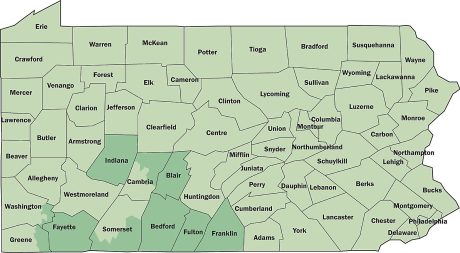
Shuster’s 9th District stretches from Waynesburg in Greene County to Waynesboro in Franklin County, a distance of about 180 miles, taking in all or part of 10 other counties in between.
Maggi, a Buffalo Township resident, said Democrats in this area tend to be on the conservative side and cross party lines to vote for Republicans.
But he said he would prefer to see what he called a “natural region” making up a congressional district, because the current system doesn’t lead “to good government. Because when you have a safe seat, you can lean far to the left or to the right. They go down to D.C. and they have no incentive to compromise.”
Echoing his sentiment was Dr. Joseph DiSarro, chairman of the Washington & Jefferson College political science department.
“As a Republican – a lifelong Republican – I think political gerrymandering limits the free-speech rights of the voters because it limits the lawmaking process,” DiSarro said. “Views will never be considered. If the primary is the election, then it makes the (general) election useless. Political gerrymandering is perhaps unconstitutional (because) it really makes the election an illegitimate contest. The primary becomes the de facto election. The election becomes just a charade, a bunch of bunk. Why have the election if you already know who’s going to win? What are they to do? Move to downtown Pittsburgh if they’re a Democrat?
“In a gerrymandered district, if you’re not in the majority, you’ll never be able to win. Theoretically, is that what the framers intended, that one party would decide?”
Decrying the gridlock in Washington, D.C., the professor said, “People think the problem is the president, but if the Congress is so partisan that no compromise can take place, the president won’t have anything to veto or sign. Why are we at such a stalemate? Districts are so gerrymandered that compromise is not happening. There are limited political solutions to various serious problems.” He checked off a list that included health care and crumbling infrastructure.
DiSarro called partisan gerrymandering “the two-ton elephant in the room. How do you decide what are the manageable standards?” The Supreme Court has slated a Wisconsin case on political gerrymandering in its next term, and if Justice Anthony Kennedy retires over the summer, as is rumored, an appointee by President Donald Trump would take Kennedy’s place.
“There is no such thing as the perfect political system. In chemistry, physics and biology there can be near certainty, but in politics there isn’t. If there is a solution, I’m not sure the courts will come up with it,” DiSarro said.