

Plan ahead to avoid leaving dogs in cars during hot weather
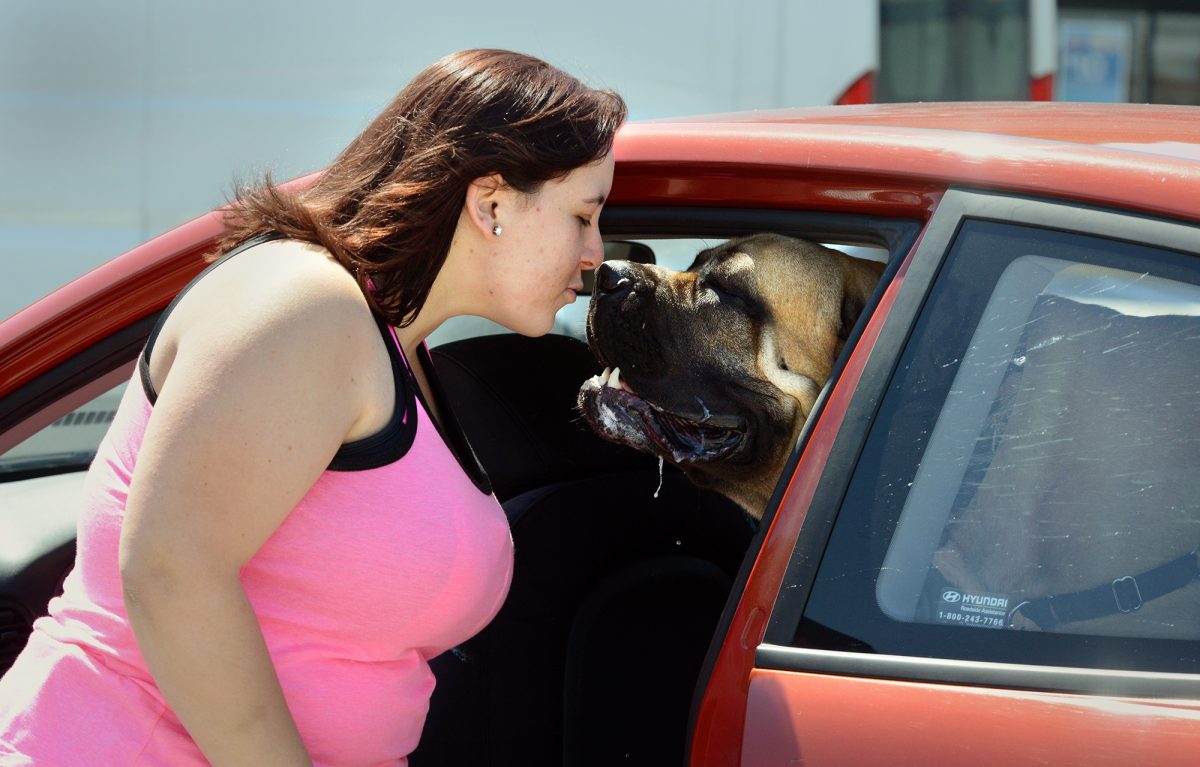
Danielle Tustin of Burgettstown manages to fit her English mastiff, Trigger, into the back of her two-door sedan.
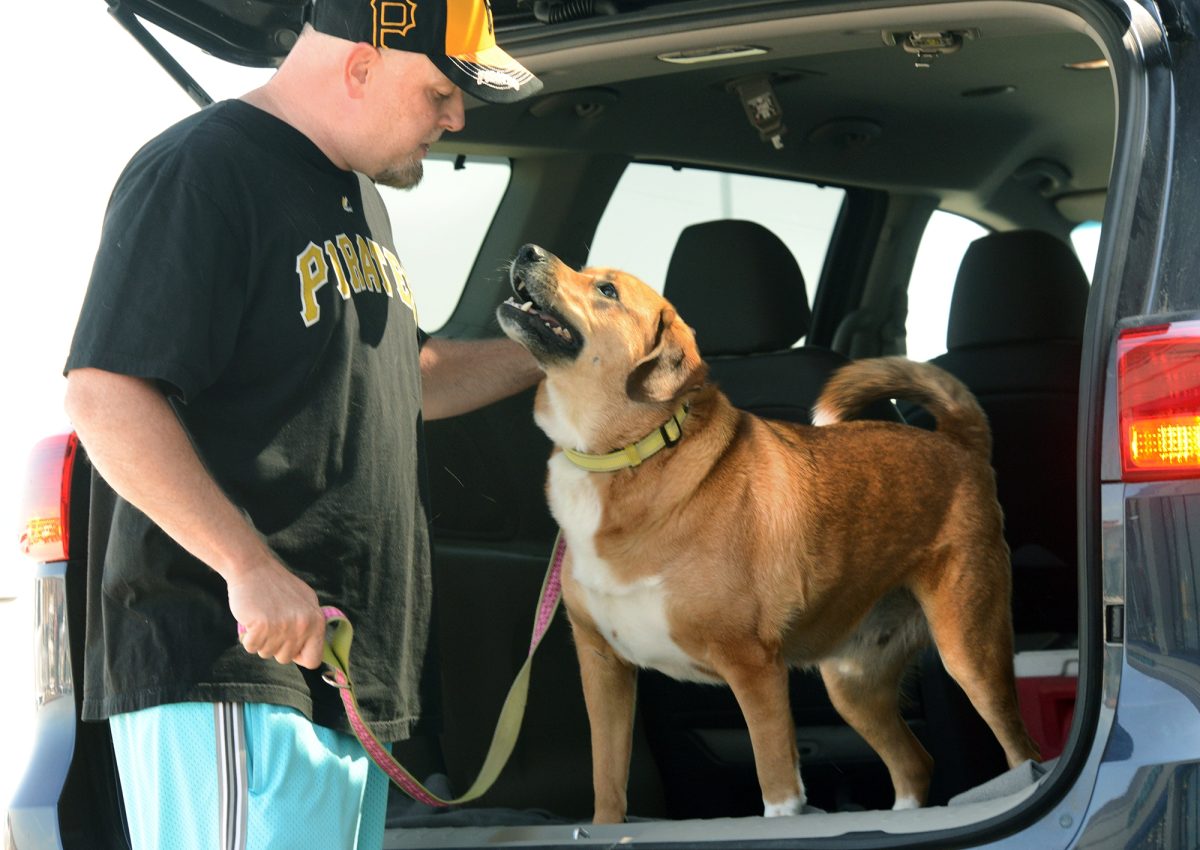
Bill Waychoff of Washington has his dog, Cooper, ride in the hatch of his SUV. Cooper, a 2-year-old boxer/collie mix, accompanies Waychoff on trips to the store and other errands around town.
No, this isn’t about a dog walking into a bar, and it isn’t a joke.
An employee was standing outside the Walmart store in Wayne, W.Va., last August when she noticed a vehicle drifting toward her. Sidestepping it, the woman spied a pooch in the driver’s seat seconds before the car struck the building. Afterward, she saw a second dog open the front passenger’s seat window.
The car and supercenter absorbed minimal damage and the doggone commuters were uninjured in a cartoonish set of events. The vehicle’s owner had left her pets inside with the engine running, and air conditioning blasting, as she strolled in to shop.
Good intention, bad decision, incredibly fortunate outcome … and reinforcement of the maxim “Never leave a child or pet in your car.”
More than 700 children left in cars in the United States have died of heatstroke since 1998, including about a dozen this year. That remains a palpable problem, despite intensive media reports about fatalities and ongoing efforts of “Where’s Baby?” – a government campaign targeting the issue.
But even though statistics have not been tabulated, the incidence of dogs and other pets being confined to vehicles probably is greater. Too many adults, with animal(s) in tow, are still driving to a store, shopping center or mall and running inside “for 10 minutes.” They open windows partway, or leave the key in the ignition with the AC on, during these warm-weather months, and believe Myrtle and Ulysses will be just fine.
In reality, they could be killing their dogs.
“Parked cars are deathtraps for dogs,” People for the Ethical Treatment of Animals has posted on its website, peta.org.
“On a 78-degree day, the temperature inside a parked car can soar to between 100 and 120 degrees in just minutes, and on a 90-degree day, the interior temperature can reach as high as 160 degrees in less than 10 minutes. Animals can sustain brain damage or even die from heatstroke in just 15 minutes.
“Beating the heat is extra tough for dogs because they can only cool themselves by panting and by sweating through their paw pads,” the PETA website indicates.
When it comes to heat, though, local animal-care professionals advocate avoiding it over beating it.
“I would never put my dog in a car,” said Jane Gapen, director of Humane Society of Greene County. “People don’t realize how hot it can be, even at 60 degrees (outside). A car is like a little tin box, which can be like a refrigerator in the winter and a furnace in the summer.”
Kym Secreet, of Houston-based Animal Control Services Inc., said simply: “If you don’t leave kids in your car, don’t leave dogs in your car. If you love your pet, leave it at home, or if you take it out, have someone sit in the car with the animal.”
Secreet, animal control officer for several Washington County municipalities, said pets in cars can result in another form of heartbreak. “Many people have their animals stolen. Someone will just open the door and take a dog.”
Dimitri Brown, chief veterinary officer at University Veterinary Specialists in Peters Township, is well aware of the potential for beastly tragedy. “You can get a greenhouse effect pretty quickly.”
As for leaving them in an air-conditioned car, “I’ve seen dogs dying of heatstroke after they accidentally turned on the heat.”
Brown previously worked in Arizona, where he said dog-in-parked-car incidents were more prevalent than what he has experienced in Western Pennsylvania. Yet … “I’ve seen a number of cases here, and we’ve been open only a year.”
South Strabane police Chief Don Zofchak oversees a township with heaps of retail and restaurants – including two strip malls, an outlet mall and a mixed-use shopping center. He said his department, not surprisingly, gets a number of calls about dogs in cars. Yet, Zofchak added, “I don’t see this as a major problem here. We respond, but the vast majority of the time, we get there and the vehicle (with an abandoned dog) is gone.”
He said South Strabane has never had a major dog incident.
Neither, apparently, has neighboring North Strabane Township. “We haven’t had any tragedies, not that I can recall,” police Lt. Kris Wagstaff said.
He said his department gets about “a half-dozen” dog-related calls a year, “outside businesses like (Meadows Racetrack & Casino) and restaurants.”
Kelly Proudfit, executive director of the Washington Area Humane Society, said there does not seem to be a high incidence of pooch abandonment in the region, but admitted the issue is difficult to gauge.
“I don’t know how many calls we get on dogs in hot cars. I don’t think we get a ton,” she said. “But it’s a problem that doesn’t get reported often.
“A kid in a hot car is going to make a news, but a dog isn’t.”
Cruelty, neglect, endangerment and abuse of animals is illegal in all 50 states. But just 16 have laws that specifically address leaving an animal inside a vehicle.
West Virginia is among those 16. When injury or death of an animal is a likely outcome, the violator faces a misdemeanor fine of $300 to $2,000, six months in jail or both.
Pennsylvania is not among those 16, although a violator can be cited and fined for animal cruelty.
So, should a person break into a vehicle to save a pet left in someone else’s car?
It is illegal to do so in Pennsylvania, although a handful of states have laws that provide immunity to anyone who does. That person, however, must adhere to strict guidelines. He or she must try to locate a pet’s owner; determine that the vehicle is, indeed, locked; and attempt to contact law enforcement. Also, an animal must appear to be in distress; undue force should not be used to gain entry; and the concerned passer-by must remain near the animal.
Ohio passed a similar law last August, along with one allowing first responders to treat dogs and cats while responding to a human emergency. West Virginia, despite its pet-inside-a-car law, does not offer immunity to anyone who breaks in.
“I would not recommend breaking a window to anybody,” Gapen said. “If I saw a dog in a car, I would call state police, give my name, the address (where the car is), description of the car, the license plate number and say ‘I think I see a dog dying.'”
“A ton of Facebook posts say you can break windows,” Secreet said. “You are not allowed to break windows. You have to call law enforcement. If an animal is in true distress, if it’s life or death, wanting to break in might be understandable. But you would be on the wrong side of the law.”
Being on the wrong side, though, may be preferable to watching an animal suffer, according to a post on dogingtonpost.com:
“If the dog is in imminent danger and help has not yet arrived, you’ll have to use your own judgment, considering the possible legal ramifications of breaking and entering to save the dog. Many of us would happily face criminal charges, fines and possible jail time if it meant saving the life of a dog.”
Police, though, rarely have to smash a window to reach a pet. “We have tools to get in,” Zofchak said.
North Strabane has a tool that, Wagstaff explained, is a literal lifesaver for its one K-9 officer. “Our K-9 handler has a temperature alarm that goes off when the vehicle reaches a certain temperature. It’s a simple device.”
It’s also available to the public, he added, but at a prohibitive cost.
Social media was abuzz recently after KDKA investigative reporter Andy Sheehan left his dog inside his car in Pittsburgh’s Bloomfield neighborhood. A passer-by saw the dog, called police and broke a window.
Sheehan apologized on Facebook, conceding “a serious lapse in judgment.” He reported that his pet, Bentley, “is fine.”
Many incidents don’t end as happily, and a remarkably surprising number involve police dogs. Nationwide, more than 75 law-enforcement canines died from heat-related causes between Jan. 1, 2011, and early October 2016, according to a review by the Press-Gazette, a USA Today news outlet in Green Bay, Wis.
Forgetful handlers, malfunctioning AC systems and overtraining dogs in hot environments have been blamed. The incidents have cost animals their lives, while law-enforcement organizations have lost thousands of public dollars to acquire and train canines.
One K-9 death occurred in central Pennsylvania last July, at the state prison in Rockview. Chad Holland, a handler from the Department of Corrections, was convicted of one count of cruelty to animals after Totti, a 2-year-old yellow lab trained to detect drugs, died. Holland testified he did not realize the dog had been locked inside the car for 2 1/2 hours,
Just three weeks ago, six dogs died in South Carolina after spending 45 minutes inside a car on an 84-degree day. The vehicle’s owner said she took them to a clinic, but after encountering aggressive pooches in the lobby, decided to keep her dogs inside the vehicle with the AC running. She said the air conditioning was off when she returned.
Dogs are integral parts of many families and law-enforcement operations, and should be treated as such. Brown, the Peters veterinarian, prescribes a healthy measure of TLC – and a healthier measure of common sense – for humans who own or handle these creatures.
“I think people are usually well-intentioned,” he said. “They like to include dogs in family activities. But you don’t want to put them in tough situations. A lot of things can go wrong if they are left unattended.”
Secreet echoed that sentiment. “We love to take our animals with us to the drive-through at Starbucks or for ice cream,” she said. “But plan on it. Make sure the dog will be safe.”