

Overdose hospitalizations high
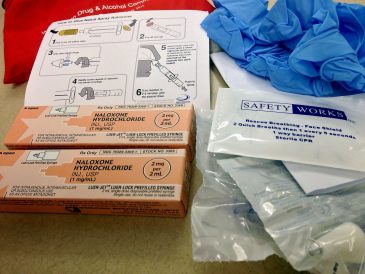
There were 59 opioid overdoses among Washington County residents last year that resulted in inpatient hospitalization. That doesn’t seem like a fully blown opioid crisis until one considers the operative phrase: “inpatient.”
This seemingly modest figure doesn’t include individuals who were either discharged or bolted after being revived in an emergency room, and those who died. And their numbers are many.
“We see an average of one overdose per day,” said Dr. Tony Aprea, director of emergency services at Washington Hospital. “But most people who are revived in the ER leave the hospital against medical advice. We like to monitor many for four hours, so the Narcan doesn’t wear off and they have problems again.”
The Pennsylvania Health Care Cost Containment Council released a report today listing the number of opioid overdose victims who were treated as inpatients across the state in 2016. Harrisburg-based PHC4 broke down the figures county by county, according to overdose by heroin or pain medicine.
PHC4 reported statistics for 42 of state’s 67 counties. Greene was among the 25 for which figures were not provided. That was “due to very small numbers,” explained Joe Martin, the council’s executive director.
He added that “hospitals are required by state law to submit data for every PA hospitalization each year to PHC4. The opioid numbers are extracted from that.”
Of the inpatient cases in Washington County, 35 were for heroin and 24 for pain medicine. That does not translate to 59 individuals.
“Some people were revived (at Washington Hospital) four or five times over the past year,” Aprea said.
Those 59 hospitalizations gave the county a rate of 33.8 per 100,000 residents, 13th highest among the 42 counties included in the statistics. That was slightly above the 42-county rate of 31.1.
Philadelphia had the highest rate of 47.3 per 100,000, which included 603 hospitalized (297 for heroin, 306 for pain medicine). Lackawanna County (41.8) was second.
Beaver had the highest rate (40.2) among counties bordering Washington. Westmoreland (38.2), Allegheny (34.9) and Fayette (32.9) followed.
Statewide, a number of patients died during a hospital stay in 2016, including 9.4 percent of the 1,524 admitted following a heroin overdose. That was up from 7.5 percent in 2014. The mortality rate for 1,775 pain medicine patients last year was 2.8 percent.
Excluded from these statistics, of course, are the 109 overdose deaths that occurred in Washington County last year, up 49 percent from 73 in 2015. That precipitous rise alarms Dr. Paul Cullen, vice president of medical affairs at Washington Hospital.
“This is an epidemic on our youth that is taking a huge toll,” he said. “Actually, it’s not just youth but all ages.”
Cullen is concerned about the number of overdose patients who are resistant to intervention.
“We think our challenge is to get these people into treatment. There is a wide range of treatments, including abstinence-based and substitution treatment (prescribing other opiates to act on cravings). It seems substitution therapy is more effective than just telling them to quit.”
Washington Hospital probably deals with more overdose cases than Canonsburg Hospital, eight miles to the north. “I’d say we get a little less than one a day, although we have a little smaller emergency area,” said Kathleen Latouf, an ER doctor at Canonsburg. “Many are revived in the field (by first responders) or here.”
She said, however, that “when you compare year to date, we’re seeing twice as many overdoses. From our perspective, the vast majority are from heroin.”
Julie Ference, nurse manager at Canonsburg, said, “there are things we’d like to offer to patients before they are discharged or leave. We’re exploring doing emergency department protocols for patients, making sure we give them opportunities for treatment.”
Ference, who is on the board of the Washington County Opiate Task Force, said, “We’re looking to get more Narcan kits.”