

Shrouded in mystery, Parcell portrayed as a work of art
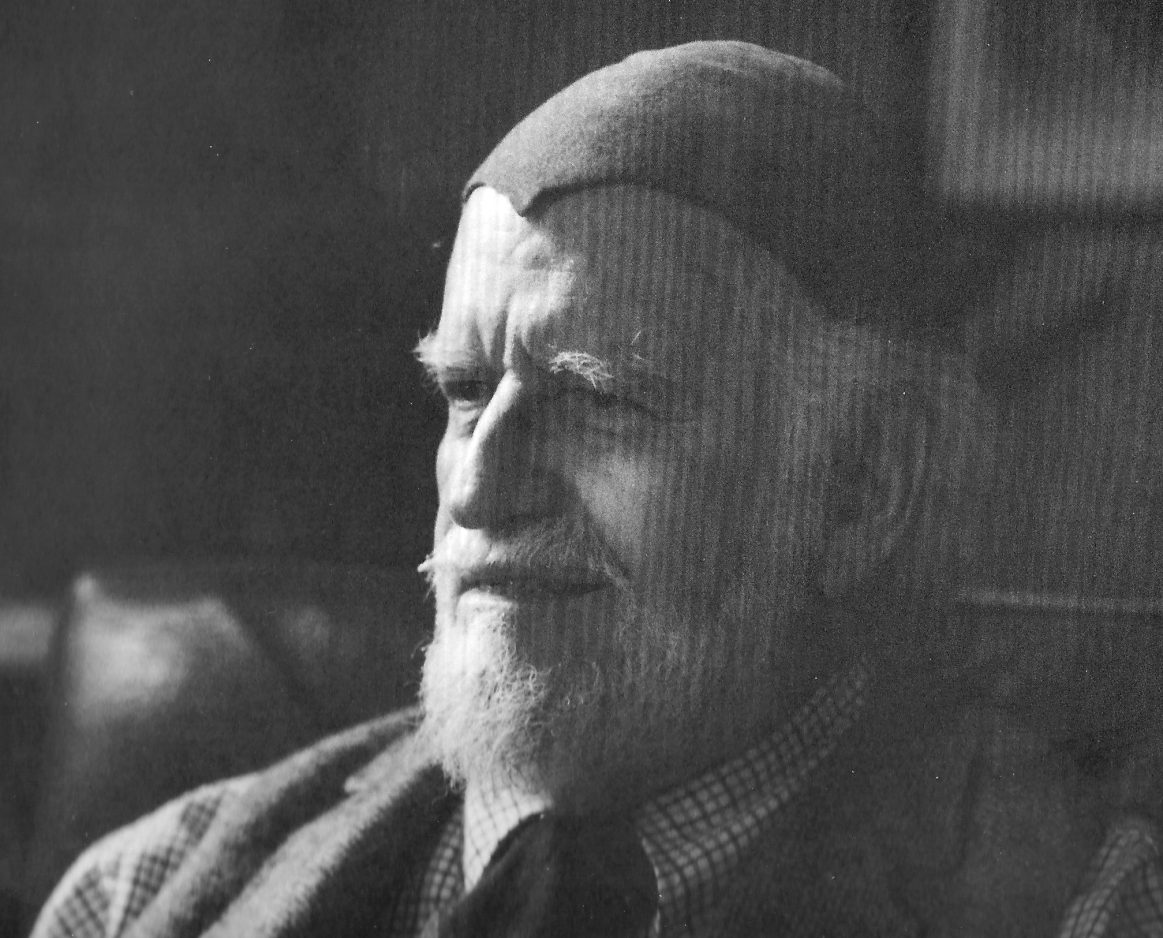
Artist Malcolm Parcell at age 89 in 1985
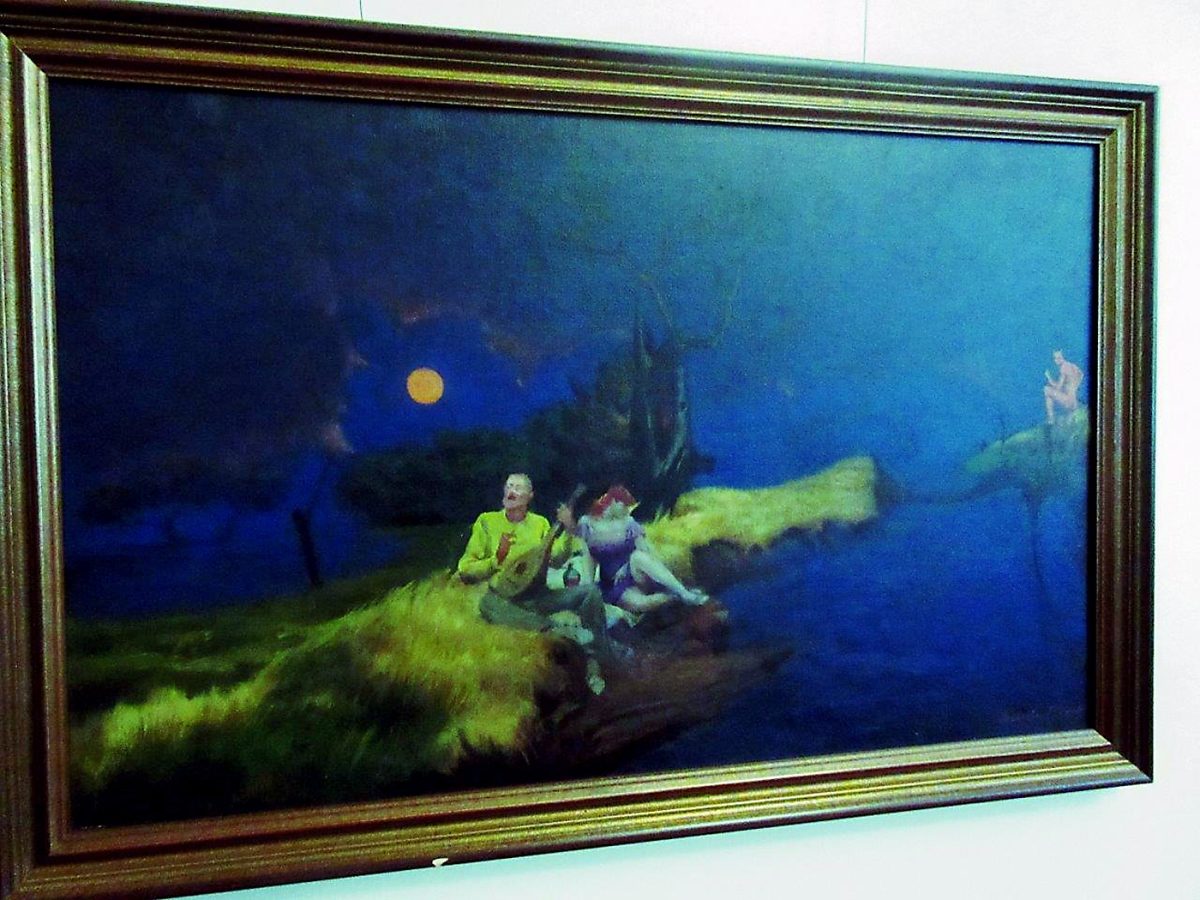
One of Malcolm Parcell’s mythologies, untitled, features a romantic couple unaware that Satan is lurking to the right.
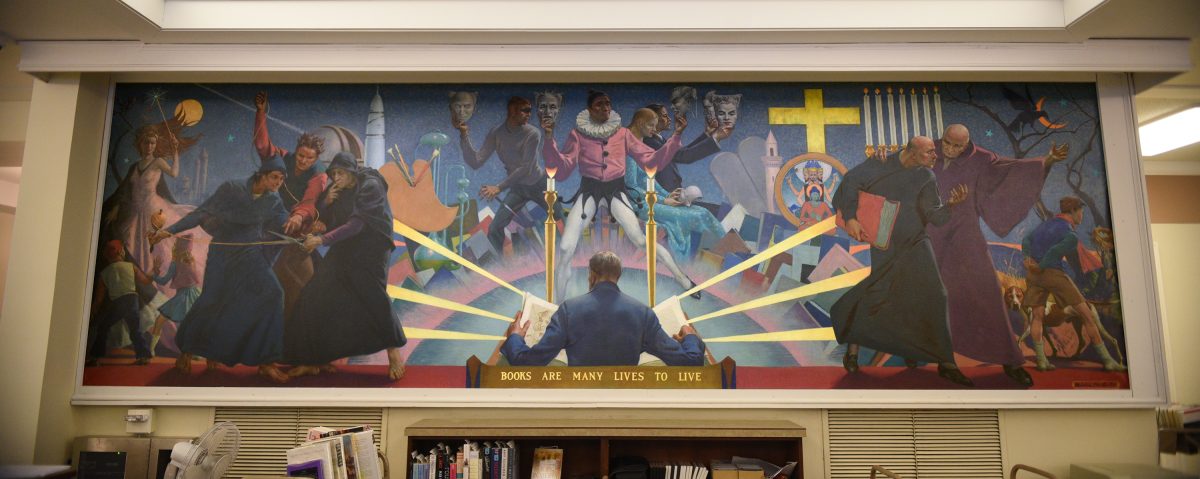
The Malcolm Parcell painting “Books Are Many Lives to Live” was commissioned by Citizens Library in 1965.

A portrait of Stephen Foster by Malcolm Parcell hangs in Citizens Library.
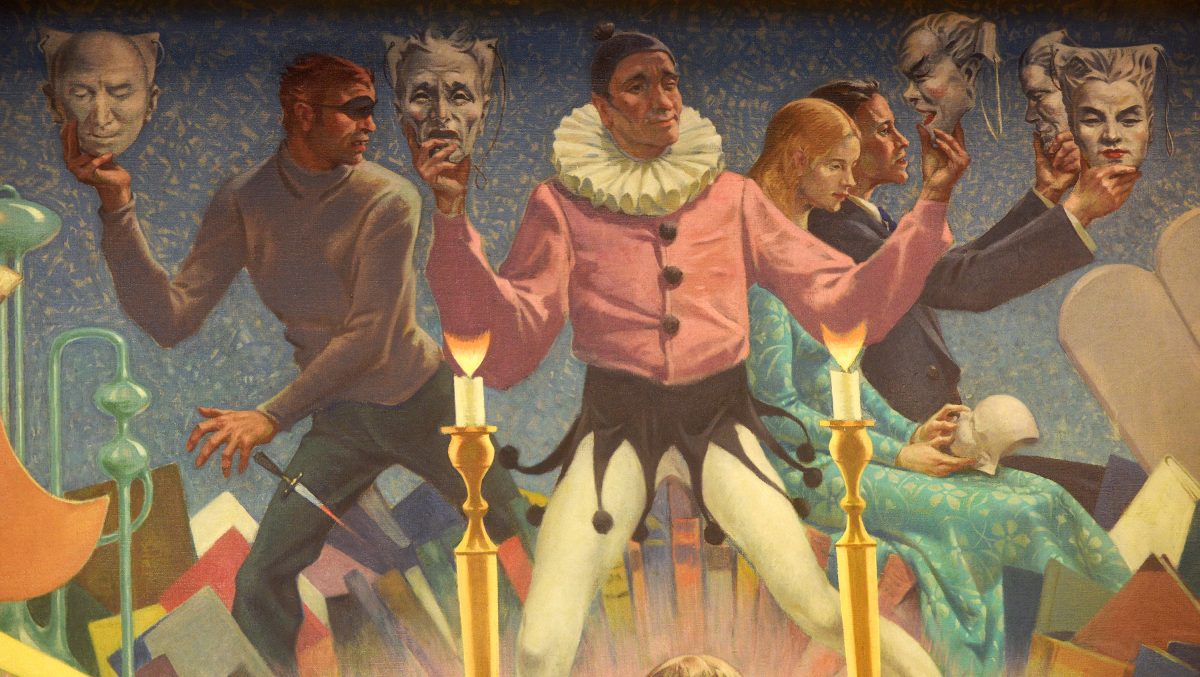
A section of the painting “Books Are Many Lives to Live,” painted by Malcolm Parcell at Citizens Library in 1965
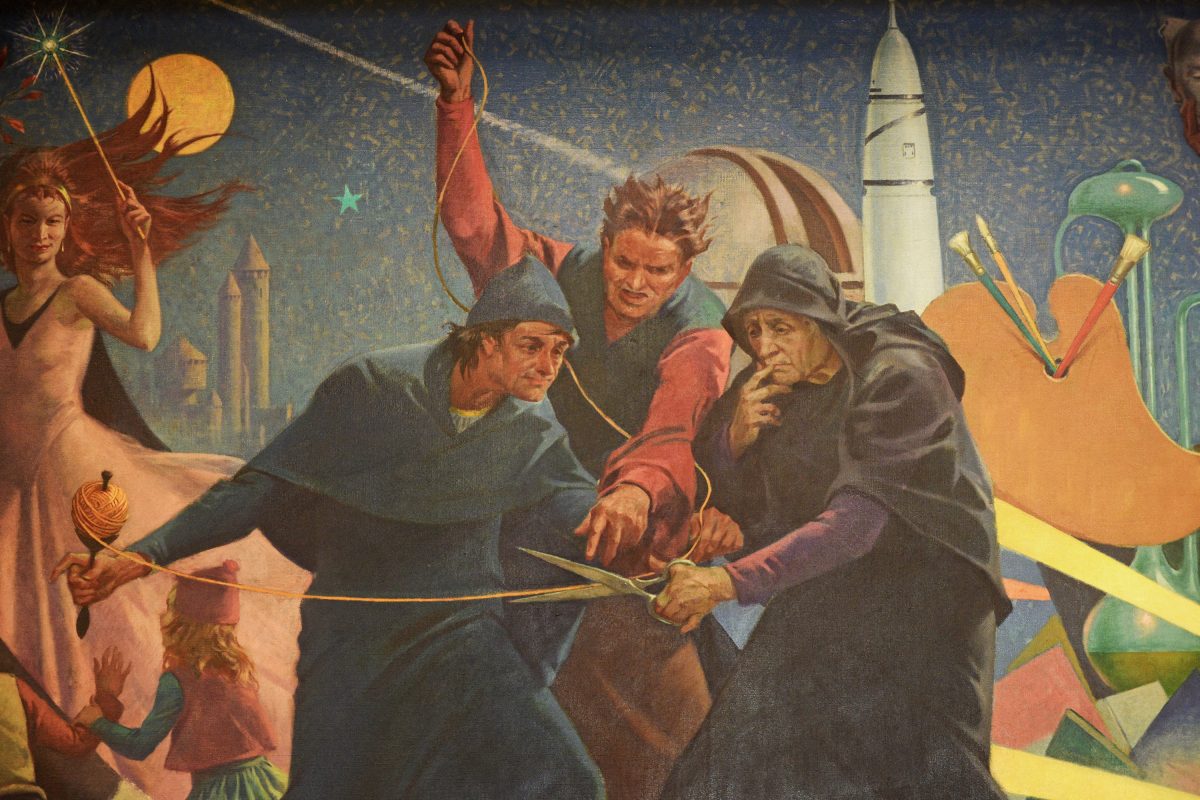
A section of the painting “Books Are Many Lives to Live,” painted by Malcolm Parcell at Citizens Library in 1965
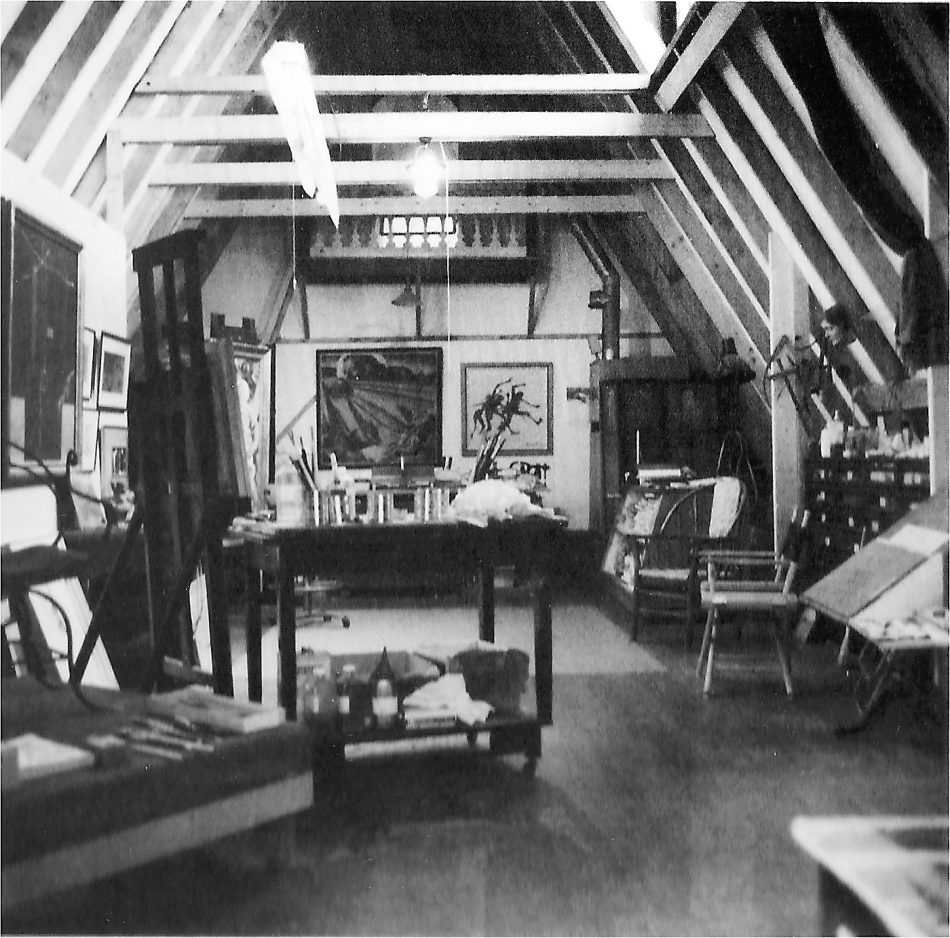
Artist Malcolm Parcell’s studio as it appeared in 1964. The photo is from “Malcolm Parcell: Wizard of Moon Lorn,” by Donald Miller.

An easel once owned by Malcolm Parcell holds the canvas as Washington artist and art teacher Ray Forquer works in his studio. Forquer was an associate of Parcell and a frequent visitor at Parcell’s Moon Lorn home.
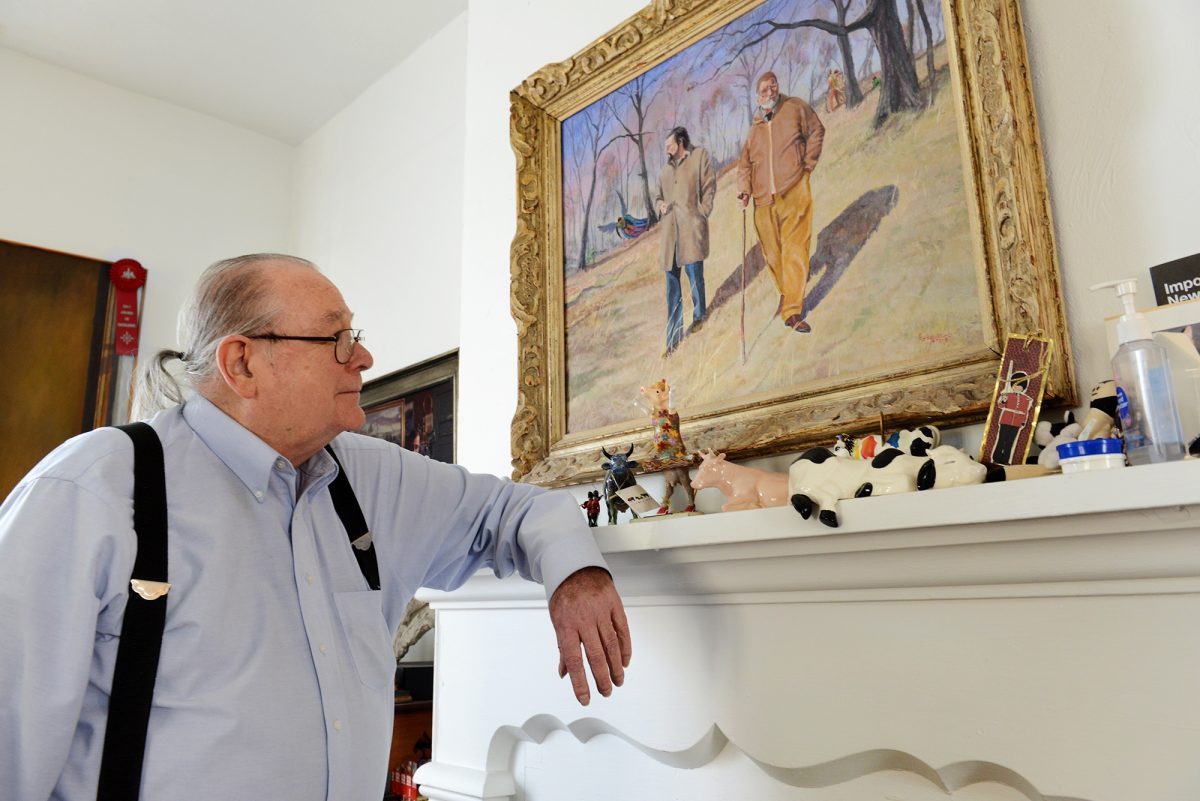
Washington painter Ray Forquer reflects on his painting that depicts him and Marcolm Parcell walking on the grounds of Moon Lorn. Forquer finished the painting, which he did in Parcell’s style, to honor his friend after Parcell’s death.
Mark Marietta/For the Observer-Reporter
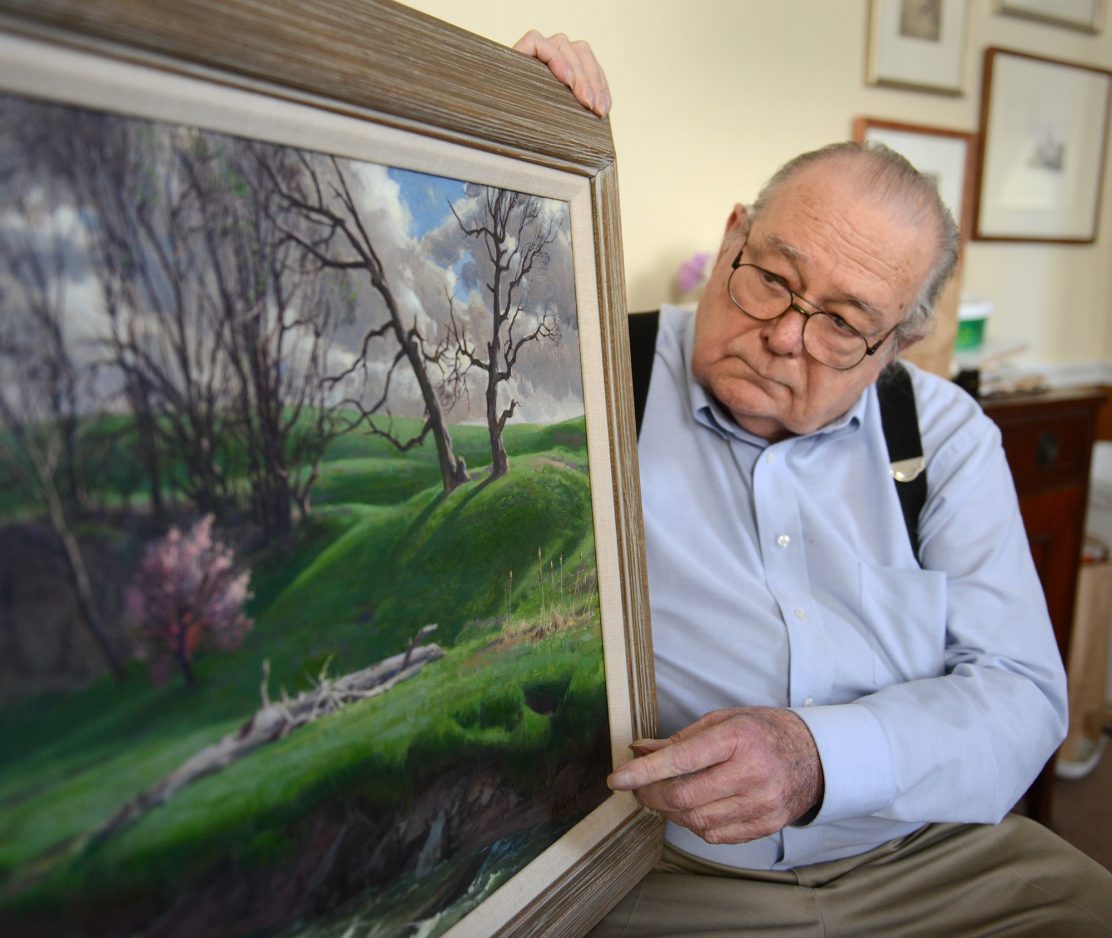
In this photo from 2017, Ray Forquer points out familiar aspects of one of the Malcolm Parcell paintings he owns. Forquer was an associate of Parcell and a frequent visitor at Moon Lorn, Parcell’s home. Forquer died Tuesday.
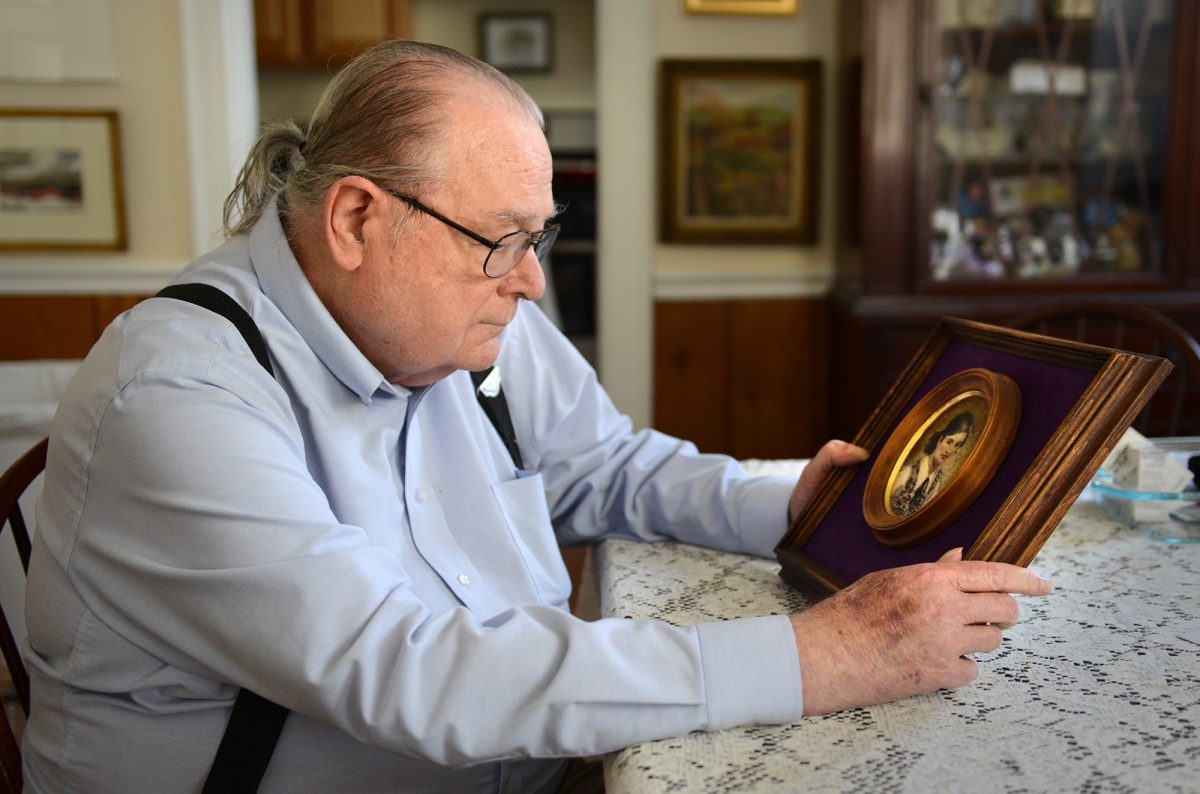
Shrouded in mystery, Parcell portrayed as a work of art
Mark Marietta/Observer-Reporter
Washington painter and art teacher Ray Forquer.
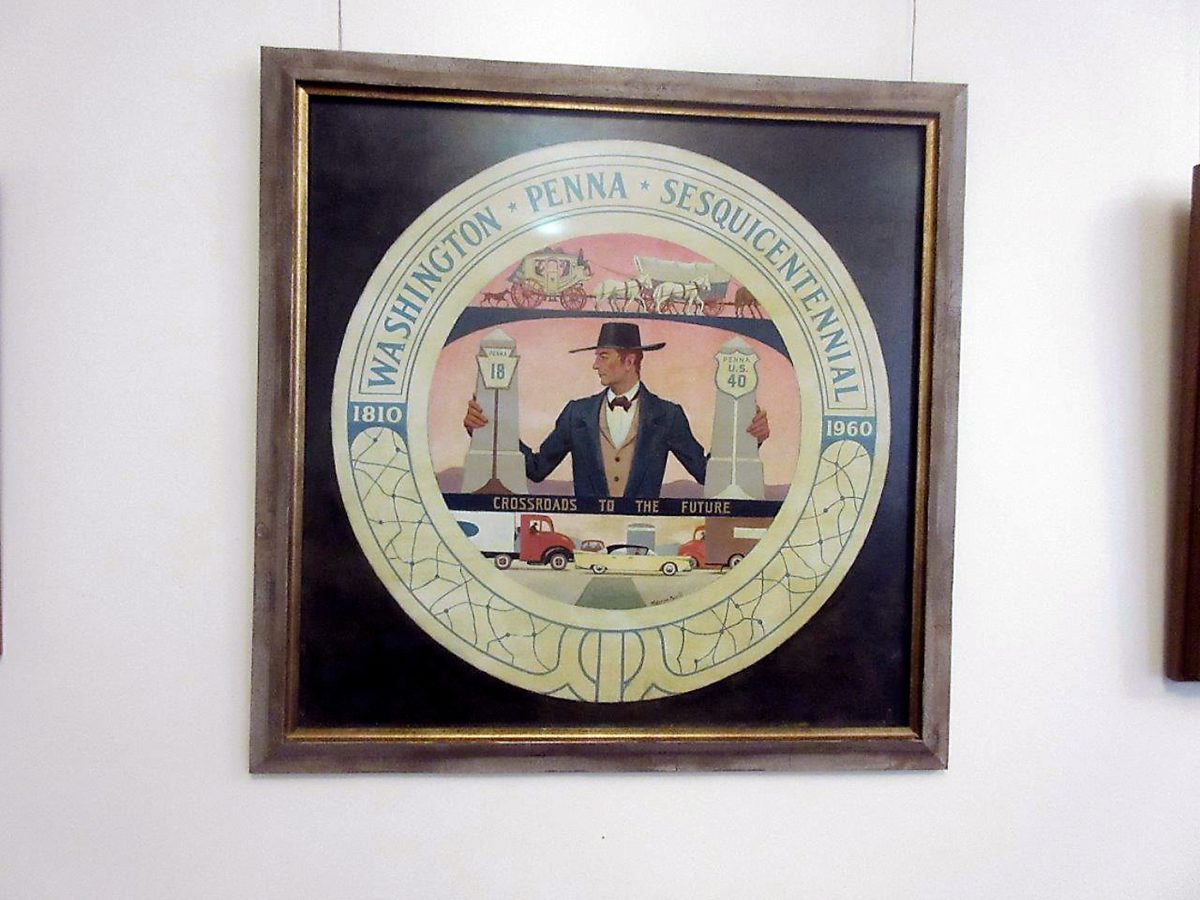
The city of Washington’s sesquicentennial is celebrated in a Malcolm Parcell work displayed at Washington & Jefferson College.
Malcolm Parcell was a globally renowned artist who specialized in portraits, landscapes and murals, and lived in Washington County for most of his 91 years. Saturday was the 30th anniversary of his passing.
He was known as the Wizard of Moon Lorn, the stylish residence he built near Prosperity that featured an immaculate studio, but which has fallen into serious disrepair from neglect, vandalism and time. Its future hinges on Consol Energy’s willingness to sell, someone’s willingness to buy, and money to restore and rebuild.
Yet, for all his professional acclaim, Parcell was a mystery man as well. He was devoted to his work and his wife, Helen, and liked to take walks near his home. But he did not often stray from Moon Lorn and the woods surrounding it, especially in his later years, and was perceived as being private to the point of reclusive. He always worked alone in his studio. Some considered him eccentric.
Those who were close to Parcell, who died in 1987, paint a much different picture, however. Three Washington County artists – Ray Forquer, Peter West and Steve Leonardi – portray him as a congenial sort with varied tastes, including one for conversation and whiskey. All three were young painters on the ascent when they met the aging Parcell, and were impressed not only by his talent, but intelligence, demeanor and structured way of doing things.
They provided insight into the mystery man, a more accurate barometer of who Malcolm Stevens Parcell really was.
Leonardi, who has lived next to Moon Lorn for nearly 30 years, vigorously denied that his neighbor was a private soul.
“Wrong! Wrong! Wrong!” said Leonardi, a wildlife artist in watercolor.
“Malcolm accidentally cultivated an image he could not get rid of and did not like. He hardly ever went into town (Washington or Waynesburg, which were equidistant from Moon Lorn), and he had this bizarre little way of dressing when he’d go walking with his dog, Foxy, He’d have a vest, skullcap and khakis – and look like a guy stepping out of a Swiss postcard. He also carried a .32-caliber pistol in his vest pocket, he said, ‘To chase away the hooligans.’ I didn’t have the heart to tell him the dog would do that.
“But he was very personable and gregarious. He could carry on any kind of conversation.”
“Malcolm was a renaissance man,” said Forquer, a Washington resident and retired art teacher in the Chartiers-Houston School District. “I would go to his studio and he would tell me what he was working on and I would tell him what I was doing. Then he’d break out the whiskey and we’d talk about politics, arts, philosophy, whatever. He was well-read and very friendly, and was always very helpful to me as an artist. I felt honored that he would take the time to look at my work and criticize it.”
West, owner of World West Galleries in Washington, said he was a boy when he met Parcell. West’s father had a painting and cleaning business and would take his son on workdays at Moon Lorn.
“Malcolm was very Old World,” West said. “His home and environment were Gothic. Moon Lorn was very interesting outside of his studio. He’d take walks in the woods, which inspired some of his mythological paintings and scenes. He was a great portrait painter early in his career, and made a living at that.
“He was a very accomplished artist. And eccentric. His life’s work was his art.”
Parcell was born in Claysville Jan. 1, 1896, the son of Steven Lee Parcell, a Baptist minister, and Emma Minor Parcell. Malcolm was the youngest of three children, behind sister Juanita and brother Evans. Evans Parcell was an illustrator for two influential magazines of his time – The Saturday Evening Post and Cosmopolitan – and several others.
“Malcolm always thought Evans was the better artist of the two,” Forquer said.
The Parcell family moved to Washington in 1902. As a boy, Malcolm played in the woods south of Prosperity, where his favorite spot was an old log cabin. Years later, in 1925, that cabin would become part of his home. Parcell converted the cabin into his studio and, over time, added a number of rooms. He christened the place Moon Lorn and lived and worked there for 62 years, until his death.
From 1913 to 1917, Parcell attended Carnegie Institute of Technology, now Carnegie Mellon University. He was categorized as a “special student,” one not pursuing a degree, and made the 70-mile round trip daily between Oakland and Washington by train and trolley. Forquer said he may have been a special student there in a literal sense.
“I’m not sure this is true,” he said, “but I understand his instructors told him not to continue, that he learned everything possible to learn.”
Parcell was a wisp of a young man, 5 feet, 7 inches and 110 pounds at age 22. Size was not a factor, though, when doctors rejected him for military service in World War I. They suspected he had a heart condition, a guy who would live to 91.
“I never paid any attention to their diagnosis,” Parcell told Donald Miller, a Pittsburgh journalist and author of “Malcolm Parcell: Wizard of Moon Lorn,” a volume featuring more than 60 illustrations of his paintings.
Artist on the rise
The artist’s career gained momentum in 1917 when he moved to New York City and established himself as an illustrator. He appeared to be on the fast track there, according to Paul Edwards, a retired Washington & Jefferson College professor and author of “The Life and Work of Malcolm Parcell.”
Instead, Parcell left after three years and returned to Washington County. The artist, Edwards wrote, was concerned he “would lose any individuality I may possess” in that big-city environment. J. Alden Weir, a renowned landscape painter and friend who influenced Parcell, agreed with that sentiment as did others in the art world.
“If I had stayed in New York,” Parcell told Miller, “I would be in one of those dimly lit studios. Good God! So grim. That would be no end at all.”
He began to win awards in 1918, including the prestigious Saltus Gold Medal from the National Academy of Design in New York City for “Louine” the next year. From 1920 to 1950, he exhibited 30 paintings in the Carnegie Internationals at Carnegie Institute in Pittsburgh.
Helen Louine Gallagher, a Washington schoolteacher, was the model for “Louine.” She sat for a number of his works over a number of years, including the celebrated “Helen.” He was enamored of her, and more than a decade later, they were married in a 1937 ceremony conducted by his father, the reverend. Malcolm was 41, Helen 40. They did not have children.
Despite his talent, dedication and numerous awards, Parcell was reluctant to exhibit his artwork. It was almost as if he was forced to do so. He did a lot of personal portraits – including his mother, father and other family members – but rejected many requests.
“The Barrymores, from the movies (in the 1930s and ’40s), wanted him to paint their portraits and he turned them down,” Forquer said.
“He was very particular with what he did and who he worked for,” West said. “If he didn’t like someone, for whatever reason, he wouldn’t do the work. But he was sought after.”
Humility, apparently, was another Parcell trademark.
“I visited him one time and he was carrying a pistol,” Forquer said. “He said, ‘We’ve been robbed a couple of times, but all they take is the silverware and the lemons. When they steal one of my paintings, I’ll consider myself a painter.'”
This, from one who was acclaimed globally.
His love for the woods inspired much of Parcell’s work, including what he called “mythologies” – depicting characters like winged sprites, elves and nudes. His strolls there also were a source for some striking landscapes.
Many works displayed here
Washington not only was Parcell’s hometown for years, it is home of dozens of his works. They are displayed at Citizens Library, W&J and the George Washington hotel. Ronald Salvitti, a longtime local ophthalmologist, has a large collection. He could not be contacted for this story.
The large mural behind the circulation desk at Citizens is Parcell’s “Books Are Many Lives to Live” – one of his mythologies. It is an 18-foot by 5 ½-foot work commissioned by the Fitch family for the opening of the new library building in 1965. The mural has a local flavor.
“Parcell used the faces of local people in some of his works,” said Ella Ann Hatfield, director of Citizens’ history center. “Some recognized people in this mural at the time it was finished.”
That mural and a portrait of composer Stephen Foster are original Parcell works displayed at the library.
W&J has a Parcell Room in the Commons, featuring 11 of the artist’s works, most of them portraits.
Seven murals hang in the Pioneer Grille at the George Washington, all scenes along the National Road.
Malcolm Parcell created them in his long-ago studio. Sandy Mansmann, coordinator of the Washington County History & Landmarks Foundation, stayed at Moon Lorn for a week in the 1990s, after Malcolm and Helen died, and loved the studio in particular.
“All those portraits on the walls,” she recalled. “I died and went to heaven.”
For six decades, that 14-acre plot was heaven to Parcell. He lived there with his wife and, later, with Helen and sister-in-law Florence G. Gardei, Helen died in 1984, three years before Malcolm. He continued to paint almost to the end of his life.
The Malcolm Parcell Foundation subsequently purchased Moon Lorn, with the intent of preserving the property and using it as a residence/studio for artists. That lasted about a decade, until 1999, when the home could no longer draw artists and the foundation sold to Steven and Rosemary Rosepink. The couple was there for 15 years until they sold the land, home, adjacent buildings and mineral rights for $270,000 to Consol Energy. Consol has done no longwall mining there, as previously planned, and the property has been unoccupied for three years.
Moon Lorn is now broken down, sorely in need of a lifeline. There is hope. In early February, Preservation Pennsylvania, a Harrisburg nonprofit that, according to its website, is “dedicated to the protection of historically and architecturally significant resources,” selected the Prosperity plot to its list of endangered historic properties. It likely needs a buyer, and definitely needs heaps of hard work and TLC.
Malcolm Parcell has been gone for 30 years and two days, but he hasn’t been forgotten. He wasn’t an impressionist, yet he left an impression.
“He was a local boy everyone in the art world knew,” Forquer said.
“He’s gone and we miss him,” Leonardi said. “But he’s not really gone, and if this place (Moon Lorn) gets to stay, he will stay even longer.”