

Penn State Fayette explores Christmases past in ‘Coal Town Holiday Traditions’

Amanda Peters, archivist, arranges a display of toys in the “Coal Town Holiday Traditions Exhibit’’ at Penn State Fayette’s Coal and Coke Heritage Center along Route 119 in North Union Township.
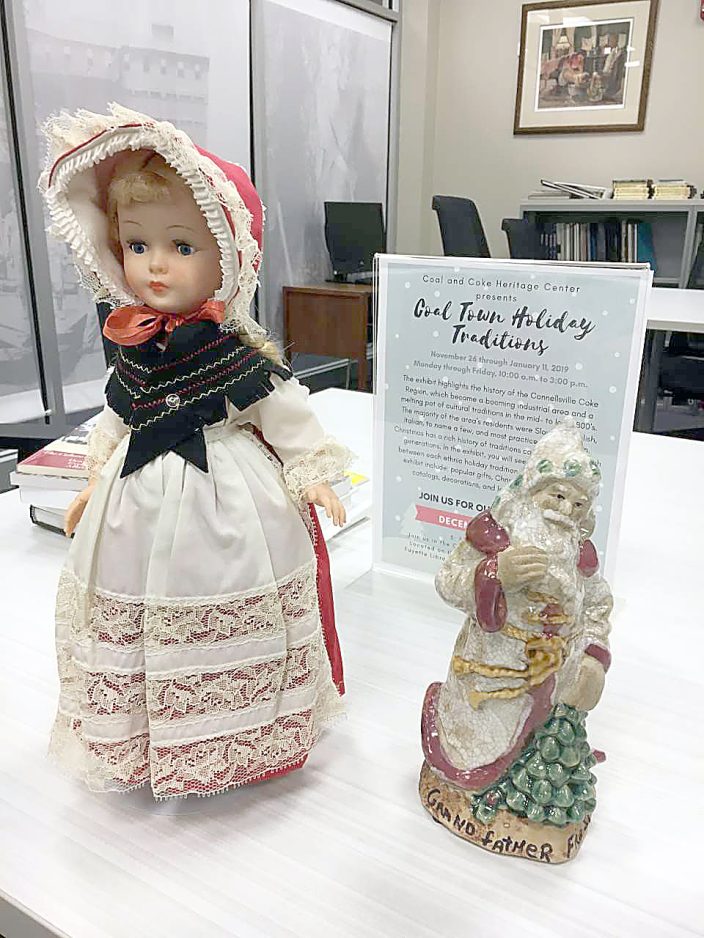
A doll in traditional dress from Denmark and a ceramic figure called Grandfather Frost from Austria-Hungary are included in the "Coal Town Holiday Traditions Exhibit'' at Penn State Fayette's Coal and Coke Heritage Center.

Amanda Peters, archivist, shows off a baseball glove among toys included in the "Coal Town Holiday Traditions Exhibit.''

This vintage photo from the early to mid-20th century features children lining up in front of a Union Supply store to meet Santa.

Frances Borsodi Zajac/For the Obseerver-Reporter
A miniature white stable and a cross-shaped staff with bells from the Hungarian Catholic Church of the Assumption in Daisytown stand beside a Christmas tree that features nature-themed decorations as part of the “Coal Town Holiday Traditions Exhibit’’ at Penn State Fayette’s Coal and Coke Heritage Center.

A Christmas tree that features nature-themed decorations is part of the "Coal Town Holiday Traditions Exhibit'' at the Penn State Fayette's Coal and Coke Heritage Center.
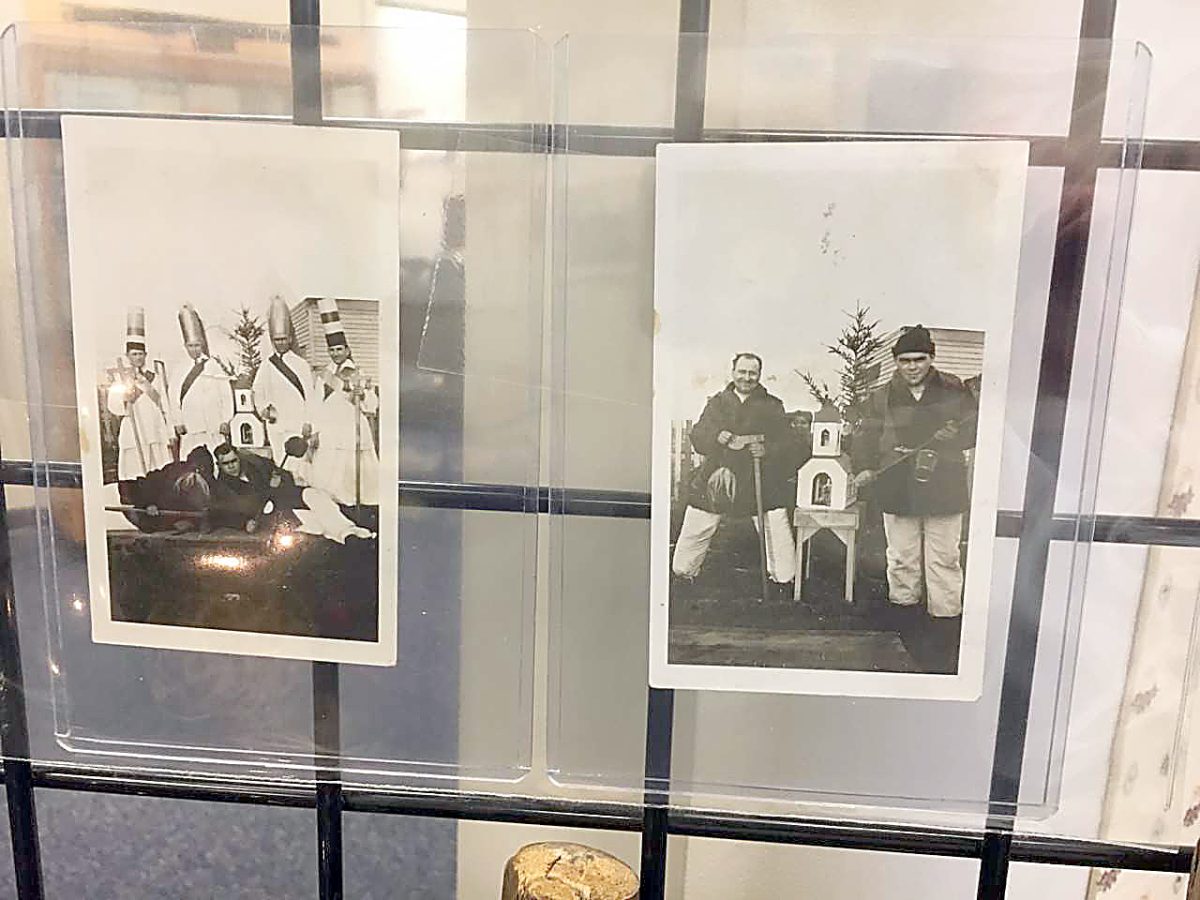
These photographs depict people taking part in a Bethlehem play. Participants in this holiday tradition would carry a miniature stable and staff while singing Christmas carols to bring holiday greetings to community residents.

Frances Borsodi Zajac/For the Observer-Reporter
The Christmas Eve dinner was called Vilija in Slovak, Polish and Carpatho-Rusyn homes, where a table was set with a white cloth to symbolize the clothes of baby Jesus, and straw is scattered underneath the table or tablecloth to symbolize the manger and animals present at Christ’s birth. An extra place setting might be added to receive a stranger or honor a loved one.
Frances Borsodi Zajac/For the Observer-Reporter
Frances Borsodi Zajac/For the Observer-Reporter
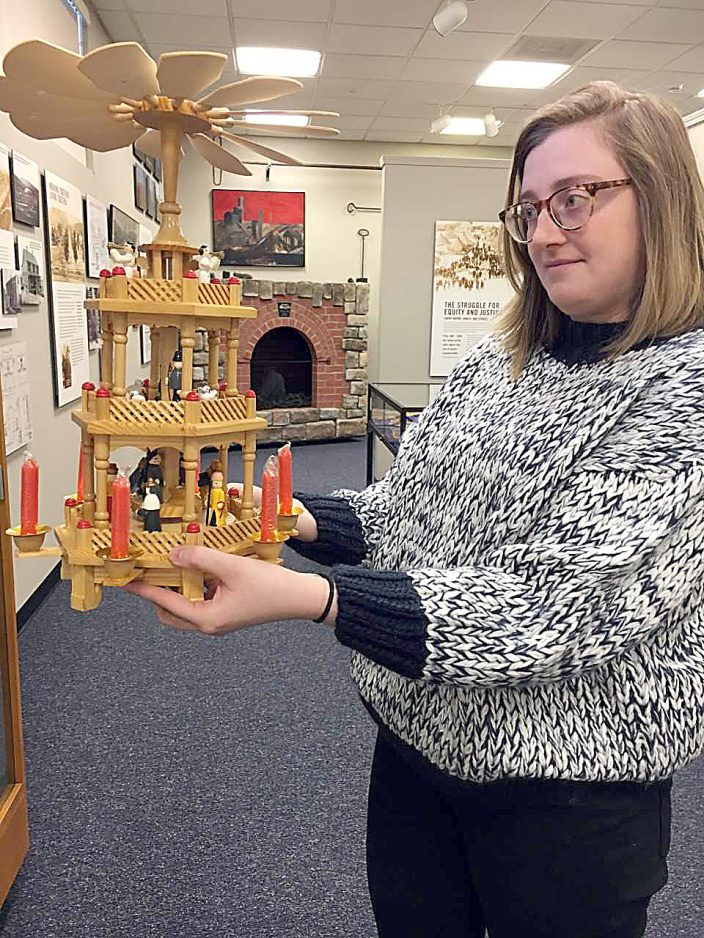
Amanda Peters, archivist, holds a German Christmas pyramid that’s included in the “Coal Town Holiday Traditions Exhibit” at Penn State Fayette’s Coal and Coke Heritage Center.
A doll, a baseball glove and roller skates that may have once fulfilled children’s Christmas dreams are making a connection to the past in “Coal Town Holiday Traditions,” a new exhibit at the Coal and Coke Heritage Center at Penn State Fayette, The Eberly Campus.
“It gives you a glimpse of what children would receive at Christmas,” noted Amanda Peters, archivist for the center, located on the bottom floor of the library at the campus, which runs along Route 119 north of Uniontown.
The toys are among the newest artifacts in the center’s annual holiday display that is located in the center’s Community section and showcases traditions practiced by European immigrants in coal-mining communities in Southwestern Pennsylvania from the early to mid-20th century.
“Coal Town Holiday Traditions” is open from 10 a.m. to 3 p.m. weekdays through Dec. 21 and Jan. 2-11.

Frances Borsodi Zajac/For the Observer-Reporter
Frances Borsodi Zajac/For the Observer-Reporter
These shepherd and lamb figurines are part of a German Christmas pyramid that’s included in the “Coal Town Holiday Traditions Exhibit” at Penn State Fayette’s Coal and Coke Heritage Center.
Peters noted new pieces for the holiday exhibit were discovered by collections assistant Abby Shirer in the Patch/Work Voices Community Collection. Many of the donations have little information, such as photographs with no recorded dates or locations, but they all have a link to the coal and coke era.
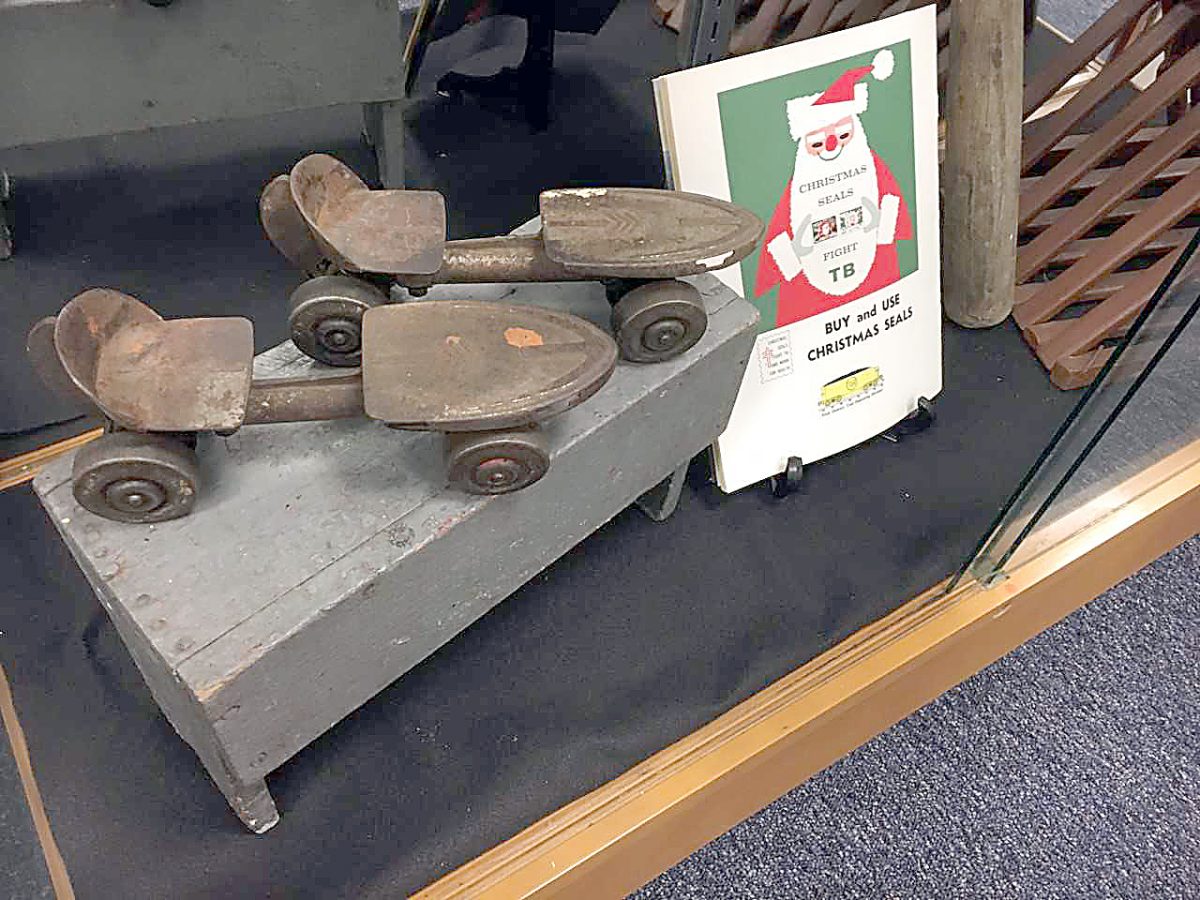
This year, visitors will be able to see toys that include a doll dressed in traditional clothing from Denmark and a ceramic Santa from Austria-Hungary that bears the name Grandfather Frost. That’s in addition to the leather baseball glove and a pair of skates that can be adjusted to fit shoes or boots.
These are housed in a glass display case along with a German Christmas pyramid that includes tiers of figurines that tell the story of the Nativity of Jesus. Peters explained the pyramid, which is believed to be a predecessor of a Christmas tree, is made of wood and surrounded by red candles that when lit give off heat that rises to spin a propeller at the top.
The exhibit also includes a photograph of children standing outside a store with Santa during the early to mid-20th century.

Frances Borsodi Zajac/For the Observer-Reporter
These figurines of Joseph, Mary, Jesus and the Three Kings are part of a German Christmas pyramid that’s included in the “Coal Town Holiday Traditions Exhibit” at Penn State Fayette’s Coal and Coke Heritage Center.
“The kids would go to the Union Supply Store to see Santa and he would pass out candy,” Peters explained.
Other photographs added to the exhibit this year include those of people who performed a Bethlehem play called Jaslickari, a tradition in which a group dressed as angels and shepherds would walk through the town, carrying the crèche and a figure of the infant Jesus.
These photos are displayed near a miniature white stable and a cross-shaped staff with bells that are from the Hungarian Catholic Church of the Assumption in Daisytown.
Participants in the play would sing Christmas carols and bring holiday greetings to residents of the company-owned town commonly referred to as a coal patch, which is based on an Old German word “pacht,” meaning to rent or be a tenant, as the homes were rented by the company to its workers.
A framed black-and-white photograph of a patch house decorated with lights for Christmas is hung near a table laid out for a Christmas Eve supper.
The Christmas Eve dinner was called Vilija in Slovak, Polish and Carpatho-Rusyn homes where a table was set with a white cloth to symbolize the clothes of baby Jesus, and straw is scattered underneath the table or tablecloth to symbolize the manger and animals present at Christ’s birth. An extra place setting might be added to receive a stranger or honor a loved one.
Frances Borsodi Zajac/For the Observer-Reporter
A pair of skates that can be attached to shoes are among toys included in the “Coal Town Holiday Traditions Exhibit” at Penn State Fayette’s Coal and Coke Heritage Center.
In Italian families, the Christmas Eve dinner is known as the Feast of the Seven Fishes, making a number of references, including God completing Creation by the seventh day, the seven sacraments of the Catholic Church and the Seven Hills of Rome, which is Italy’s capital city. At the dinner, fish dishes are served alongside pasta, bread, vegetables and homemade wine.
Peters invites the public to share their own traditions by writing them on paper slips that will be added to a Christmas tree decorated with nature-themed ornaments. The Christmas tree is another tradition that began in Germany.
“Since the exhibit is mainly Catholic traditions, this gives people of other faiths an opportunity to share the way they celebrate the holiday or a holiday,” said Peters of the paper slips.
For many, viewing the holiday exhibit will bring back memories they shared with their parents and grandparents. For others who are unfamiliar with the customs, it could be a link to a past shared by their own families.
And in a busy world, Peters noted it’s important to remember these traditions.
“It connects us to our ancestors,” said Peters. “If we celebrate the same way, it brings the traditions to younger generations so they can carry them on, and I think it helps you appreciate what you’re celebrating.”
More information on the Coal and Coke Heritage Center is available at www.fayette.psu.edu/visit/coalandcoke.