

Drummers drumming – not for Christmas, but in battle
Drums sometimes play a prominent role in songs this time of year.
“The Twelve Days of Christmas” wraps with 12 drummers drumming.
“Pat-a-pat-a-pan” mimics the sound of shepherds’ simple instruments, a flute and drum.
And “The Little Drummer Boy” has been pah-rum-pum-pum-pumming his way through American holidays since 1951.
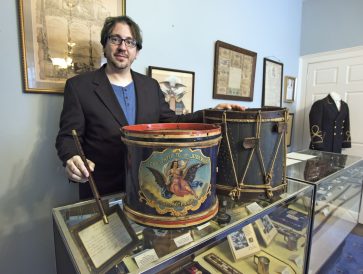
Christmastide aside, Clay Kilgore, executive director of the Washington County Historical Society, has been contemplating not peace on earth, but drums of war.
A few months ago, Sara Perri Greenlee, a Washington County resident, donated both a drum and a 19th-century ballot box to Larry Maggi, Washington County commission chairman and history buff.
Maggi, also chairman of the county elections board, would like to display the ballot box at the Courthouse Square office building, which houses the elections office.
But the drum, which is believed to have been used during the Civil War Battle of Gettysburg, has no apparent connection to county government. So he offered it to the historical society, which has a room to house artifacts of that era.
Greenlee said her late husband, Barrett, a funeral director, was given the drum several years ago by an employee, Kenneth White.
“It was either his uncle or the great-uncle who was the drummer,” Greenlee recounted.
White “never married. He retired and worked for us in Bentleyville. He had to move – he wasn’t well – and he knew how much we loved Gettysburg and Williamsburg, which we would visit every few years.
“He said, please pardon my French, ‘I don’t want this goddamn thing.’ It was in the late ’70s, maybe early ’80s, so he just gave it to us.”
White had a cousin who worked for a well-known Pittsburgh business, Volkwein’s music store. The cousin said the staff of Volkwein’s researched the drum and said it was from the Civil War.
Kilgore explained how he reached the same conclusion.
The drum from Greenlee bears no maker’s stamp, but it has a style that matches known examples.
Its rope may have been re-strung later.
“Drums were not manufactured during the 1860s,” Kilgore said. “Pretty much everything was handmade, but done using a standard process. There is some variation, but you’re going to see different types. They followed certain specifications.”
It’s been 155 years since the Battle of Gettysburg, but the Washington County Historical Society has the authenticated drum of Jesse Morris, principal musician for the 140th Regiment of the Pennsylvania Civil War Volunteers, and that one is completely original, Kilgore said.
Hamilton K. Bell donated it to the historical society in the 1920s. He was a Civil War veteran from what was known as the First Virginia Cavalry in western Virginia before that chunk of the state seceded and became West Virginia.
Hamilton Bell was a friend of drummer Jesse Morris.
The drums are “two different styles,” Kilgore said. “I like having different styles.
“The drum Sara Greenlee donated is a lot taller. It’s strung just a little bit differently. It’s made of the same materials: wood, sheepskin and rope.”
But how does a historian establish this drum was actually used in the battle during the Confederacy’s infamous invasion of Pennsylvania?
It’s unknown if White and his uncle or great-uncle had the same surname, which complicates the issue.
“The first thing we’re going to do is look at family history here or in Carlisle at the Pennsylvania Archives, to see if that ancestor was even at Gettysburg,” Kilgore said. He has also sent an inquiry to the American Battlefield Trust.
What was the role of a wartime drummer? Conveying to marching troops a cadence, and, as Kilgore related, “Battles with guns going off were loud. The drums signaled maneuvers, such as retreat or advance, and at a pace fast or slow.”
There were drummers in the Spanish-American War in 1898, but as warfare tactics changed, the rank was abolished from regiments in 1917, the first year in which the United States sent troops to Europe during World War I.
Kilgore said of Greenlee, “I think she has a really good interest in history. For her to keep these things in the county, it shows an understanding of the importance of our history.”
She could have donated the drum to Gettysburg, but Kilgore suspects “it would just be in storage because they have so many of them. Here, we’re going to tell the story to every person who walks in.”